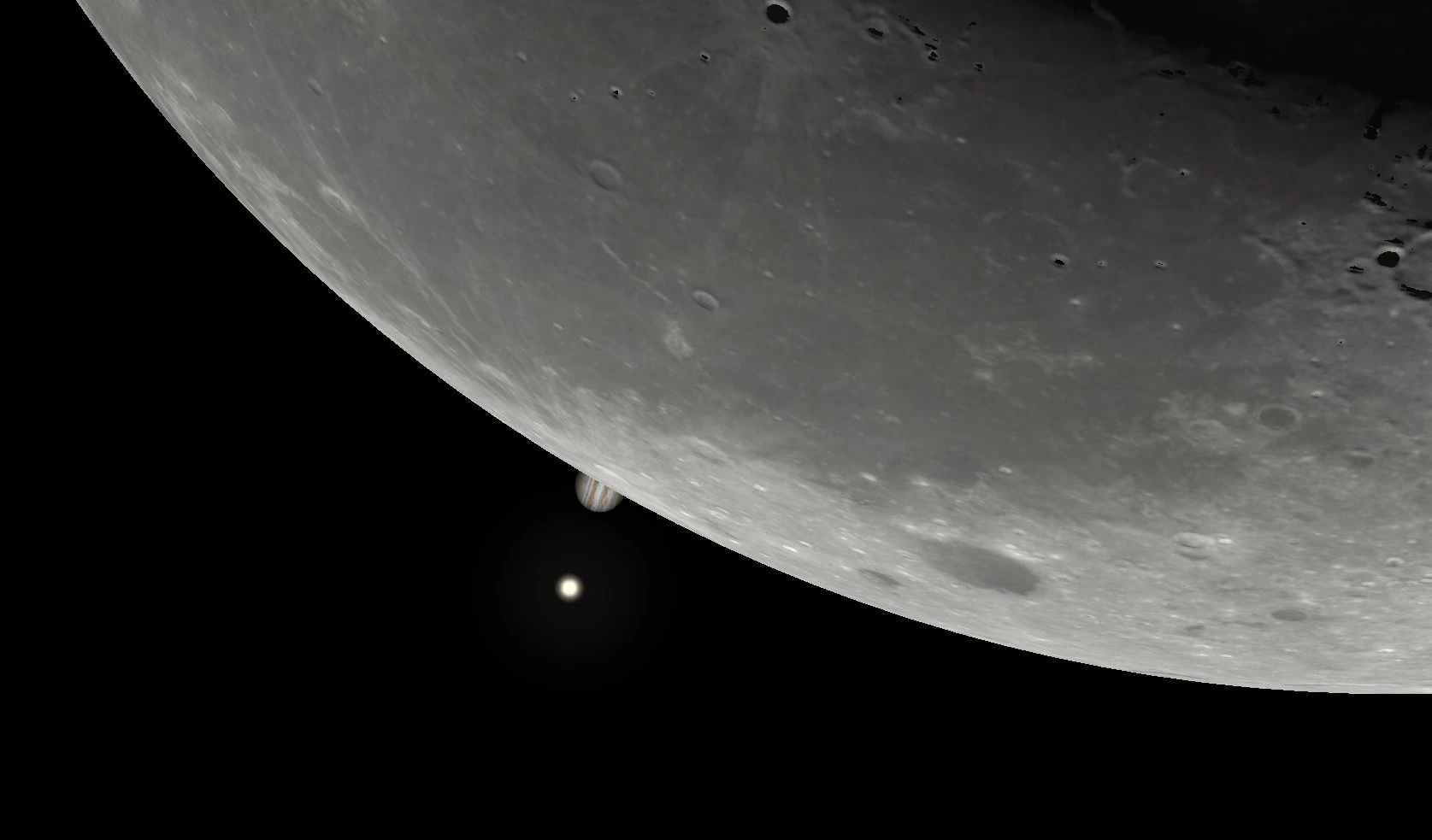
The astronomical events of the month October 2026 not to be missed will be different, starting from theopposition of Saturn on October 4thwhen the ringed planet will reach its closest distance from Earth of the year and will be visible throughout the night. Only two days later, the October 6the Moon in its waning phase it will pass very close to Jupiter, even obscuring it for observers in some regions of the Americas and Africa. From Italy we will not witness the occultation, but we will still be able to observe the two bodies very close in the pre-dawn sky.
The Moon will also be the protagonist of close encounters with the PleiadesUranus, Mars and again Saturnwhile the October 26 we will have the Full Hunter’s Moon. For lovers of “shooting stars”, however, October is one of the richest months of the year in terms of number of active meteor showers: among others we will have the October Camelopardalids, the Draconids, the Southern Taurids, the Epsilon Geminids and the Minor Leonids. The main appointment, however, will be with the Orionids on the night between 21 and 22 Octobergenerated by the debris left by the famous Halley’s Comet.
The astronomical events of the month
Saturn at opposition on October 4: the best time of year to observe it
The October 4 Saturn will reach oppositionthat is, the configuration in which the planet is on the opposite side of the sky from the Sun as seen from Earth. The exact moment will fall around 2.20pm Italian timewhen naturally it will be daytime in Italy, but from an observational point of view this changes very little: the previous and following evening Saturn will have practically the same brightness and the same apparent dimensions.
During an opposition the Earth is practically located between the Sun and the outer planet. Saturn then rises eastward around sunset, reaches its maximum height in the sky around mid-night, and sets westward at dawn, resulting observable practically all night long. The opposition also coincides with the minimum distance between Saturn and Earth in 2026equal to approximately 8.43 astronomical unitsthat is, approximately 1.26 billion km. The planet will reach an apparent magnitude of approximately 0.3 and it will be so easily identifiable with the naked eye, while its disk will have an apparent diameter of approximately 19.7 arc secondsthe highest of the year.
To the naked eye, Saturn will appear simply as a bright point, but a small telescope is enough to distinguish its characteristic ring system. The latter are progressively opening up again with respect to our line of sight after appearing almost edge-on in 2025, making the 2026 opposition particularly interesting for telescopic observation.
The Moon will occult Jupiter on October 6, but not from Italy
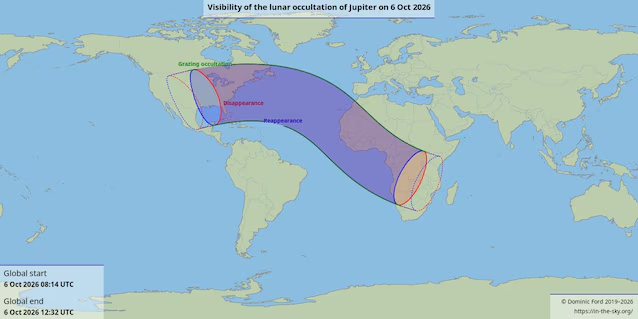
Probably the most particular event of the month will take place on October 6when one Waning moon illuminated for about 20% will pass in front of Jupiter producing a lunar occultation. In practice, for observers located along the right band of the Earth’s surface, the planet will disappear temporarily behind the disk of the Moon to reappear about an hour later.
The occultation will be visible in the pre-dawn hours from some regions of the North America and the Caribbeanwhile in some areas of Africa it will happen during the day. The moment of maximum global occultation is expected around 12.16pm Italian time. From Italyhowever, the geometry will be slightly different and Jupiter will not be hidden by the Moon. The reason is the parallax: the Moon is only about 384 thousand km from the Earth and its apparent position with respect to objects much further away changes significantly depending on the place from which we observe it.
The setup will still be very interesting in the pre-dawn hours of October 6. Around 06:00taking central Italy as a reference, the Moon and Jupiter will be separated by approximately 3 degreeswith Jupiter slightly lower than the crescent moon in direction east. This will be the most interesting time to observe the couple from Italy. The next morning, the October 7the Moon will have already traveled a considerable part of its orbit and Jupiter will be higher than our satellite, with a separation now close to 10 degrees.
The Moon’s close encounters with the Pleiades, Uranus, Mars and Saturn
The first meeting of the month will actually start already in night between September 30th and October 1stwhen the Moon will cross the constellation of Taurus passing at approximately 1 degree from the Pleiadesthe famous star cluster M45. In the same region of sky it will also be present Uranuswhich in the middle of the night will be less than 5 degrees from the Moon. The planet, with a magnitude around 5.7, will require though at least one binoculars to be able to be seen, especially due to the strong lunar brightness.
In the night between 4 and 5 October instead it will be the turn of Mars. The waning Moon will just pass 1.1-1.2 degrees from the red planet, offering an encounter easily observable with the naked eye in the hours before dawn. In the same area of sky it will also be present Polluxone of the two main stars in the constellation Gemini. The evening of October 24however, the almost full Moon will rise in the direction est around 5:10 p.maccompanied once again by Saturn. The planet will be located slightly lower and to the right compared to our satellite, with an angular separation of approximately 6 degrees in the early hours of the evening. The apparent distance will then slowly increase over the course of the night.
Finally, in the night between 27 and 28 Octoberthe Moon will return to the constellation of Taurus and pass through the region again Pleiades. The angular separation will go down to approx 1 degree in the middle of the night. In some areas of Europe the Moon will also pass in front of some of the stars in the cluster, producing stellar occultations.
The meteor showers of October: from the Draconids to the Orionids
October is one of the richest months of the year for the number of active meteor showers, although most produce only a few meteors per hour. According to the 2026 list ofAmerican Meteor Societythe first appointment will be with October camelopardalisactive only between 5 and 7 October and with maximum the October 6. The radiant is located far north in the constellation of Giraffe and always remains above the horizon from Italian latitudes. However, it is an extremely weak swarm, with less than two meteors per hour and an atmospheric entry velocity of approx 46 km/s.
Much more interesting are the Draconidswhose maximum will arrive on the evening ofOctober 8. Unlike most meteor showers, Draconids are best observed in early hours of the nightbecause their radiant in the constellation of Draco is already high in the sky after sunset. They are generated by the debris left by the periodic comet 21P/Giacobini-Zinner and produce particularly slow meteors, with a speed of approx 21km/s. The activity is extremely variable: in normal years only a few meteors are observed, while on rare occasions the Earth passes through particularly dense regions of the shower producing actual outbursts. In 2026 the Moon will be reduced to a thin waning crescent and will not disturb the first hours of the night when the swarm will be most visible.
Around the October 14th instead, the maximum annual component will arrive Southern Taurids. The shower is associated with the comet 2P/Enckehas a theoretical zenith meteor rate (ZHR) of approx 5 meteors per hour and produces relatively slow meteors, approx 27 km/s. The Taurids are not very intense, but are known for their ability to produce particularly bright fireballs. In 2026 the American Meteor Society distinguishes a first annual maximum on October 14th and a second component, the one more linked to bolide activity, with a maximum on the night between November 4th and 5th. The October 17 then it will be the turn of Epsilon Geminidsminor swarm with just 2 meteors per hour under ideal conditions, but characterized by very rapid meteors entering the atmosphere at almost 69 km/s. The October 22 instead they will reach the maximum Lesser Leonidsalso a weak shower of about 2 meteors per hour and with speeds of over 60 km/s.
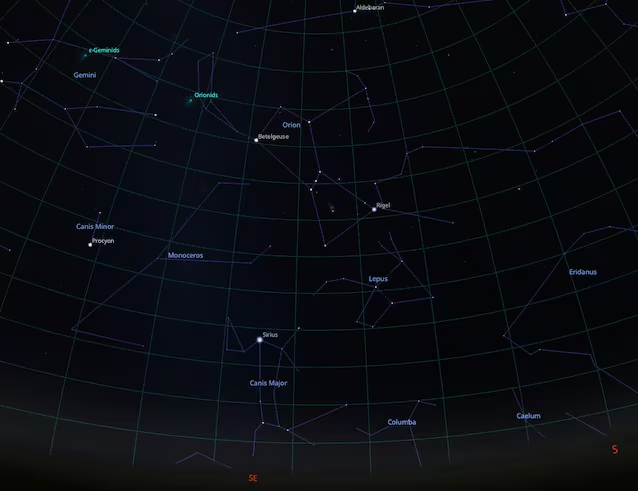
The main appointment, however, will be with the Orionids on the night between 21 and 22 October. This is a class I swarm produced by the debris of the famous comet 1P/Halleythe same one that also generates the Eta Aquarids of May. Orionids can produce normally 10-20 meteors per hourwith an entry speed of approx 66 km/s. Lunar conditions this year will not be ideal: the Moon will be crescent and about 80% illuminated, hiding many of the fainter meteors during the first part of the night. Taking Rome as a referencehowever, the Moon will set around 03:09 on October 22ndleaving a few hours of dark sky before dawn just when the radiant in the constellation of Orion will now be high on the horizon. The best window to attempt observation will therefore be indicative from 03:00 until the first light of dawn.
The Full Hunter’s Moon on October 26th
We close the roundup of October events with Full moon of the month which this year will fall on October 26 at 05:11 Italian time. This is the traditional one Hunter’s Moonname attributed to the full moon that follows the Harvest Moon and linked to the agricultural and hunting traditions of the northern hemisphere. The exact moment of the full moon will fall in the early hours of the morning, but from a visual point of view the Moon will appear practically full both in the evening of October 25th both in that of 26. In Rome, on October 26th our satellite will rise around 5pmshortly after sunset, remaining visible throughout the night.
