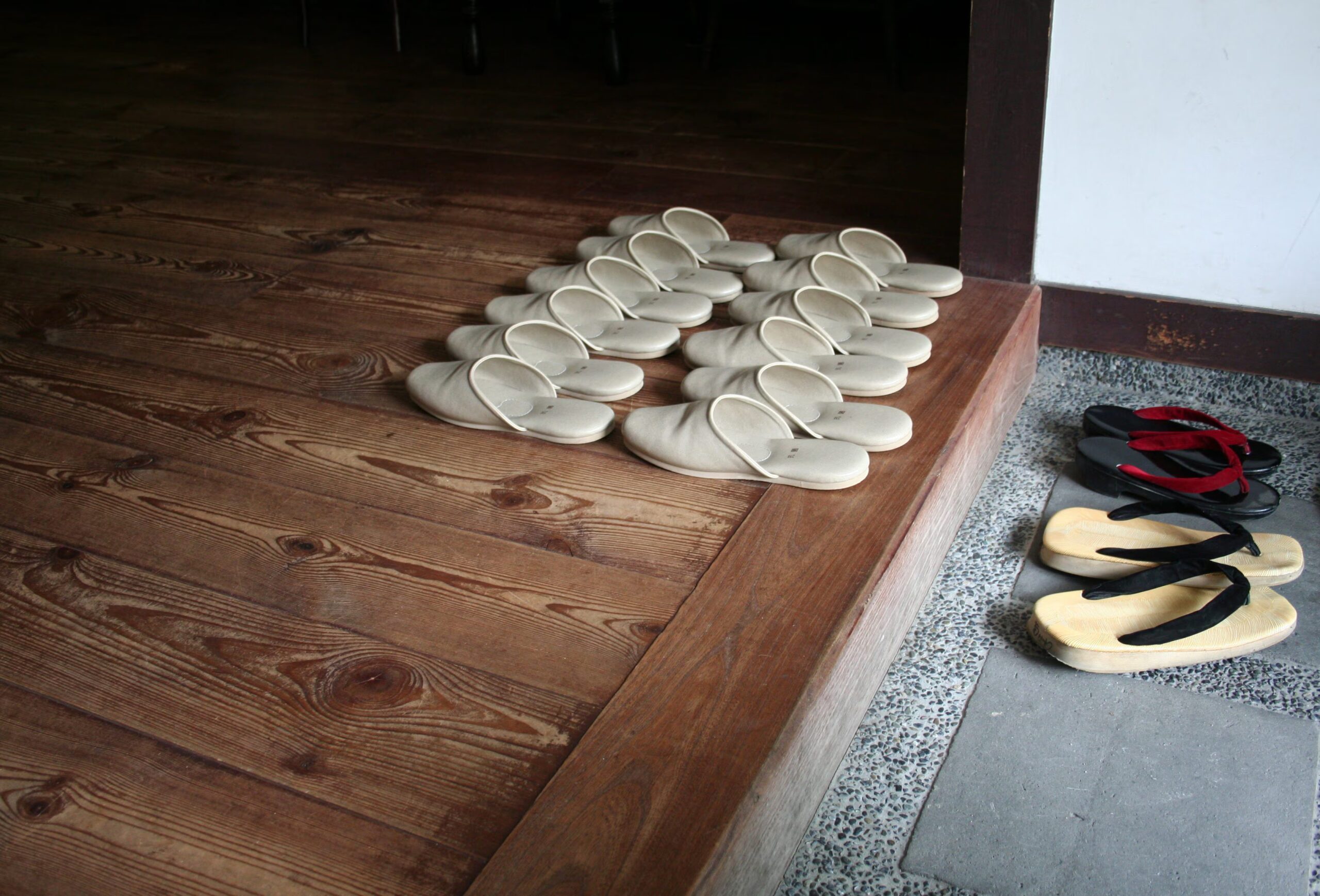
Enter one house it is a gesture as simple as it is rich in meaning. The intimate dimension of the domestic environment brings with it deeply rooted customs and traditions: in Japan entering the house also means take off your shoes before crossing the threshold.
For many Westerners this practice is synonymous with order or hygiene; for Japanese culture, however, it represents a daily ritual that reflects a precise vision of the world. Religion, philosophy, architecture and anthropology converge in a habit that, for centuries, has defined the boundary between public and private space.
As observed by L‘anthropologist Joy Hendry in Understanding Japanese Society (2013), many behaviors of Japanese society acquire meaning only if interpreted within their own symbolic systemwhere even the most ordinary gestures contribute to preserving harmony, respect and belonging.
The threshold as a place of transformation: the Japanese genkan
In traditional Japanese homes the entrance is occupied by genkana lowered space where shoes are left before entering the rooms of the house.
This is not a simple architectural solution, but a truly symbolic threshold. Cross the genkan it means abandoning the outside worldcharacterized by frenzy, work and public relations, to access a space dedicated to family, quiet and intimacy.
The anthropologist Victor Turnerin The ritual process: Structure and Anti-Structure (1969), defines these places of passage as liminal spacesi.e. moments or environments in which the individual temporarily changes their social and symbolic status.
Although Turner elaborates on this theory by studying the rites of passage of African societiesthe concept of liminality was later also applied to the interpretation of Japanese culture. The genkan in fact it represents a boundary between two different orders: the outside and the inside, the profane and the familiar, movement and stillness.
This distinction also recalls the anthropologist’s reflection Mary Douglas in the famous Purity and Danger: An Analysis of Concepts of Pollution and Taboo (1966). Douglas argues that every society builds classification systems to distinguish what belongs to a space from what is excluded from it.
The “dirt”writes the author, it is not only unwanted matter, but it is also “matter out of place”. From this perspective, shoes are not removed just because they are dirty, but because they symbolically belong to the outside world and not to the domestic context.
Purity, Shintoism and daily practice
The origins of this tradition lie in the beliefs of Shintothe indigenous religion of Japan. According to what is supported by the historian of religions Helen Hardacre in the volume Shinto: A History (2017), one of the fundamental principles of Shinto is the distinction between kiyome (purity) e kegare (impurity). The latter does not indicate a moral fault, but rather one condition of imbalance caused by contact with certain events, places or external elements.
Even the scholar Ian Rederin Religion in Contemporary Japan (1991), highlights how purification practices are central to Japanese religiosity. Before entering Shinto shrines, for example, it is customary wash your hands and mouth at the Temizuyathe ablution pavilion. Likewise, leaving one’s shoes at the entrance to the house constitutes a daily form of purification that protects one space considered symbolically ordered.
This vision is accompanied by the contribution of Zen Buddhism. In his classic Zen and Japanese Culture (1959), Daisetz Teitaro Suzuki underlines how cleanliness cannot be separated from spiritual practice. In Zen monasteries, in fact, sweeping the floors, tidying up the rooms and keeping every object in its place are mindfulness exercises (mindufluness) and discipline.
Cleaning space means, at the same time, ordering one’s mind.
Traditional architecture and the relationship with space
The custom of taking off one’s shoes is also closely related to the evolution of Japanese architecture. Traditional homes were built with wooden floors and paneled rooms tatamirice straw weaves intended not only for walking, but also for eating, sitting and sleeping. Walking on the tatami with the shoes would have compromised both their conservation and the cleanliness of the environment.
The architectural historian Arby Brownin the book Just Enough: Lessons from Japan for sustainable living (2015), observes that the Japanese house is designed as a flexible space, in which the same room can transform into course of the day from living room to bedroom.
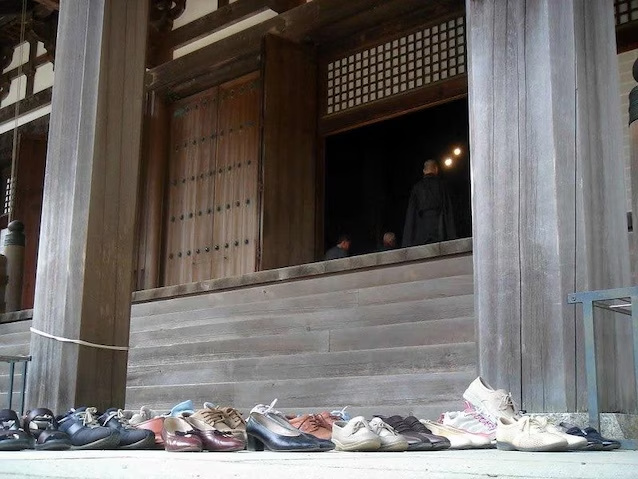
The tatami it is what makes the latter of the same environments possible for very different purposes. Therefore it is essential to maintain the flooring perfectly clean, since it constitutes the main one place of relationship between the body and the home.
According to the geographer and philosopher Augustin Berquein Japan: Nature, Artifice and Japanese Culture (1997), this characteristic reflects a different conception of the relationship between human beings and the environment. In Japanese culture the house is not simply a container for daily activities, but an extension of the individual and their relationships.
Living thus becomes a cultural practice based on the continuity between person, space and nature.
Don’t wear shoes at home in Japan: much more than a rule of good manners
Interpreting this tradition exclusively as a hygienic rule means neglecting its deeper meaning. The daily practices constitute tools through which every society symbolically organizes its world. In the Japanese case, the simple gesture of taking off one’s shoes delimits the boundary between order and disorder, between public and private, between exteriority and concentration.
Also Claude Lévi-Straussin the collection The other side of the moon. Writings on Japan (2011), was fascinated by the ability of Japanese culture to attribute profound meanings to the most ordinary gestures.
Taking off your shoes, therefore, didn’t just mean protecting a floor: it means recognizing that each space has its own identity and that the respect towards others start with the simplest actions.
Sources
Berque, A. (1997). “Japan: Nature, Artifice and Japanese Culture” Brown, A. (2015). “Just Enough: Lessons from Japan for Sustainable Living” Douglas, M. (1966). “Purity and Danger: An Analysis of Concepts of Pollution and Taboo” Isozaki, A. (1979). “Ma: Space-Time in Japan” Lévi-Strauss, C. (2011). “The Other Side of the Moon. Writings on Japan” Reader, I. (1991). “Religion in Contemporary Japan” Suzuki, D.T. (1959). “Zen and Japanese Culture” Watsuji, T. (1961). “A Climate: A Philosophical Study” Turner, V. (1969). “The Ritual Process: Structure and Anti-Structure” Hardacre, H. (2017). “Shinto: A History” Hendry, J. (2013). “Understanding Japanese Society”
