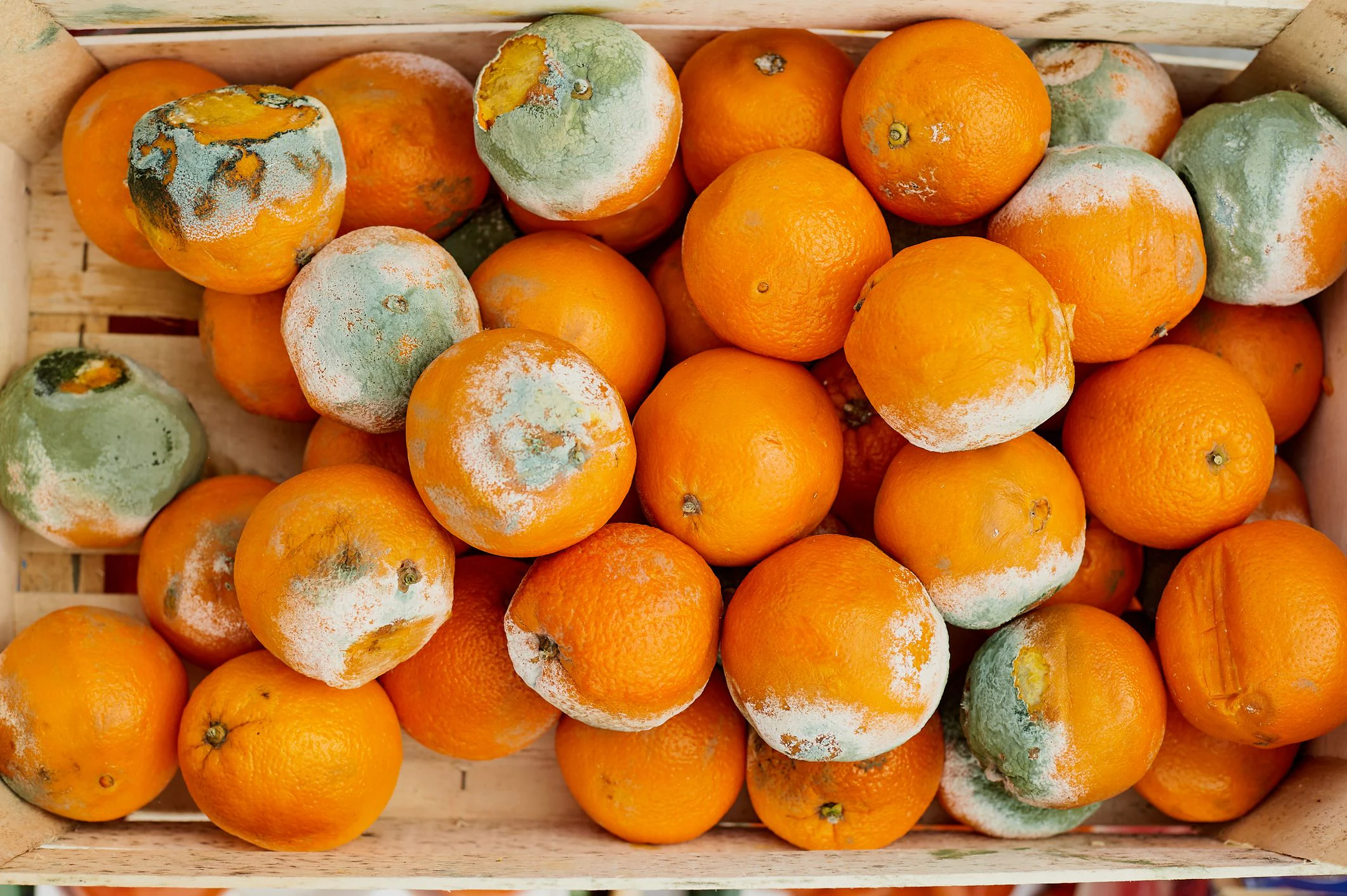
Molds can grow on any food, but prefer those with a high water content and at temperatures between 20 and 30 °C. Some are harmless, others are life-altering or even toxic and extremely harmful to health. To prevent them, it is important to store food correctly, keep the refrigerator and utensils clean and reduce humidity.
We open the fridge or pantry and notice a piece of cheese, a piece of fruit or a piece of bread with some traces of mould; Should we throw them in the garbage or will it be enough to eliminate the mold to be able to eat them? The answer is not unique and depends on the food. For some foods, eliminating the spoiled part may be enough to be able to consume the rest, but often the mold has penetrated deeply and the contaminated product must absolutely be discarded. Molds cause an alteration of the organoleptic characteristics of a food, developing unpleasant odors and flavours, but in some cases they can generate potential health risks.
What are food molds and where do they live?
Some information on these microorganisms helps to clarify their effect on foods and possibly keep them under control. Molds belong to the vast Mushroom kingdom and they are multicellular organisms. Their “body”, the myceliumis nothing more than a dense network of microscopic filaments called hyphae which allow molds to expand on different types of substrate, even where they are not immediately visible.
They reproduce through sporessingle cells capable of giving rise to new mycelium when they find suitable conditions. These disperse transported by water, air or other organisms, conquering new substrates in which to proliferate and therefore also the foods in our pantry. It’s about saprophytesthat is, capable of using decomposing organic substance as nourishment and for this reason a food that is not too fresh can represent an excellent environment for development. Among the determining factors in the proliferation of mold are the conditions of temperature, oxygen, pH and humidity of a certain environment.
These organisms preferably grow a temperatures between 20 and 30 °Cwhile above or below this range development is slower. They need oxygen because they are organisms aerobic and they multiply well in neutral or slightly acidic pH conditions (generally between 5 and 7). The percentage of water available present in foods, i.e. that part of water not bound to salts (such as sodium chloride) or sugars (such as sucrose), favors the proliferation of mould. For this reason, dry biscuits, packaged pasta or powdered milk with low quantities of available water are less subject to mold than fruit, bread, yoghurt and fresh cheeses. In summary, a slightly acidic food, rich in water and left at room temperature presents all the conditions for the development of mold.
They are not all the same: useful, altering and toxic
Just by looking at their appearance, you can see that the colonies of the different mold species are very variable form, color And compactness. It is extremely difficult to classify them, but today it is of great helpgenetic analysis of the strains. In relation to the edibility of foods it is possible to divide them into three large groups:
- Useful molds if it’s a species inoculated voluntarily in some foods during the production cycle. For example, the particular flavor and creaminess of gorgonzola are obtained by inserting specific strains of mold into the cheese. Likewise, stumps allowed to take root on the surface of cured meats they favor its maturing. These molds they do not produce metabolites that are toxic to humans.
- Altering molds if they are species that cause alterations in the organoleptic characteristics of foods making them inedible, but non-toxic.
- Toxic molds if they produce mycotoxins which, if ingested, have short and long-term effects on human health.
What to do with moldy food and which to throw away
In foods ad high water content (fresh fruit, soft cheeses, yoghurt, jams) the contamination penetrates well beyond the surface quickly and invisibly. The colored fluff that we see on the surface is, so to speak, only the “tip of the iceberg”. In more compact foods and with a lower water content (carrots, potatoes, mature cheeses, dry biscuits) the penetration of the hyphae is more difficult and proliferation is therefore slower.
- Bread: it must be immediately thrown awayprecisely because of the structure of the crumb, the fungus that contaminated it managed to penetrate deeply.
- Butter: it can go rancid due to attack by mold species Moniliella suaveolens And Cladosporium herbarum.
- Cheeses: in those vacuum-packed sometimes a stringy mold forms which creeps between the folds of the plastic film if the packaging is not perfect and oxygen has entered. If there is only some traces of mold on mature cheeses and compact, simply remove the moldy part with a generous cut, while the yogurt e fresh cheeses they are no longer edible even if there is very little external mold.
- Jams: for those produced with sugar and not with sweeteners, the sugar binds with the water and prevents the formation of toxins, so it is possible to clean the mold by removing a large spoonful from the jar and using the rest only if there are few traces and only on the surface. Dietary jams, on the other hand, given their low sugar or sweetener content, must be eliminated entirely.
- Dried fruit and spices: they must be eliminated because they are particularly dangerous for the development of mycotoxins.
- Meat or fish: they should absolutely be thrown away even at the first sign of contamination.
What are mycotoxins
Mycotoxins are produced by some species of mold, particularly genera Aspergillus, Penicillium And Fusarium and develop under certain conditions. They are toxic compounds and can contaminate products at the time of harvesting, during the production phases or during storage, often favored by heat, humidity and condensation. The most common are the aflatoxinstheochratoxin Athe fumonisins and the patulin. I am stable and resistant to high temperaturestherefore also to cooking, acidifying treatments and radiation and, unfortunately for us, they are tasteless, not visible and therefore particularly insidious. As explained by theEuropean Food Safety Authority (EFSA), aflatoxins on our body can have short and long-term effects especially on the liver, kidneys and nervous system.
The aflatoxins they are among the most poisonous; produced by some molds such as Aspergillus flavus And Aspergillus parasiticus, they grow up nuts like peanuts and pistachios, come on cereals such as corn and rice, on dried fruit and on spices Store in hot, very humid environments. They cause chronic poisoning and liver cancer. As a recent study on rice storage conditions to reduce aflatoxin contamination explains: “Investigating safe storage conditions to mitigate aflatoxin contamination in rice”, contamination by molds of this kind Aspergillus represents a problem in the conservation not only of rice, but also of its derivatives such as biscuits, packaged rice-based preparations, malt beer or flours derived from rice. More and more sophisticated conservation techniques are being tested, but nevertheless they are not always sufficient to avoid the risk of aflatoxin production. These toxic compounds persist even after treatments at 150-200 °C or chemical treatments which, moreover, can compromise the organoleptic and nutritional properties of the cereal. The study also confirmed that temperature and humidity are the main predisposing factors for fungal proliferation and maximum growth of Aspergillus flavus occurred under laboratory conditions 30°C and 95% relative humidity
Ochratoxin A occurs on coffee, wine and cereals and its most obvious effect is kidney damage. There Patulina it is the prevalent toxin in fruit juices (particularly apple juice) if contaminated by mold. The tolerable levels of mycotoxins are very low considering their degree of toxicity. For example, the maximum permissible levels of aflatoxins in various types of dried fruit, cereals, dried figs and milk are between 0.5 and 15 µg/kg (1µg is equivalent to one billionth of a kilogram).
Some precautions to limit their proliferation
Unfortunately, mold contamination is not always visible and this is why a series of precautions must be adopted. Food manufacturers recommend respect the instructions on the label of packaged foods. Many product labels say “Store in a cool, dry place” precisely because mold proliferates in humid heat.
Fridge compartments and kitchen countertops go sanitized often with very clean sponges or better yet with disposable rags. It is good practice to wash your hands and not use utensils that have already come into contact with other uncleaned foods before handling food.
Cooked foods should be eaten immediately or cooled very quickly in your fridge to prevent heat from promoting the proliferation of mould. Finally, the products stored in the fridge go covered with films and lids or kept in closed containers and the fridge should be kept at a temperature of around 3°C.
