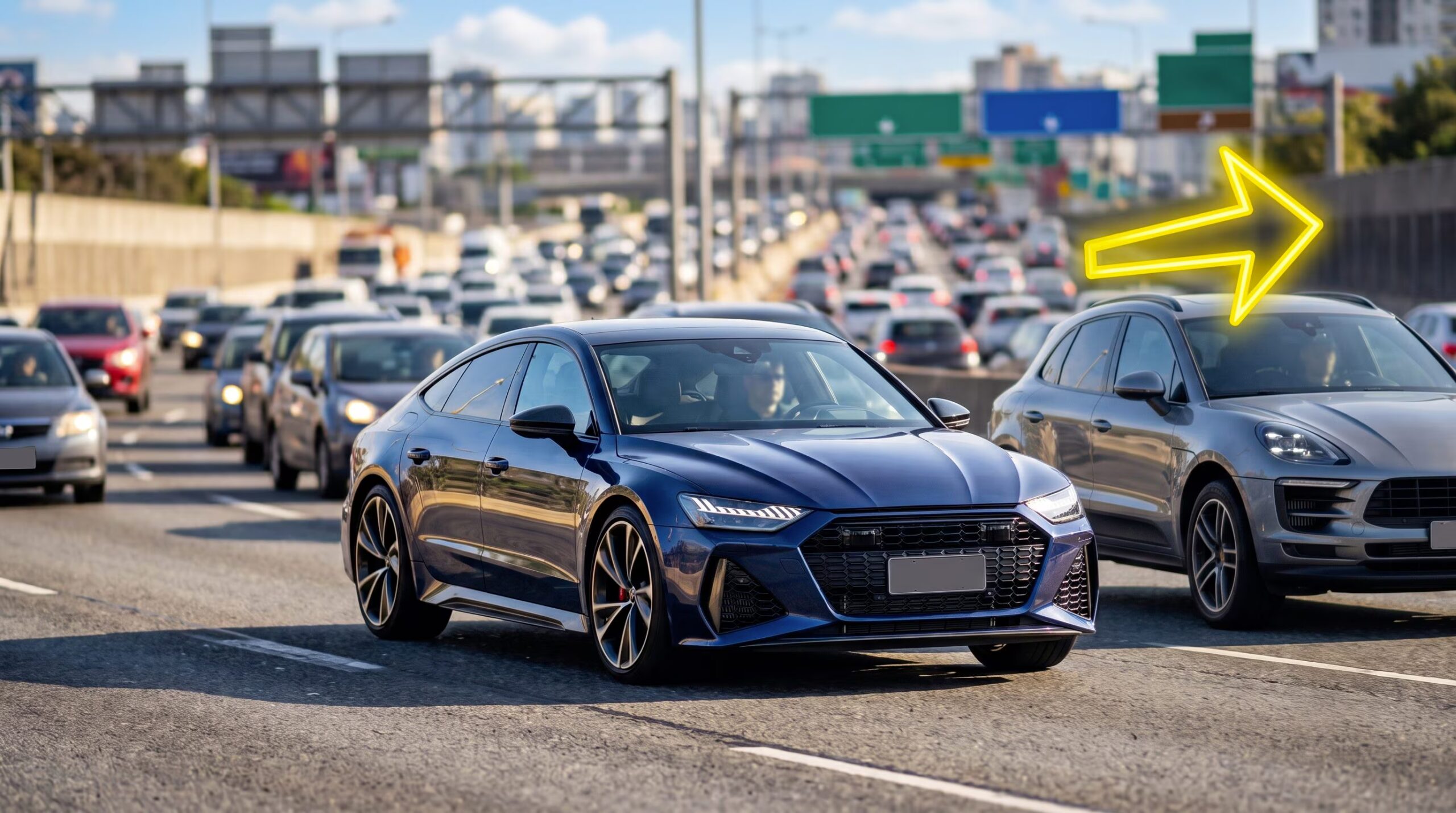
When we are in traffic, perhaps on the motorway, it always seems to us that the next row is moving faster than ours, but is it really always like this? Obviously our line isn’t always the slowest, but there are three good reasons why it seems right there to us our queue is the slowest one.
First, when the speeds of the rows are equal, a illusory effect so it seems to us that our queue is slower than the others even if it isn’t. Secondly, from one point of view statisticalwe actually could find ourselves more often in a slow queue. Thirdly we tend to overestimate the speed of cars that surpass us.
These three factors contribute to making us believe we are always in the slowest queue, often called “next row effect“, let’s see how they are explained in terms of the difference between the time spent overtaking and that passed to be surpassedi, of statistics, and of misperception of the speed of other cars.
Imagine two files proceeding at approximately the same average speed. There will be times when one row goes faster than the other, and vice versa, but overall they will go at the same speed and take more or less the same time to travel the same number of kilometers. This situation was studied by Donald A. Redelmeier and Robert J. Tibshirani (University of Toronto) who in the late 1990s wondered whether in such a situation motorists in both rows tend to perceive their own row as slower than the other.
To answer the question they simulated a situation on the computer traffic with two lines of cars, which proceeded at the same average speedin which motorists in a row judged moment by moment whether the cars next to them were going faster or slower. THE’statistical analysis of the situation showed that
The elapsed time by a motorist to be overcome from other machines it is superior al time spent overtakingeven though the total number of overtaking cars is equal to the number of overtaking cars.
Basically the motorist passes more time thinking about being slower of others compared to the time he spends thinking he’s fasteralthough overtaking on one side and the other is balanced: in this way the illusion is generated that the other row is faster.
To confirm this theory, the two scholars then made a film, taken from the point of view of the inside of a real car in a queue, in a situation where the next row it made little progress more slowly. The footage was then shown to 120 subjects: in 70% of cases they stated that, in their opinion, the next row proceeded faster and in 65% of cases they would have even changed lanes. Although the queue next door was slower, most respondents perceived it to be faster.
According to Redelmeier and Tibshirani, a fundamental point is that when a queue slows down, yes compresses and the cars get closer to each other, vice versa when a row picks up speed the cars move closer they distance themselves between them.
One consequence is that if a motorist finds himself in the slow queue and is overtaken by 3 spaced cars he tends to perceive 3 overtakings suffered, on the contrary a driver in the fast queue, who overtakes 3 cars close together, tends to perceive the event as a single overtaking carried out.
According to the illusion explained by Redelmeier and Tibshirani we think we are in a slower queue even when the two queues are more or less equivalent. But the impression of being in the slowest queue is further supported by the fact that, according to mathematician Nick Bostrom (Yale University), we are usually actually in the slowest queue:
generally a slow queue accumulate more vehicles in the same space than a fast queue and if we take a driver at random it is statistically more likely that this is in a slow queue.
In other words, according to Bostrom, in a traffic situation it is reasonable to expect that the number of slowed vehicles is greater than the number of fast vehicles and for this reason it is easier that we are in a slow vehicle rather than a fast one.
Consequently, the sensation of being in a slow queue is often true, but be careful, we do not always correctly perceive the speed of the cars around us. Researchers B. Dawson and T. Riggs (Union University, Jackson), in fact, have quantified how much we tend to exaggerate the perception of the speed of a car overtaking us, finding that, for example, if we are overtaken by a car proceeding at 90km/h we tend to perceive it as if proceeding to 95km/h.
In general we often find ourselves in the slowest queue, since these queues include a greater number of cars, but even when our queue proceeds at the same speed as the one next to us we have theillusion that the other is faster, and in any case when a car overtakes us it seems to us that it is going faster than its actual speed. All this contributes to making us think that we are always in the slowest queue.
