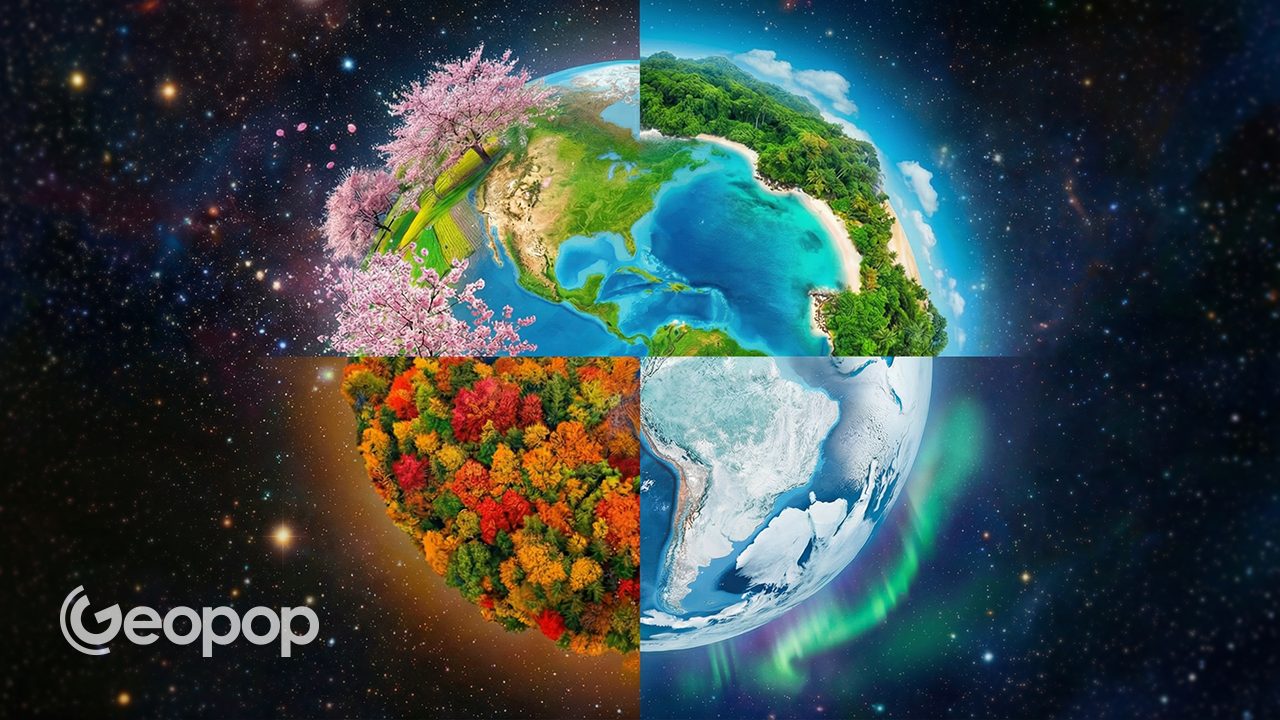
Spring, summer, fall, winter. The seasons are such a part of our daily lives that we take them for granted. Yet, they are not at all obvious. They don’t exist the same way everywhere on the Earththere have not always been four and without them our way of measuring time – even the very concept of “year” – would be completely different.
Why do we have seasons?
To understand this we need to take a step back. Far behind: approx 4 and a half billion years ago.
According to one of the most accredited hypotheses, when the Earth was still young it suffered a very violent impact with a celestial body more or less the size of Mars, a planetoid called Theia. From that clash the Moon was born, but above all another fundamental thing happened: the Earth tilted. Today the Earth’s rotation axis is tilted by approximately 23 and a half degrees with respect to the plane of the orbit around the Sun. And it is precisely this inclination – not the distance from the Sun – that is the cause of the seasons.
The Earth makes one full revolution around the Sun in about a year, but while moving along the orbit the axis always remains oriented in the same direction in space. This means that, depending on the position of the Earth along the orbit, one hemisphere is tilted towards the Sun and the other is tilted in the opposite direction.
When the northern hemisphere is tilted towards the Sun, the Sun appears at noon highest in the sky. Six months later, when the Earth is on the opposite side of the orbit, the same point in the northern hemisphere sees the Sun much lower. This height difference changes everything.
Let’s imagine that the Sun sends 100 rays of light towards the Earth, carrying energy and heat.
If the Sun is high in the sky, those rays hit the ground more directly and concentrated. If, however, the Sun is low, the same rays are distributed over a larger surface. The result is that the same energy heats less. High sun means more heat: summer, Low sun means less heat: winter.
Between these two extreme situations there are intermediate phases, when the Earth’s axis points neither towards the Sun nor in the opposite direction: spring and autumn.
When it’s winter here, it’s summer in Australia: how it works
At this point the consequence is almost inevitable. If one hemisphere is tilted towards the Sun, the other is necessarily tilted in the opposite direction. When it is summer in the northern hemisphere, it receives more light and more heat because it is oriented towards the Sun. But this means that the southern hemisphere receives less light and less heat: It’s winter there. Six months later the situation is reversed.
The same goes for intermediate seasons: when it is spring in the northern hemisphere, it is autumn in the southern hemisphere, and vice versa. The seasons are therefore mirrored between the two hemispheres, simply because they share the same inclined axis.
Why are there four seasons: spring, summer, autumn and winter
Hot, cold and two ways in between: so far everything is clear. But why did we decide that there are actually four seasons? And above all: when do they begin and when do they end?
The answer is partly astronomical and partly cultural.
The key moments are four precise astronomical events: two solstices and two equinoxes.
The solstices
The summer solstice it is the moment in which, for a given hemisphere, the Earth’s axis is oriented in the most direct way possible towards the Sun. In the northern hemisphere the June 20th or 21st and it’s the day with more hours of light in the yearthe one in which the Sun reaches its maximum height in the sky.
The winter solstice it’s the opposite: the axis points as far away from the Sun as possible. It’s the day with fewer hours of lightin which the Sun remains very low on the horizon.
The solstices are not “symbolic days”: they are precise momentswhich occur at a well-defined time and which may vary slightly from year to year.
During the summer solstice the Sun is at midday zenith along a specific parallel: the Tropic of Cancer. During the winter solstice the same thing happens on the Tropic of Capricorn. And this is exactly why the tropics exist.
The equinoxes
Between the two solstices there are the equinoxeswhich occur when the Earth’s axis is tilted neither towards nor away from the Sun. At those moments the line that separates day from night passes exactly through the two poles. The result is that day and night last almost exactly 12 hours everywhere on Earth. The name “equinox” derives from the Latin aequa-nox, “equal night”.
In the northern hemisphere the March equinox marks the beginning of springthat of September the beginning of thefall. We therefore have four well-defined astronomical moments, and around these man has built the cultural subdivision of the four seasons.
Seasons don’t exist everywhere: the explanation
If the tilt of the Earth is the same for everyone, then why aren’t the seasons the same everywhere? Because he Tilt effects change dramatically with latitude.
Near the equator the Sun is always very high in the sky at noon, all year round. The length of the day varies very little and the temperature remains almost constant. Here there are no real thermal seasons. What really changes is the rain. Warm, moist air rises, condenses and causes heavy precipitation. This band of rain moves throughout the year: when it passes over an area there is the rainy season, when it moves away the dry season arrives.
In medium latitudes (like Italy), the inclination of the Earth’s axis produces two very marked effects:
- the Sun changes height a lot between summer and winter;
- the length of the day varies by several hours.
These variations are enough to create four very distinct seasonswith clear differences in temperature, light and biological cycles.
In the polar regions the Earth’s tilt dominates everything. Here the Sun can do not arise for months (polar night) or never set (polar day). In these places there are no four seasons as we understand them. There are quite a few two great periods: one dominated by light and one by darkness. The temperature depends almost exclusively on one thing: whether the Sun is there or not.
