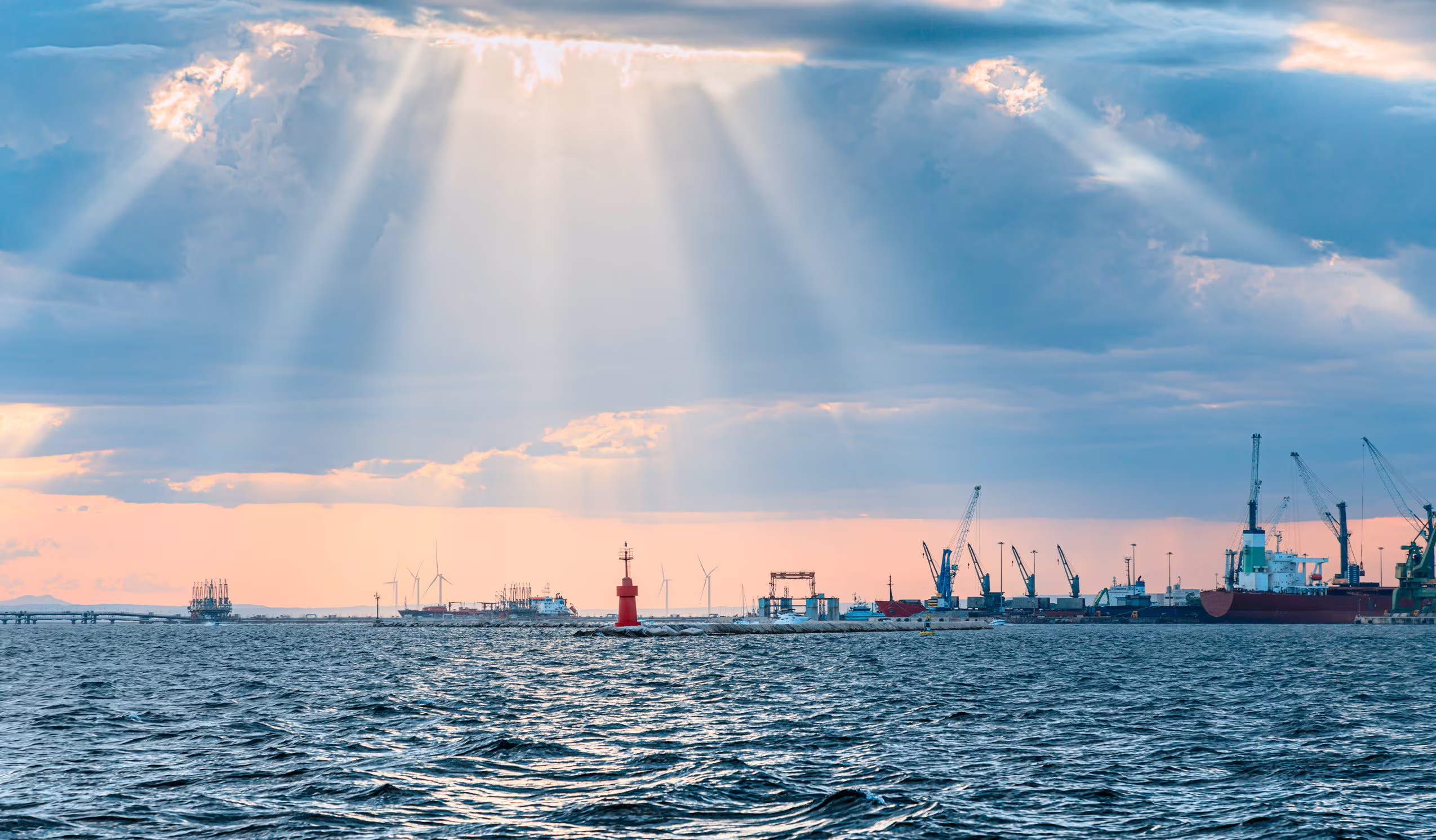
The Beleolico of Taranto it’s the first marine wind farm of the Mediterranean. The plant, with a total installed power of 30MWis among the most significant achievements of the offshore wind sector in Europe. Renexia SpA promoted and developed the project, supporting an investment of approximately 80 million euros. Inaugurated on 21 April 2022, the park therefore marks an important stage for the technological and industrial innovation of the Italian energy system and concretely contributes to the reduction of greenhouse gas emissions and the achievement of decarbonization objectives of the country.
A record-breaking infrastructure in the Mediterranean
The park occupies an area of approximately 131 thousand square meters and is located in the outer harbor of the port of Tarantoat a distance from the coastline between 10 meters and 2.5 kilometers. The system consists of ten wind turbines (wind turbines), each characterized by a nominal power of 3MW, and is able to guarantee an estimated annual production of 62 GWh of electricitysufficient quantity to satisfy the energy needs of approximately 60 thousand people. Over its useful life, estimated at twenty-five yearsan overall saving of 730 thousand tons is also expected carbon dioxide equivalentcompared to a scenario of electricity production based on conventional fossil fuels.
The construction phases of the Beleolico of Taranto
THE’authorization process of the project required overall fourteen yearsfrom the initial presentation in 2008 until entry into commercial operation in 2022. Once the administrative procedures were completed and the necessary environmental, maritime and energy authorizations were obtained, the shipbuilding activities, which began in August 2021, were completed in a relatively short time and without any particular operational criticalities. The initial phase of the works involved the installation of the foundation structures. They were, in fact, stuck in the seabed ten steel monopileswith lengths varying from 40 to 52 metersat water depths between i 4.5 and 18 meters.
These structural elements constitute the supporting system of wind turbines and are designed to transfer to the seabed the static and dynamic loads deriving from the action of the wind, wave motion and the mechanical stresses induced by the rotation of the rotor. Subsequently they were assembled and installed tubular towers of steeleach composed of four sections prefabricated. At the top of the towers, approximately 80 meters above mean sea level, the spacecraft (nacelle), which houses the main electromechanical systems of the turbine, such as the gearbox and the electric generator, which converts mechanical energy into electrical energy. The last construction phase involved the rotor assembly by installing the three blades and the hub on each wind turbine. The layout of the turbines was designed on the basis of anemological and fluid dynamic studies aimed at optimize the capture of wind resources and to minimize the effects of aerodynamic interference between the various wind towers. Both during the driving activities of the monopiles and in the assembly and lifting phases of the towers, the self-lifting vessel was used (jack-up vessel) MPI Resolutionsupplied by the Dutch company Van Oord. Thanks to its retractable legs, the unit is able to rise above the sea and operate on a stable platform, eliminating the effects of wave motion and ensuring high standards of safety and precision.
For the introduction of the energy produced into the national grid, a electrical substation in the locality Triolo Towera few kilometers from the port area. The infrastructure receives the electrical energy transported by the submarine and terrestrial cables that connect the wind turbines to the plant’s collection and conversion system, subsequently arranging for its transformation and delivery to the transmission network. The entire wind farm is operated by remote control systems And remote supervisionsupported by a dedicated and redundant communication network, which ensures continuous monitoring of operating parameters and energy flows in real time.
A work that respects the environment
The construction of Beleolico represents a result of particular importance for the city of Taranto and for the Italian energy sector: it marks a significant stage in the development path of renewable energy sources. The project was developed through a process of discussion with environmental associations, institutions and local and national stakeholders, and accompanied by intense data collection, monitoring and analysis activities, carried out in collaboration with qualified research centres. This approach has allowed us to identify maximum-oriented design solutions environmental compatibility and sustainable integration of the work in the territorial and marine context.
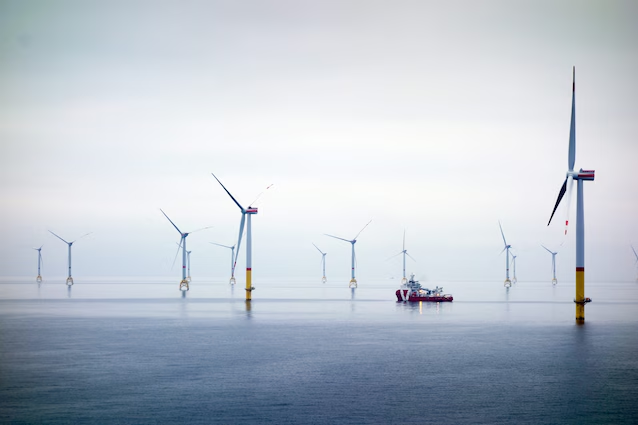
Particular attention was paid to acoustic aspects and the protection of avifauna. As regards the protection of migratory and resident birds, the park adopts an integrated system mitigation of the risk of collision. One of the three blades of each turbine is characterized by a high color contrast marking, obtained by applying a longitudinal black band (black blade). This solution, validated by experimental ornithological studies, increases the perception of the rotor in motion, contributing to diminish the risk of impact by birds. This measure is accompanied by the Bird Monitoring Systeman advanced monitoring system made up of cameras and sensors installed on the wind turbines. Through automatic recognition and tracking algorithms, the system is able to detect the approach of groups of birds and, if certain risk thresholds are exceeded, activate automatic procedures slowing down or temporarily stopping the turbines. Even from the point of view ofcircular economyBeleolico was conceived according to sustainability criteria. At the end of the useful life of the system, beyond 90% of the materials used in structures, including steel, copper and other metal components, can be recovered and sent to processes recycling and reuse.
Benefits for communitiesto premises
Offshore wind represents one of the most promising technologies for the production of electricity from renewable sources, thanks to the possibility of exploiting air currents generally faster And regular compared to those found in terrestrial installations. This greater operational efficiency makes marine wind a strategic alternative for reducing dependence on fossil fuels and for achieving the decarbonization objectives set at national and European level.
In addition to the environmental and energy benefits, the infrastructure has a significant socio-economic value for the territory tarantino. By inserting itself into a context historically characterized by the presence ofheavy industrythe project was also conceived as a tool for productive diversification and sustainable economic development. In particular, the construction and management of the plant favored the creation and consolidation of professional skills related to the offshore wind sector, promoting the creation of a industrial supply chain local dedicated to the operation, maintenance and monitoring of infrastructures, both in land and maritime environments.
