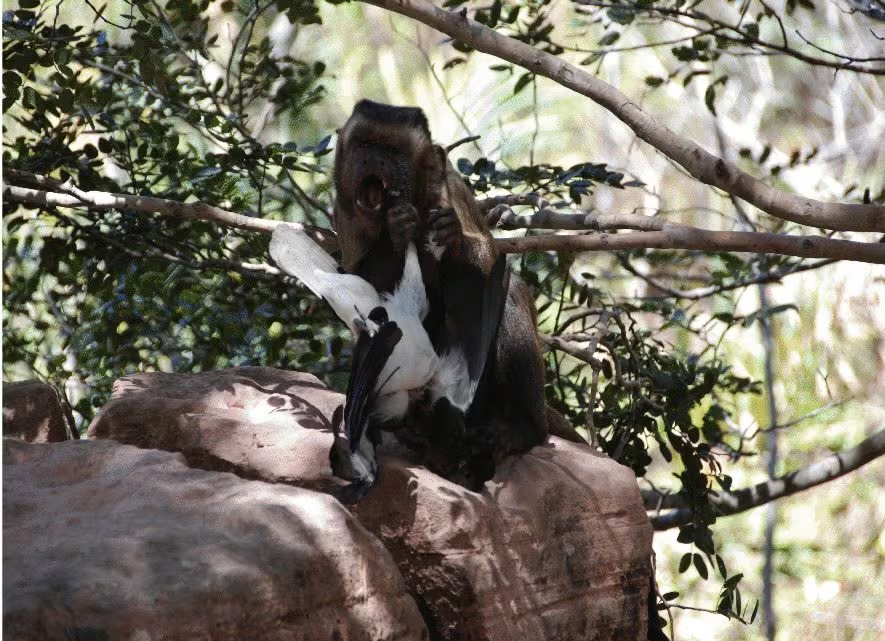
In the daily routine of tufted capuchin monkeys (Sapajus libidinosus), observed for almost four years in Brazil by an international team of researchers that includes Cnr-Istc and the Sapienza University of Rome, there is the consumption of meat from reptiles, mammals and birds. The work, published on PLOS Oneit is the larger register never collected on the predation of small vertebrates in this species and uses these very monkeys as a window into a much larger question: how did the habit of eating meat arise in our evolutionary line? Capuchins are opportunistic omnivores: they eat fruit, seeds and insects.
What was less well known is how much, and how, they hunted vertebrates such as lizards, birds, rodents and small snakes. To fill this gap, the research team led by Susana Carvalho and Noemi Spagnoletti followed up two wild groups of capuchins in Fazenda Boa Vistaan area in northeastern Brazil, in a transition zone between the Cerrado and Caatinga biomes. For 45 months the observers noted every event of hunting and consumption of vertebrate prey, for a total of 5,093 hours of observation. The result of this effort is a dataset that matters 446 predation eventsfor an overall rate of 6.34 catches per 100 hours of observation.
What and how capuchin capuchins eat
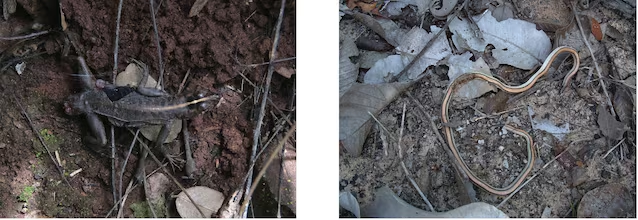
The researchers classified prey into three broad categories: reptiles such as lizards, geckos, snakes and iguanas (136 events), mammals such as rodents, possums and bats (97 events) and birds, especially eggs and nestlings (34 events). The order in which capuchins devour their prey is almost macabre. Birds are often eaten whole but, when this is not the case, monkeys prefer to eat first the brain and the viscera. The reason, as co-author Noemi Spagnoletti explains to PLOS Oneit could be that these are the parts richest in easily assimilable fats and calories. The same goes for lizards and mammals, while snakes are opened by discarding the head and eating the internal organs first.
Hunter males, more cautious females: there is a pattern between the sexes too
One of the most solid data emerging from the authors’ statistical model is the difference between sexes: adult males hunt vertebrates at a rate 1.4 times higher than females. A figure that aligns with what has been observed in other study sites on capuchin monkeys, but also in baboons and chimpanzees. The most immediate explanation involves body size: in Fazenda Boa Vista adult males weigh on average 3.5kg against i 2.1kg of females, resulting in greater caloric needs. But the authors also propose a more fascinating behavioral hypothesis: females would adopt one more prudent foraging strategyoriented towards less risky foods (such as insects) rather than towards potentially dangerous vertebrate prey.
Comparing two groups sympatric (living in the same area), one of which received a small daily supply of extra food from the researchers, the “foraged” group was seen to hunt vertebrates 1.88 times less of the group that received nothing. When food is plentiful and costs little effort to get, hunting a snake or lizard becomes a less convenient option. Consistently, the availability of fruit in the environment was found inversely proportional to the predation rate.
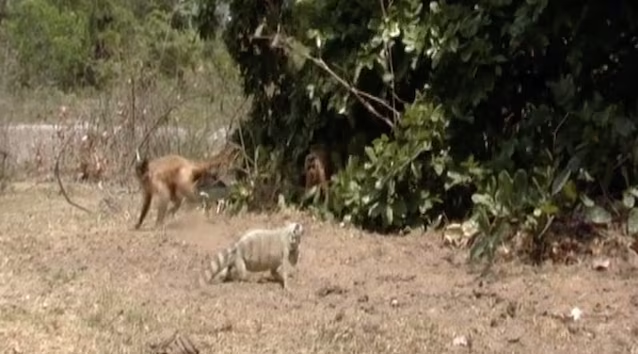
As for hunting methods, the majority of hunting and eating events occurred alone (over 80% of cases), not in groups. However, when the prey was captured by multiple individuals together, a true one was observed in 64% of cases food transfer between group members.
As Spagnoletti explains, this behavioral complexity was the biggest surprise of the research:
“What surprised me most was the extent to which vertebrate predation was integrated into the daily lives of capuchins (…) I certainly didn’t expect it to become such an important part of what we were documenting.”
What this means for human evolution
The same behavior was observed in the chimpanzees of Gombe, Tanzania and scholars link it to a possible evolutionary stage towards what in anthropology is called “human predatory pattern”that is, the ability (unique among living primates) of human beings to habitually hunt animals as large as or larger than themselves. Before we get to that, according to the hypothesis discussed in the study, our ancestors may have gone through a phase in which “easy meat” from small vertebrates constituted a nutritional stepping stone, earlier and cheaper to obtain than big game hunting.
As Spagnoletti herself points out, the capuchin monkeys they are not a direct model of our ancestors. They are New World primates, evolutionarily much further from us than chimpanzees and bonobos.
But precisely for this reason, the fact that such sophisticated behaviors (targeted hunting, differentiated management of prey parts, social sharing of food) emerged completely independently in a distant branch of the primate tree is powerful evidence that these traits are not “exclusive” of the human line or great apes. For the authors, the next step is to re-analyze fauna fossils in search of signs of predation on small vertebrates, to understand if the same consumption “signatures” observed in these apes are also found in the finds left by early hominids.
