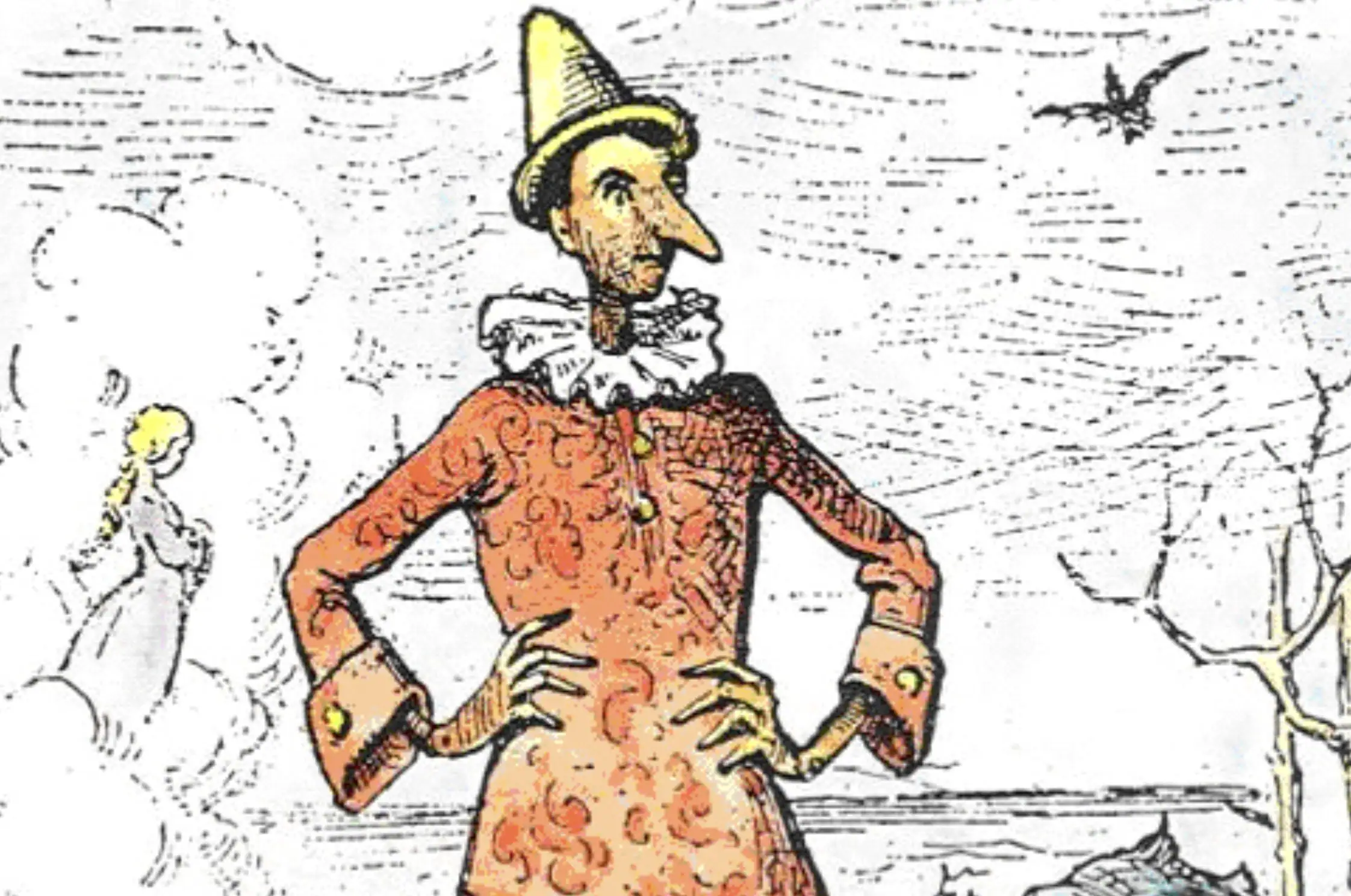
Two hundred years ago today, Carlo Collodi was born, journalist and protagonist of the Italian Risorgimento, known above all for being the author of the “adventures of Pinocchio”, the puppet who comes to life: a founding work of children’s literature, with a dark and gothic tone, much more severe than the film adaptations.
November 24, 1826, exactly two hundred years ago today, the writer Carlo Collodi was bornliterary pseudonym of Carlo Lorenzini.
The Italian journalist, as well as a protagonist of the Italian Risorgimento, is best known for having been thereauthor of “The Adventures of Pinocchio”, the famous story of the puppet who comes to life and who through a thousand vicissitudes becomes a real child: a foundational work in children’s literature, which however retains a dark and gothic tone in the original, much more severe (and dramatic) than the adaptations for cinema and television.
Who was Carlo Collodi, Pinocchio’s father
Born Carlo Lorenzini in Florence on 24 November 1826, Collodi was the son of Domenico Lorenzini, cook to the Ginori counts, and Angiolina (Maria Angela) Orzali, eldest daughter of the Garzoni counts’ factor. Carlo spent his childhood with his mother’s family who lived in the medieval village of Collodia fraction of the municipality of Pescia, in the province of Pistoia (in Tuscany). He attended religious schools in Colle Val d’Elsa, where he was in the seminary from 12 to 16 years old, and in Florence, with the Piarists, that is, the poor regular clerics of the Mother of God of the pious schools.
His career as a professional writing author began very earlyat just 20 years old, as editor of the annotated catalogs of a prestigious Florentine bookshop. In 1847 he began publishing in the specialized periodical “L’Italia Musicale”, among the most important of the time. As a journalist, he founded and directed numerous newspapers, including “Il Lampione”, which was closed by censorship after the revolutionary uprisings of 1848, and which Collodi reopened in 1859, after the fall of the Grand Duchy of Tuscany. On these pages he wrote his humorous articles and published incisive political cartoons.
In 1856 he used the pseudonym Collodi for the first time, with which he signed all his children’s and school books. His first children’s book was published in 1876: Fairy Tales, translations of some French literary fairy tales by authors such as Charles Perrault, Madame Leprince de Beaumont, Madame D’Aulnoy. He signed a series of books for school use (1877-1890), in which he introduced the concepts and notions to be learned through the adventures of a character (such as Giannettino and Minuzzolo): these volumes were highly appreciated and widespread in the very young Italian compulsory schools.
Collodi stood out as Risorgimento intellectual, working hard for the unification of Italy (also as a volunteer soldier, in 1848 and 1859), and throughout his life he maintained a close correspondence with colleagues and friends, reported in the biography written by his nephew Paolo Lorenzini.
Death suddenly reached him in Florence, where he lived with his brother Paolo, in 1890: he is buried in the family tomb at the monumental Florentine cemetery of San Miniato al Monte. The papers he kept in his study at the time of his death, after having been selected by his brother and friend Giuseppe Rigutini (author of the commemorative plaque on his house in Collodi), were donated to the National Central Library of Florence, where they still remain.
The Adventures of Pinocchio, his masterpiece
His masterpiece, “The Adventures of Pinocchio“, is a work of maturity: he wrote it in installments between 1881 and 1883, when he was now famous as a journalist and writer. The first episode of “Story of a puppet” was published in 1881 in the “Giornale per i bambini” (created as an insert for the “Fanfulla della Domenica” and immediately became an independent newspaper), one of the first children’s periodicals in Italy. Also in the Giornale, Collodi saw his other short stories published, including “Pee, or the rose-colored monkey”a sort of self-deprecating continuation of Pinocchio (a book that Giunti brings back to the shelves for the 200th anniversary of the author’s birth).
In this first version, the story, titled “Story of a puppet”was released in eight illustrated installments between July and October 1881 and ended with the death of the protagonist. Following protests from readers, Collodi resumed the narrative in 1882, bringing the puppet back to life and changing the title to “The Adventures of Pinocchio”: with this name the first volume edition was printed in 1883, in 36 chapters.
The story, a Bildungsromanwould become one of the great classics of literature, with translations all over the world and the cementing, in the collective imagination, of images like the puppet’s nose getting longer when he tells a lie.
The plot begins when the carpenter Master Ciliegia finds a piece of wood that turns out to be animated: he gives it to the elderly craftsman Geppetto, who decides to build a puppet with it and call him Pinocchio. This wooden child is very rebellious: instead of going to school he continually lets himself be tempted by shortcuts, promises of wealth and bad company. So he meets the Cat and the Fox and the Fire Eater, experiencing a long series of adventures that lead him to confront a very harsh reality: he experiences poverty, he is scared and deceived, and he experiences guilt, learning the values of responsibility and family. This is how Pinocchio manages to transform into a real boy.
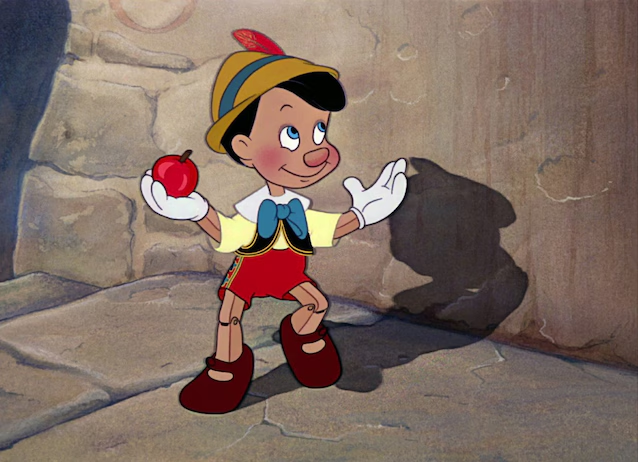
Disney adaptations of Benigni and del Toro
The most famous film adaptation is the animated film “Pinocchio” produced by Walt Disney in 1940. In Italy, one of the most loved versions is the miniseries “The Adventures of Pinocchio” directed by Luigi Comencini in 1972 with Andrea Balestri in the title role and Nino Manfredi in the role of Geppetto.
There have been many other adaptations: there is the one directed by and starring Roberto Benigni in 2002, the one directed by Matthew Garronemore nineteenth-century, of 2019, and the one directed by Guillermo of Bullmade in stop-motion in 2022 with a new setting in fascist Italy (winner of the Academy Award for Best Animated Film).
Book and film and cartoons: the differences
As we were saying, the cut of the book is much more gothic than the subsequent adaptations for the big and small screen. The most obvious example of this distance is that, in the book, one of the vicissitudes that little Pinocchio goes through is that ends up hanged by the Cat and the Fox. This would also have been its ending, if Collodi had not decided to resume the story, making the “almost hanging” an intermediate chapter, inserting the new happy ending: the transformation of Pinocchio into a child with the help of the Fairy.
What saves him from hanging is the Blue Fairy, who in reality is initially presented as “a little girl with blue hair”: this character with great strength (and great severity) would be inspired by the socialist activist Anna Kuliscioff. Collodi had met her at her trial in Florence in 1879 and was enchanted by her intelligence and moral strength, so much so that she inspired one of the key figures in her history.
Even the fate of Talking cricketrecall of Pinocchio’s conscience, is very different: it is the same puppet a crush it with a hammerleaving him “stoned”, very early in the story (he will appear in the story in the form of a “shadow”).
Sources
R. Bertacchini, Pinocchio’s father, Milan, Camunia, 1993
Carlo Collodi, Works, edited by Daniela Marcheschi. Milan, Mondadori 1995
Collodi Foundation