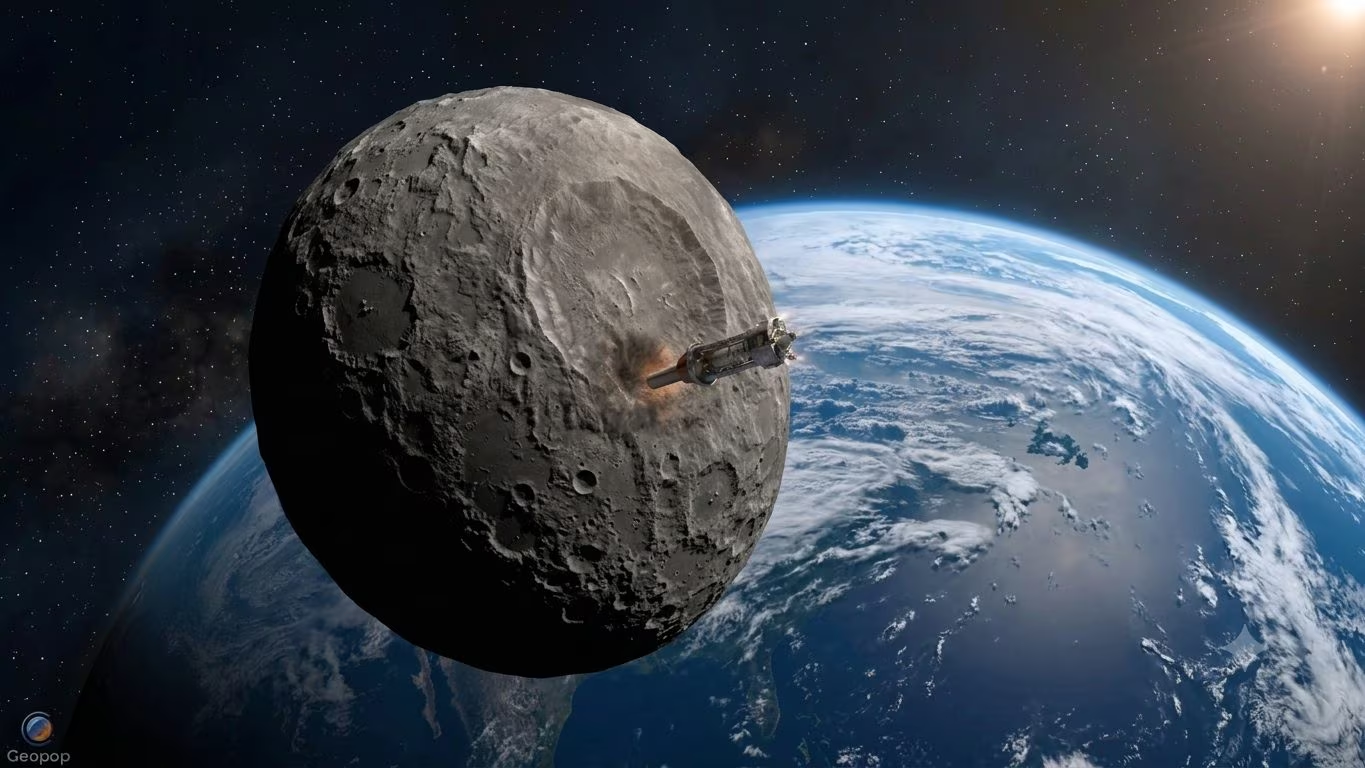
In a recent study carried out by researchers from the China Academy of Launch Vehicle Technology of Beijing the proposed solution is to use a device nuclearcausing it to detonate beneath the surface of the asteroid. Such an explosion could represent one of the few options capable of producing enough energy to quickly change the trajectory of an asteroid in potential collision with Earth.
The goal of planetary defense is to identify potentially dangerous asteroids in time and, if necessary, find a way to change its trajectory before it’s too late. On the other hand there is no single technique valid for every asteroid. For example, in September 2022, a probe of about 600 kg was projected into Dimorphos, a small asteroid orbiting the larger Didymos, changing its orbital period. There DART mission (Double Asteroid Redirection Test) from NASA demonstrated for the first time that humanity is capable of experimentally changing the trajectory of a celestial body through kinetic impact.
However, the mass of the object, its composition, speed, direction of arrival and especially the time you have available they can completely change the problem. If an asteroid is discovered many years before the possible impact, a very small thrust can be applied and wait for the effects of the change in trajectory to accumulate, as in the case of DART, to solve the problem of a possible impact with the Earth. If, however, the alarm arrives when there are a few months or even weeks to go, it becomes necessary to transfer a much larger amount of energy to the asteroid.
The plan of the Chinese planetary defense mission
On Earth, the enormous destructive power of an atomic warhead is given largely by the shock wave generated by the air that is compressed and overheated. In space, however, there is no atmosphere and the explosion of a nuclear bomb on the surface of an asteroid would not produce any atmospheric shock waves and much of the energy generated (in the form of radiation such as X-rays and heat) would simply be lost in the cosmic vacuum. To transfer the maximum amount of kinetic energy to the asteroid’s rock and be able to modify its orbital trajectory, the explosion must occur inside the asteroidso that the rock cavity allows the kinetic and thermal potential of the explosion to be absorbed.
The strategy proposed by the Chinese research group consists of two phases and involves two spacecraft. The first should reach the asteroid and hit it at high speed with a metal penetrator, creating a cavity in the surface. The second vehicle would arrive later carrying the nuclear devicee, which would be placed inside the cavity prior to detonation.
In the models used by the researchers, the asteroid is represented through a material with mechanical properties similar to those of high-strength concrete. This is an important simplification, because a real asteroid might have a completely different structurefor example being very porous or even an aggregate of fragments held together mainly by gravity.
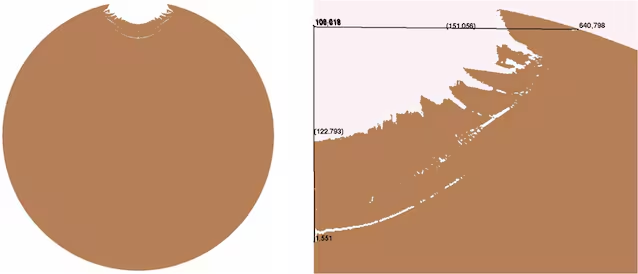
Computer simulations conducted by the research team revealed that to maximize the effectiveness of the energy transferthe nuclear device should be buried at approx 30 meters deep below the surface of the target. This specific thickness of rock is sufficient to contain the very first critical moments of the detonation, sealing the explosion just enough before the pressure destroys the crater cavities. Detonating the bomb at a depth of 30 meters allows, according to the results, to triple the variation in speed of the asteroid compared to an explosion that occurred at surface level. This change in velocity is what allows the trajectory of the orbit to be changed, e.g the greater the variation produced the more feasible a last minute intervention becomes before a potential one Asteroid on collision course hits Earth.
200 times Hiroshima to reach 3000 kilotons: the variables
An asteroid of approx 50 meters in diameter can be completely disintegrated by a detonation from 300 kilotons. For comparison, the atomic bomb dropped on Hiroshima on August 6, 1945 it generated an estimated horsepower of approx 15 kilotons of TNT (TNT, or TNT, is used as the reference unit for these energy scales). For an asteroid of 100 metershowever, the explosion itself does not necessarily lead to complete destruction, but can produce a slight variation in speed. Increasing power a 3000 kilotonsthe model instead predicts the complete disintegration of the body.
When we move to a kilometer-scale asteroid the situation changes radically. With a 3000 kiloton detonation (approximately the energy released by the currently operational hydrogen bombs in the arsenals of the main nuclear powers) the speed variation is a few centimeters per second. But in the context of orbital mechanics even a velocity variation of a few centimeters per second can become significant if applied sufficiently in advance of the encounter with Earth. On the contrary, if the intervention occurs too latenot even a much larger velocity change would be enough to move the asteroid off the impact trajectory.
As the diameter of the body increases, its mass grows approximately as the cube of the radius. Doubling the diameter means, for the same density, multiplying by approximately eight is the mass to be modified. For this reason a solution that can destroy an asteroid of a few dozen meters becomes progressively less effective when you move on to hundreds of meters or kilometers.
It is necessary to discover asteroids as soon as possible
THE’asteroid 2019 OK was discovered on July 24, 2019, just twenty-four hours before closest approach to Earth on July 25, 2019. Estimates indicate a diameter of approximately 57 and 130 meters.
The most significant data is the distance as rose to around 70,000–72,000 km from the earth’s surfacethat is, less than a fifth of the average Earth-Moon distance (the Moon is on average about 384,000 km). The asteroid came from a region of the sky close to the direction of the Sun, making it very difficult to spot with ground-based telescopes observing the night sky.
However, it was not a small object that went unnoticed until it arrived near Earth. With a diameter in the order of 100 meters, 2019 OK had dimensions comparable to those of a skyscraper, very easily identifiable by planetary defense telescopes. For planetary defense the international reference threshold is approximately 140 meters in diameter. NASA has as its goal find and catalog at least the 90% of NEOs (from English Near Earth Objectsi.e. asteroids and comets whose orbit brings them close to the Earth) of this size or larger. They are objects large enough to cause very significant regional damage in the event of an impact. For asteroids with diameters greater than 1 km instead over 90% have already been discovered. While in the range between 50 and 140 meters many are still to be discovered and some may be identified only shortly before the passage.
Because of this a nuclear bomb used in a mission like the one conceived by the Chinese researchers’ study it would above all represent a sort of last resort for planetary defense to be taken into consideration in cases where conventional techniques are not sufficient. The best solution it still remains that of discover dangerous asteroids as soon as possiblewhen even a tiny change in their speed can be enough to completely change their future.
