
Every time we look at the sky, the clouds appear soft and light, almost like cotton balls that “float” in the air, but the reality of the facts is very different: the clouds are not light at all and can become heavy hundreds of tons.
But how is this possible? If we think about it for a moment, the reason is quite simple: a cloud is nothing more than a agglomeration of very small particles of waterfall in the liquid state or as small ice crystals (if the temperature is sufficiently low), or both. This is why a heap – the classic “cotton ball” cloud that can be seen during sunny days – can weigh quite a bit 500 tons (i.e. 500,000 kg), approximately the equivalent of an airplane Fully loaded Boeing 747 at takeoff.
But how do you calculate the weight of clouds? First, we must first know their density: the researchers of the National Center for Atmospheric Research in Colorado (USA) they calculated that, on average, the density of the mounds is approximately 0.5 grams of water per cubic meter. At this point we will have to multiply the density by the volume.
To simplify the calculations, the researchers ideally approximated a mound to a cube, with a side of 1 km. Its volume will therefore be 1 km3which corresponds to 1 billion cubic meters.
From here just do the calculations: 1,000,000,000 m3 x 0.5 g/m3 = 500,000,000 grams = 500 tons
Clearly, the weight of clouds depends on their shape and size: cumulonimbus clouds, for example, will tend to be much denser and heavier, being thunderclouds.
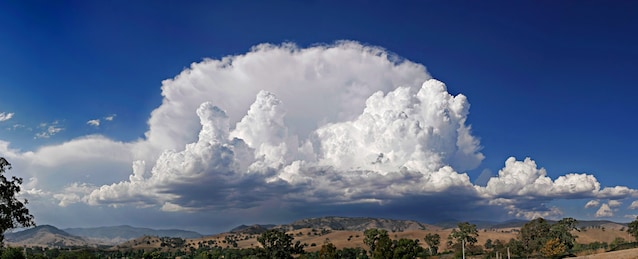
At this point, however, it comes naturally to ask: why, despite being so heavy, don’t they fall? This essentially depends on three reasons. First of all the density: water, in fact, is denser than air: 1 m3 of water weighs almost 1000 times more than 1 m3 of air. However, humid air is less dense than dry air. In short, clouds tend to stay at altitude because the moist, warm air that forms them is less dense than the drier air below.
The second reason has to do with the updraftsi.e. the movements of the air from bottom to top – fundamental for the formation of clouds themselves – while lastly the balance between the forces acting on the individual particles of water or ice must be taken into consideration, i.e. the gravity forcewhich would lead them to move towards the ground, and the air resistance force, which instead opposes the previous one, preventing them from falling.
