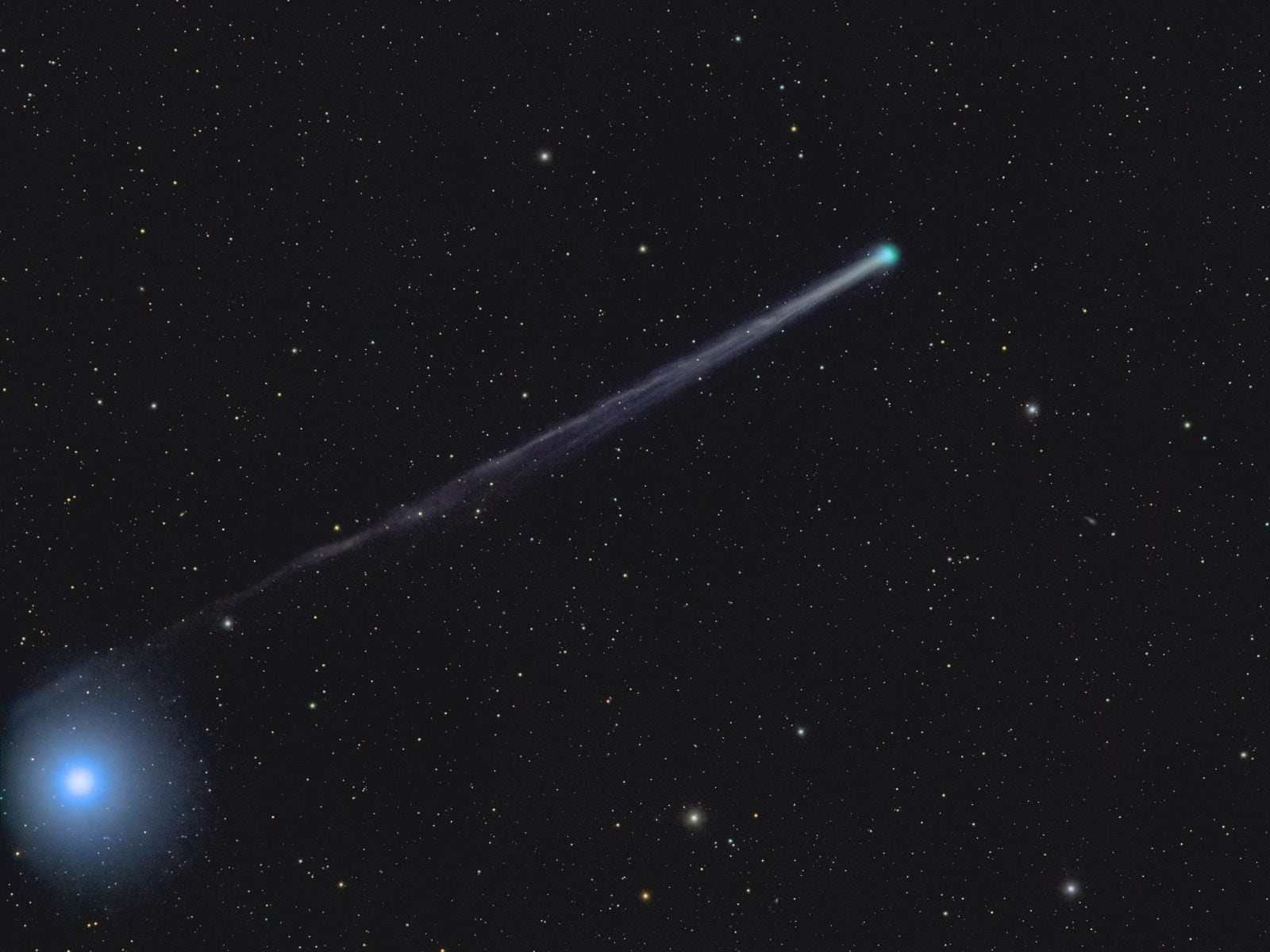
In the September sky there is a new and unexpected protagonist: it is the comet Swan 25bidentified thanks to the SWAN tool of the Soho telescope and now officially renamed C/2025 R2 (SWAN). Having just been discovered (last September 12), the information on its orbit is still scarce, but according to the estimates of the international astronomical union, the comet will reach the minimum distance from the earth between 12 and 19 October: currently it is in the Constellation of the Virgin And it is still very close to the sun of the sun at sunset, which makes observation from Italy extremely difficult.
It is a non -periodic cometsince it performs a complete tour around the sun every 22,554 years. According to the calculations of the experts, it will not reach a brightness that can be observed with the naked eye: they will serve stable binoculars or telescopes, as long as the sky is still without light pollution.
The characteristics of comet c/2025 R2 (Swan)
Discovered on September 12, 2025 by the Ukrainian astronomer Vladimir bezugly Thanks to the Swan (Solar Wind Anisotropies) tool of the space telescope Solar and Heliospheric Observatory (Soho) of the Europe Agency Europe, C/2025 R2 is a comet with a period of about 22,554 years.
Until now, C/2025 R2 had not been spotted because along our line of view he was behind the sunwhich therefore hid it with its glow: now the comet (which at the time of the discovery had magnitude 7, therefore invisible to the naked eye) is increasing its angular distance from the sun and is approaching our planet, which will favor the observations in the coming weeks. According to reports from the international astronomical union, the comet will arrive between 12 and 19 October 2025 at a minimum distance from the land of about 39 million km (about a quarter of the land-sell distance) and will shine with a magnitude 5.8.
Thanks to the first published images, scholars identified one tail that extends in the sky of 2.5 °which is equivalent to five times the apparent diameter of the full moon.
When we could see comet c/2025 R2 in Italy
Comet c/2025 R2 is currently located in the Constellation of the Virgin: being still very close to the sunset of the sun, for the moment the observations are difficult. Between 12 and 19 October, however, the spatial object could be more visible: in its point as a maximum approach to Earth C/2025 R2 will be sufficiently far from the sun on the evening horizon that it is not covered by its light.
According to the IAU estimates, the magnitude of the comet should be 5.8practically to the limit of visibility to a naked eye in a perfectly dark sky. Precisely for this reason, C/2025 R2 could only be observed with the help of a stable binoculars or a telescope. Below one of the first images published after its discovery.
As with all comets, the behavior of the hair and the tail could still change: its hair, in fact, could become more extensive, but the problem remains the superficial brightnessgiven that a larger hair dilutes the brightness on a greater area, making observation more difficult to naked eye.
Because comet C/2025 R2 (Swan) has been called that
The task of assigning the names to the comets is entrusted to the international astronomical union: the abbreviation with which a space object is identified, however, is never accidental. In particular, in the case of comets a provisional name is first assigned (often linked to the telescope with which they were discovered), and then identify them with one definitive acronym Composed of a letter (p o c), from the year, by a letter from the alphabet and a number.
In the specific case of comet C/2025 R2letter C indicates that it is a non -periodic comet (i.e. with a highly eccentric orbit and an orbital period of at least 1000 years) or with a period over 200 years; 2025 refers to the year in which it was discovered, while the R indicates the period of the year in which it was sighted for the first time and which, precisely, corresponds to the first half of September. The final number, on the other hand, refers to the order of discovery of the discovery within that period.
