In the last few hours, while we are already talking about canceled flights, Of increase in fuel prices and consequently of air flights, the news regarding the Spanish low-cost airline Volotea has circulated widely, which asked passengers, a few days before departure, an addition to the ticket already purchased (between 7 and 9 euros), due to the expensive fuel resulting from the instability of the energy markets and the war in the Middle East between the USA, Israel and Iran. An integration that the company declares in its “Fair travel promise”, which it is applying to all bookings made from March 16th, “until further notice”. Is this something legitimate? And could other companies do it too?
Expensive fuel: flight ticket surcharges and surcharges
Between supplements and surcharges that airlines can apply, which must always be declared explicitly and transparently on booking platforms, there are usually those relating to luggage (large hand baggage to be placed in the overhead compartment, hold baggage, additional baggage, oversize or overweight during boarding, the supplement for declaration of “special interest” and the supplementary baggage insurance fee). Then there are the supplements linked to services (such as seat selection, priority boarding, check-in at the airport) and booking fees; finally, insurance surcharges, such as supplementary travel policies. These are optional services – compared to the airport charges (embarkation, disembarkation, security, fire taxes) and the municipal surcharge on Italian airports – which the passenger can select when purchasing the ticket.
Then there are surcharges such as “fuel surcharge” (fixed fuel surcharge) and the “fuel adjustment factor” (fuel adjustment factor), which is periodically recalculated on a market basis, which we are perhaps less familiar with, but which we should start paying more attention to during the booking phase. The first is a predetermined and fixed surcharge that the company adds to the price of the ticket at the time of purchase. The passenger immediately sees it in the cost detail, pays it immediately and therefore finds it incorporated into the final price. It is the model that Volotea explicitly states not to use: “Unlike many airlines, we do not include fixed fuel costs in the ticket price under any circumstances.”
Instead, the company adopts a fuel adjustment mechanism dynamic, indexed to an objective and public market parameter, which applies in a time window following the purchase and which can move in both directions: both increasing and decreasing. This is a widespread adaptation in freight transport (maritime and air cargo), where it is also called BAF (Bunker Adjustment Factor) o YQ/YR in the IATA tariff systems for cargo. In this case, however, contrary to what is normally done, FAFs are applied at the time of bookingdefinitively, the Volotea mechanism instead applies the logic of the FAF after the transport contract has already been concluded with the payment of the ticket.
The “fair travel promise”
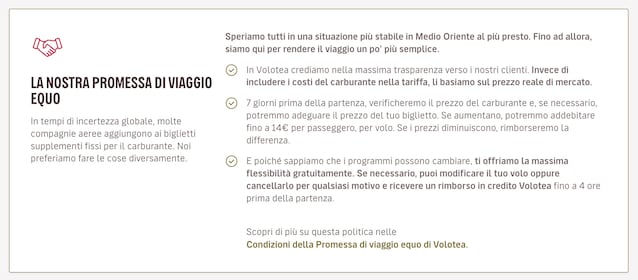
In this case, Volotea has activated a company policy, that of “Fair travel promise”“Fair Travel Promise,” applicable “to all bookings made from March 16 until further notice.” In this case, as reported on the company’s contractual conditions page, the cost of fuel was not fully included in the initial ticket price: the company reserves the right to make a subsequent adjustment due to market developments.
“In the event of exceptional events that significantly affect fuel prices, such as the current situation in the Middle East,” it is also specified on the company’s website, “we may apply limited and proportionate adjustments to ticket prices to reflect changes in fuel costs.” The price of fuel is checked 7 days before departure. If it has increased, an adjustment is made according to a table on the site. In case of decrease, the company instead undertakes to refund the difference.
What does the European directive provide and what are the consumer protections?
Is it legit? The price variability clause is contained in the general conditions of transport which the user is obliged to accept when finalizing the purchase of a ticket. However, all of us may have failed to read them before proceeding to the final purchasing phase. What does European legislation say? The reference text is Regulation (EC) 1008/2008which regulates price transparency in intra-community air transport, and in particular the art. 23.
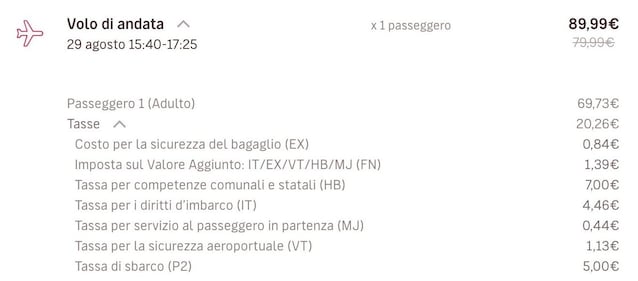
As he explained to us Mark De Laurentiis, Director of the Passenger Rights Protection Directorate of ENAC (National Civil Aviation Authority)the art. 23 establishes the obligation on airlines to “make all the components of the airline ticket transparent, therefore tariffs, taxes, any surcharges, including the fuel surcharge and the fuel tax. When a passenger purchases the airline ticket he should be able to view all the components of the final price of the airline ticket, technically called breakdown of the price”.
According to this principle of transparencythe final price of the airline ticket should be published including all taxes, airport charges and unavoidable and foreseeable surcharges at the time of booking and before the final purchase. These pricing elements should be provided in a broken down and detailed manner, as in the image below.
This principle has also been reiterated by the jurisprudence of Court of Justice of the European Unionwho has repeatedly clarified that supplements must be transparent and non-misleadingso as to give the passenger the possibility to accept the service or not.
Having clarified this, continues De Laurentiis, what is stipulated with the companies and providers every time we purchase a ticket for a flight or a train, is always and in any case a contracteven if the amounts are smaller than more expensive purchases. “The first thing you need to do is always to carefully read all the contractual clauses. Because when you buy a ticket, even though it is now a fairly routine operation, a synallagmatic relationship is established (editor’s note: a link of reciprocity and interdependence) between the buyer and the service provider, in this case the airline”. In short, the contract contains not only the obligations of those who provide the services, but also of those who purchase them, and it is therefore advisable to read carefully.
Should we expect other companies to adopt the same policy? “It’s possible,” says De Laurentiis. “Beyond some fixed components, they have the right to set the part of free fares proposed for individual trips, as provided for by the legislation”, and there are no ceilings, because, without prejudice to the passenger’s guarantees, they are all free activities of a commercial nature.
Can we be refunded?
Is it therefore permissible for airlines to apply the FAF logic to a ticket that has already been sold? It is so when the clause has been inserted in a clear and transparent way in the transport contract accepted at the time of purchase. Following numerous reports from passengers, Codacons has nevertheless announced a complaint to the Antitrust, to verify the effective transparency of communications, and that the adjustment also occurs with a refund of part of the ticket price in case prices drop, as stated in the “promise”.
Is there a right to a refund? Not alwaysit all depends on the contractual conditions. If the company has activated a flexible option, as Volotea does, which includes it in its Fair Travel Promise, the passenger who does not want to pay the adjustment can choose to cancel up to four hours before the flight and obtain a travel credit. Otherwise, with non-refundable basic low-cost fares, the passenger who refuses to pay the supplement risks losing the ticket.
However, if the clause has not been communicated in a transparent manner or has a disproportionate impact on the price, the passenger can contest it by contacting ENAC, the AGCM or consumer associations, based on consumer protection legislation (Legislative Decree 206/2005), and request a refund of the amount paid. The scenario in which the company cancels the flight is different: in that case EC Regulation 261/2004 applies, which guarantees the passenger the right to a full refund or an alternative flight, and in certain cases also to financial compensation.
