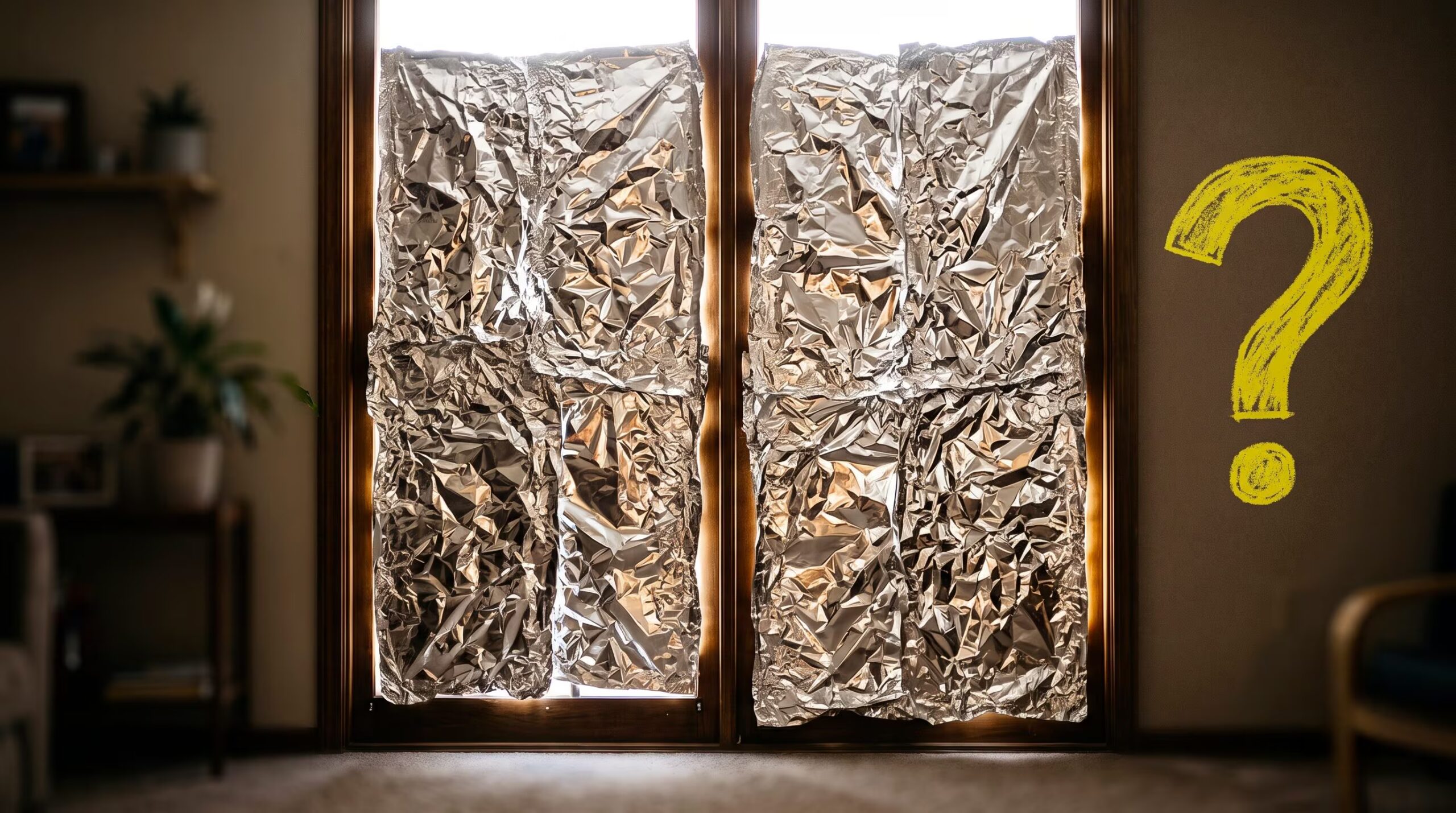
While Western Europe is in the midst of a wave of heatwith temperatures around 10/12 °C above average and peaks beyond 40°C“do it yourself” remedies against the heat are very popular on social media, especially for homes without air conditioning. In France, for example, videos of shops, apartments and entire buildings with windows covered in tinfoil are becoming increasingly viral, with the aim of “shielding” the sun’s rays and lowering the internal temperature.
But does it really work? Let’s start by saying that, actually, aluminum is a highly reflective material.
As reported in several scientific studies, it solar spectrum is composed of approximately the 3-5% UV raysfrom the 42-43% visible light and from 52-55% infrared light close.
A shiny aluminum foil behaves like a real one mirror for most of the solar spectrum, reflecting up to 90% of the incident radiation: in this way the sunlight passes through the glass, hits the aluminum foil and is largely sent back outwards, thus reducing the amount of energy that remains trapped in the room in the form of heat.
This is why ENEA itself (the National Agency for new technologies, energy and sustainable development) indicates that among the most economical interventions for the energy requalification of existing buildings is the use of «low films emissions which allow to reduce part of the heat dispersion towards the outside or reflective solar films which limit the entry of solar radiation”, which in summer allow the use of the air conditioner to be reduced.
The problem, however, is that i aluminum foil they are not from the certified solar films: Aluminum foil is a completely different product and lacks, for example, a protective substrate against tears, oxidation and moisture.
In short, homemade aluminum foil may also be able to temporarily shield the sun’s rays, but they are not meant to stick to glass of a window nor to last over time.
Among other things, this trick hides a potential harm, namely the risk of breakage due to thermal stress of double glazing: when the aluminum is applied in contact with the internal glass plate, the solar radiation passes through it a first time and then, bouncing off the reflective aluminum, passes through it a second time towards the outside. This means that the internal glass finds itself absorbing solar energy twice (once on the way out and once on the way back), leading its center to overheat rapidly, up to 60-80°C.
On the contrary, the edges of the same slab remain cooler, because they are protected by the shading of the frame. This temperature difference between the hot center, which expands, and the cold perimeter, which resists, generates such strong stress that it can cause cracks or even the breakage of the internal plate.
In short, theoretically the trick has a real scientific basis: Aluminum reflects almost all infrared and can lower the temperature by a few degrees. But using homemade aluminum foil is an extremely temporary solution, which does not replace professional films or external screening and which, above all, could cause damage to the glass.
To this must then be added one consideration from an energy point of view: if we were to shield the windows with tinfoil, the rooms would inevitably become darker, leading us to consume more electricity for lighting and therefore eliminating any energy savings due to the reduced consumption of air conditioning.
