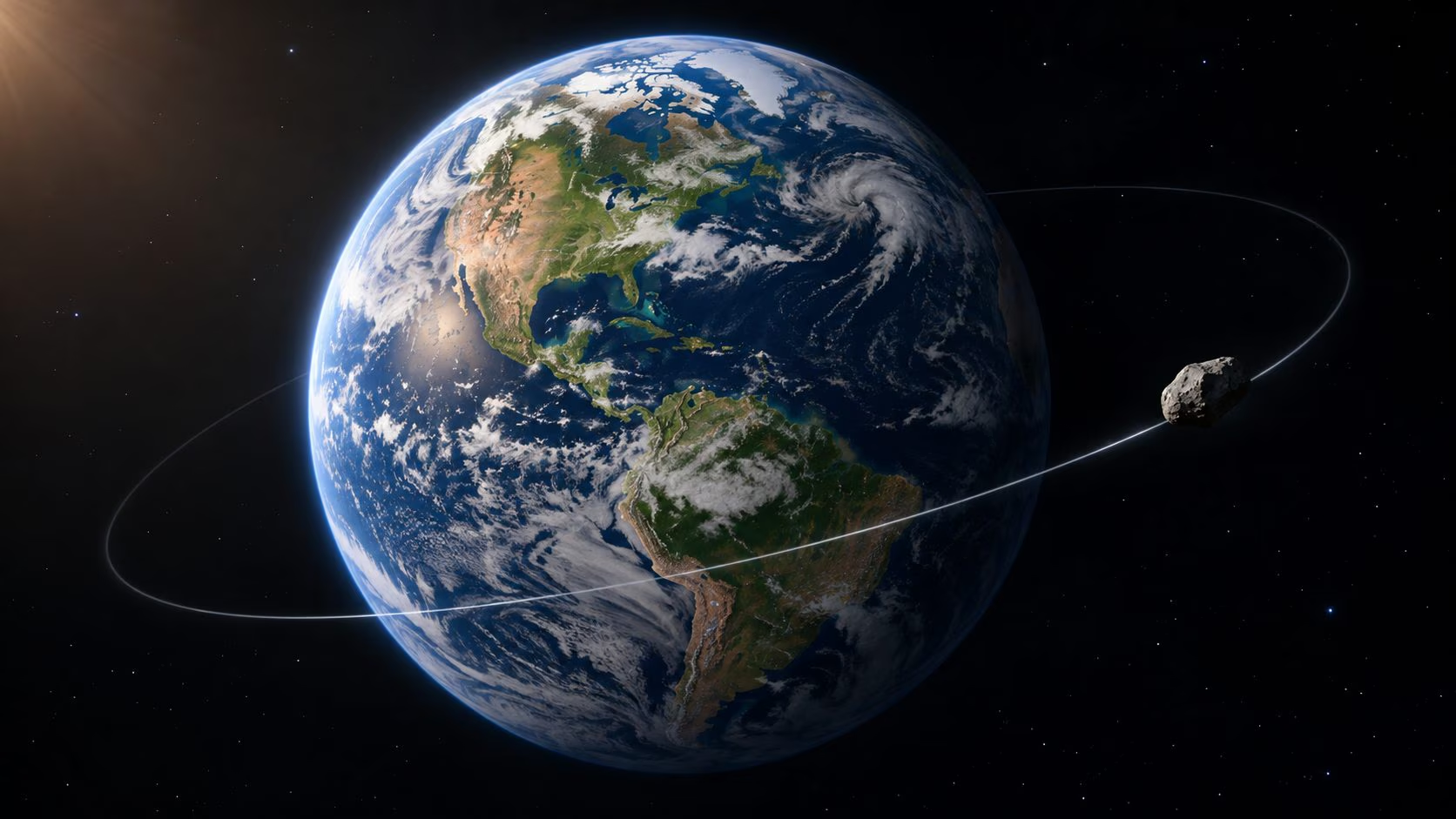
Earth has gravitationally captured a new mini-moon, asteroid 2026 QQ8, just 1.4-3 meters in size. Initially considered an old rocket stage, it will remain temporarily tethered to Earth’s gravity until after Christmas 2026, before returning to orbit the Sun in 2027.
There Earth has a new mini-moona tiny asteroid called 2026 QQ8 which it was temporarily captured by the gravity of our planet. The object, with an estimated diameter of just 1-3 meterswas captured towards the end of April 2026 and will remain around the Earth until the end of the year, therefore spending the Christmas 2026before returning to independently orbit the Sun in early 2027.
The asteroid was only discovered in August by the Hungarian astronomer Krisztián Sárneczkywhile its nature as a temporary satellite of the Earth was officially communicated by the Minor Planet Center of the International Astronomical Union on 29 October.
Despite being called a second Moon, 2026 QQ8 naturally has nothing to do with our natural satellite. In addition to being tiny, it follows a very irregular trajectory around the Earth and will remain tied to its gravity only for a few months. During this visit it passed by approx 537,000 km from our planet, just over one and a half times the average distance of the Moon, without any risk of collision. The object it won’t be Furthermore visible to the naked eye and professional telescopes will be needed to observe it.
How asteroid 2026 QQ8 was discovered and where it is located
The discovery of 2026 QQ8 occurred during the night between 19 and 20 August 2026 thanks to the astronomer Krisztián Sárneczkywho identified the object by analyzing the images collected byPiszkéstető Observatoryin Hungary, under the GINOP-KHK programme. The search for near-Earth asteroids is conducted using a 60-centimeter Schmidt telescopedesigned to photograph large regions of the sky and detect small objects that move relative to the background of fixed stars.
It was initially unclear whether 2026 QQ8 was a natural asteroid or a piece of space junk, like an old rocket stage, as seen in the video below.
To clarify this, further observations were made using the 2.2-meter telescope at the University of Hawaii and the Lowell Discovery Telescope in Arizona. The measurements made it possible to reconstruct the object’s orbit with greater precision and to identify it as a body of natural origin, probably a small asteroid.
Its size was not measured directly, but estimated from brightness. According to data from the European Space Agency, 2026 QQ8 has one absolute magnitude of approx 31.5 (defined as the brightness of an object located 1 astronomical unit away), compatible with a diameter of 1.4-3 meters depending on the surface’s ability to reflect sunlight. To give an idea of how dim the object is, its absolute magnitude implies an intrinsic brightness a thousand billion times lower than that of the Moon.
According to the ephemeris of the Minor Planet Center, al November 9, 2026 the asteroid is apparently located in the Hydra constellationapproximately 1.8 million km from Earthwith an apparent magnitude around 25.3. Given its low brightness, it will not be possible to locate it with the naked eye, nor even using binoculars or an amateur telescope, therefore remaining the prerogative of large professional telescopes.
Why it became a mini-moon and how long it will remain in orbit around Earth
2026 QQ8 belongs to the population of near-Earth asteroidsthe so-called Near-Earth Objects (NEO). Normally these objects orbit around the Sun, but when they cross the vicinity of our planet they can be temporarily captured by its gravity, becoming mini-moons.
An important concept for understanding this phenomenon of temporary capture is that of Hill spherei.e. the region around a planet within which its gravitational attraction can prevail, in the local dynamics of small bodies, over the influence of the Sun. In the case of the Earth this region extends approximately up to 1.5 million kmalmost four times the distance of the Moon.
However, it is not enough to enter Hill’s sphere to automatically become a satellite. The asteroid must also have a sufficiently favorable speed and trajectory to remain temporarily tied to the Earth rather than simply passing by it. And that’s exactly what happened to 2026 QQ8 in late April, when the object entered the region dominated by Earth’s gravity and began following a temporary capture trajectory.
Orbital reconstructions show that the asteroid passes relatively close to Earth at intervals of about ten years, but not all encounters result in captures. The first data available on the ESA portal concerns the 1965when the asteroid passed by approx 1.8 million km from our planet, therefore outside its Hill sphere, without becoming a satellite, while the closest approach instead occurred on August 18th about 537,000 km from our planet.
The current visit will last approximately eight-nine monthsfrom the spring of 2026 until the end of the year or the beginning of 2027. The next relatively close passage will occur on December 13, 2026when the asteroid will transit at approximately 1.35 million km from Earthbefore continuing along its trajectory and progressively moving away from our planet.
It is not the first time that Earth has captured an object of this type. The most recent example is that of 2024 PT5, which accompanied our planet for about two months in the autumn of 2024. The exact number of mini-moons present simultaneously around the Earth is unknown, because most of these objects are too small and faint to be detected. According to some models, there may be approx six mini-moons measuring more than one metre in temporary orbit around our planet at any given time, but this is a statistical prediction, not six objects actually observed.
But could we ever visit a mini-Moon? From a technological point of view, reaching a small asteroid with a robotic probe is possible and these objects could become interesting targets for studying material passing through Earth’s vicinity.
However, it would be very different to imagine a human moon landing. At just one to two meters in diameter, 2026 QQ8 would have extremely weak gravity and a surface too small for astronauts to walk on like on the Moon. A mission should rather involve a controlled approach, possibly with instruments to collect samples.
