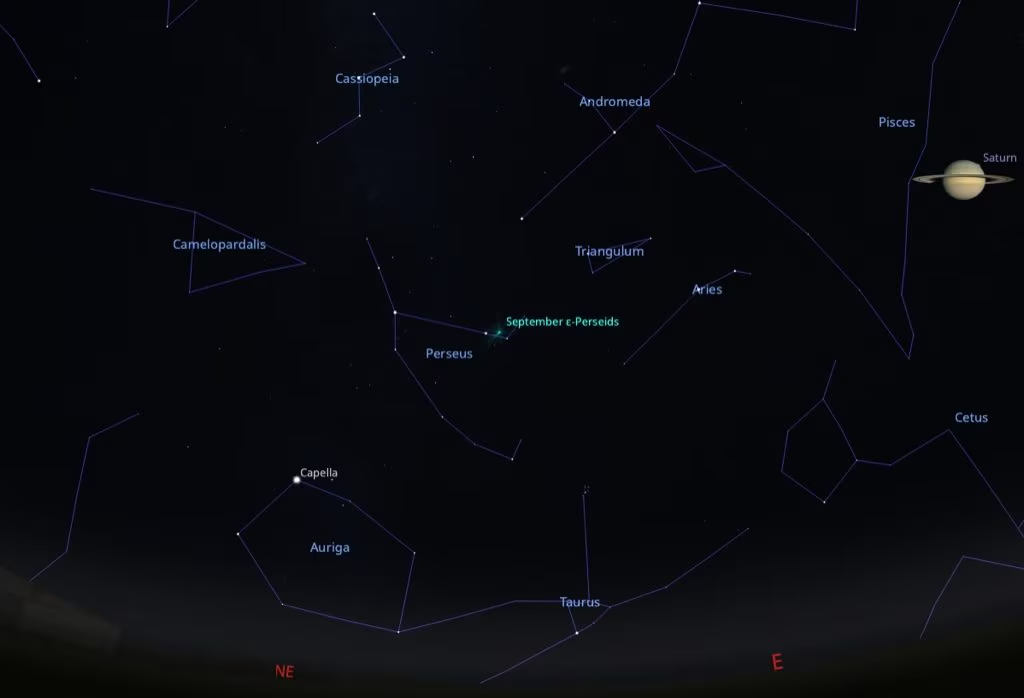
After the spectacle of the Perseids in August, the sky of September 2026 gives us two more meteor showers, much less intense than the more famous “Tears of San Lorenzo”, but favored this year by excellent lunar lighting conditions. The Epsilon Perseids of September they will reach the peak in the night between the 8th and the September 9, 2026while three days later, on the night between the 11th and September 12thit will be the turn of September lynxes.
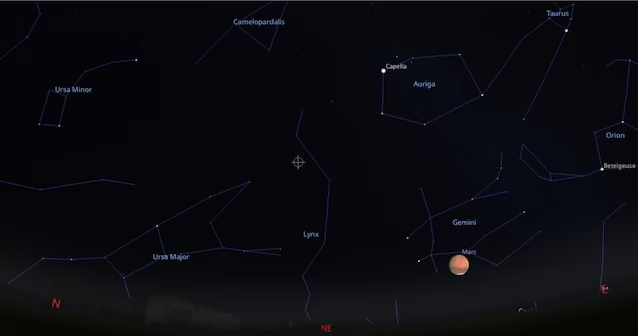
Both swarms will offer the better visibility conditions during the second part of the night: le Epsilon Perseids starting from midnight on September 9th and the Lincids starting from 2.30am on September 12thwhen both radians (apparent direction from which the meteors appear to come) will have exceeded i 30 degrees high on the east/northeast horizon, for the Perseids, and north/northeast, for the Lincidia.
The spectacle of the sky will be easily visible to the naked eye, with the foresight of going to one area with little light pollution. However, one should not expect a spectacle comparable to the Perseids in August.
According to theAmerican Meteor Societyboth belong to the class IIthat of minor meteor showers, normally characterized by a zenith hourly rate (ZHR) between 2 and 10 meteors. For the Epsilon Perseids and the Lincids the maximum expected value is approximately 5 meteors per hour under ideal conditions. The actually observable number will generally be lower, even from very dark skies, because the ZHR assumes a radiant exactly at the zenith and perfect visibility conditions.
What time to see the peak of the Epsilon Perseids on September 9, 2026
The Epsilon Perseids of September they are a meteor shower that has been active since 2 to 23 September which this year will reach its maximum peak of activity on the morning of September 9th. The radiant, i.e. the point of the celestial vault from which all the meteors in the shower appear to come from, due to a perspective effect, is found in the constellation of Perseus. THE’American Meteor Society estimates this year a maximum zenith hourly rate, or ZHR, of approximately 5 meteors per hour.
The meteors of this shower are particularly fast: the meteoroids enter the Earth’s atmosphere at approximately 64 km/sthat is, beyond 230,000 km/h. THE’American Meteor Society he describes them as rapid, but weak meteors, which are normally to be expected above all rapid and dim trailsnot a large amount of cars. In the past, however, the Epsilon Perseids have occasionally produced brief increases in activity also accompanied by very bright meteors, as occurred in the outbursts observed in 2008 and 2013.
The best time to observe them will be starting at midnight on September 9thwhen the radiant in the constellation of Perseus will have exceeded i 30 degrees on the east/northeast horizon. The meteors will be accompanied by the presence of Saturn high in the sky for the rest of the night. There visibility it will improve as the height of the radiant increases until it reaches the maximum in last hours before dawn, when the number of potentially observable meteors is also maximum. THE’American Meteor Society indicates around 05:00 the moment in which the radiant is in the most favorable position.
This swarm should not be confused with the much more famous ones Perseids of August. The two meteor showers are named after the same constellation because their radiants are both found in the Perseus regionbut they are completely distinct swarms. The Perseids of August I am generate from comet debris 109P/Swift Tuttle and normally reach a ZHR around 100, while the progenitor body of the Epsilon Perseids September is currently unknownwith astronomers hypothesizing an origin due to debris left by an unknown long-period comet, in retrograde orbit, with an orbital period of the order of a thousand years.
On September 12, 2026 it will be the turn of the Lincidia swarm
Only three days later it will be the turn of September lynxes, an active swarm from 4 to 19 Septemberwith the maximum expected for September 12th and a theoretical ZHR also equal to approximately 5 meteors per hour. Their radiant is located in the northern part of the constellation of Lynxat a declination of approximately +56°. From Italian latitudes the radiant is therefore circumpolarthat is, the region of sky from which the meteors appear to come never drops below the horizon in its apparent rotation around the north celestial pole. However, this does not mean that all hours are equally favorable. Also for the Lincidae the observable activity increases when the radiant rises more in the sky, with the better visibility window that will happen starting at 2:30 amwhen the radiant will have exceeded 30 degrees on the north/northeast horizon. The Lincids will also be “escorted” by a planet during the night, namely Mars, which will be located lower in the sky near the constellation Gemini.
The Lincidi are just slower than the Epsilon Perseidsbut these are still very rapid meteors: the speed of entry into the atmosphere is approximately 58.7 km/smore than 210,000 km/h. Even for this swarm, theAmerican Meteor Society it predicts weak meteors, so it is not a meteor shower particularly full of bright fireballs. The most common appearance will be that of rapid light trailsoften quite faint and therefore easily erased by light pollution. Also the progenitor body of the Lincidae he has not been identified with certainty. Meteor showers are normally produced by particles dispersed along the orbit of a comet or, in some cases, an asteroid, but for some smaller showers it is not yet possible to safely associate the meteoroid orbits with a specific known object. This is precisely the case with these weak September meteor sources.
The proximity to the new Moon phase will favor both swarms: how to see the show
The lunar conditions during the peaks of both swarms will be particularly favorable. The Moon new it will happen on September 11th at 5:27 am ETpractically halfway between the two maximums. During the peak of the Epsilon Perseids on September 9th we will therefore only have a very thin waning crescent Moon in the morning, while during that of the Lincids on the night between September 11th and 12th the Moon will have just emerged from the new phase and will not disturb the central and final hours of the night.
It is an important circumstance precisely because we are talking about very weak swarms. With a ZHR of just 5, even a Moderate moonlight could hide a considerable part of the meteors. In 2026 it will be above all light pollution to determine how many we will actually be able to see. To increase the possibilities of observation it will therefore be necessary to choose a place as dark as possibleaway from city lights, and give your eyes at least one twenty minutes to adapt to the darkness. There is no need for telescopes or binoculars, which would limit the field of view too much: to observe meteors it is preferable to simply use your eyes and have as large a portion of the celestial vault in front of you as possible.
It is also not necessary to fix the radiant directly. Meteors can appear in practically any area of the sky and those observed exactly close to the radiant tend to have very short trails for a perspective effect. For example, the American Meteor Society recommends observing an indicative region 30 degrees away from the radiantwhile still keeping it in the peripheral area of your field of vision.
The next big swarm will be the October Orionids
After the Epsilon Perseids and the Lincidi, we will have to wait until October for the next meteor shower class Ithat is, belonging to the category of large annual swarms: le Orionidsgenerated by the debris of the famous Halley’s comet. This year their peak is expected in the night between October 21st and 22ndwith approx 10-20 meteors per hour observable from dark skies and an entry speed of approximately 66 km/s. This year, however, a Moon that is approximately 80% illuminated will make conditions decidedly less favorable than the almost perfect ones that will accompany the September swarms.
