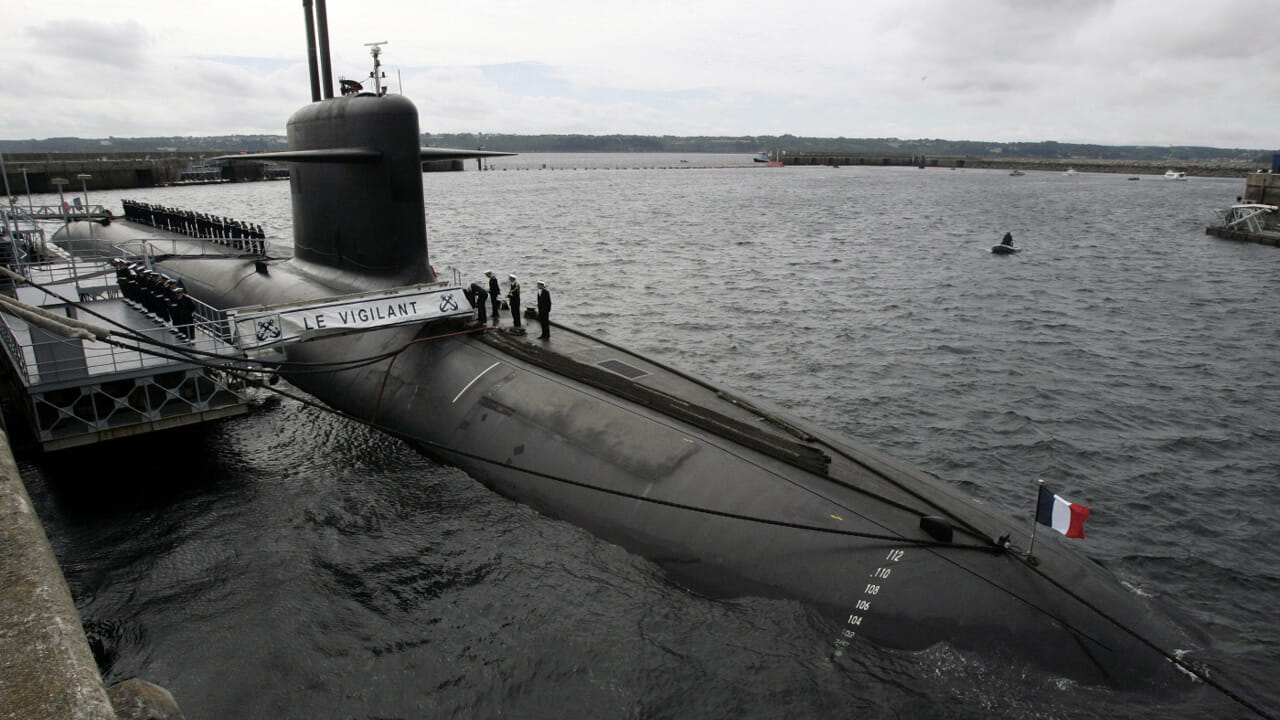
Five drones flew over the French submarine base of Ile Longue, in the Brest bay, in the far west of France, where the nuclear-powered ballistic missile submarines are located. The sighting was recorded on the evening of Thursday 4 December around 7.30pm. Overflight in this prohibited area by drones is not uncommon, and on the night between 17 and 18 November another one was reported “over the Crozon peninsula”, of which Ile Longue is part. The French navy opened fire on the unmanned aircraft, carrying out “several anti-drone fires”.
The base that hosts the heart of French strategic deterrence
The Ile Longue base is one of the most sensitive military sites in France: it hosts the SNLE, the nuclear submarines armed with M51 ballistic missiles, considered the pillar of French strategic deterrence. Due to its strategic and national security importance, the area is guarded by approximately 120 Navy gendarmes in coordination with a rifle battalion. There are four submarines at the base, one of which is always at sea to ensure the continuity of nuclear deterrence.
The intervention to shoot down drones: the precedents
Reports of drone overflights at airports and other sensitive sites, including military ones, have multiplied in Northern Europe in recent months, and the leaders of these countries see Moscow’s hand behind these actions. And it is certainly not the first time, since the increase in hybrid threats attributable to Russia, that national armies have struck drones that have entered European airspace. Last September, NATO, together with the Polish armed forces and some allied contingents, shot down several Russian drones that entered Polish airspace. According to authorities in Warsaw, on the night of September 9-10 between 19 and 23 unmanned aerial vehicles violated Polish airspace following a massive drone incursion into Ukraine. At least three or four of these were destroyed because they were considered “a direct threat”. The episode was described by Reuters as the first time since the start of the war in Ukraine that a NATO member country shot down Russian drones.
The issue of defense from low-altitude airspace has also become central in other European countries. In Germany, the government approved a bill in October 2025 authorizing the federal police to neutralize unauthorized or potentially dangerous drones with firearms, laser systems or signal jamming techniques. The measure comes after a series of suspicious sightings around airports, military bases and critical infrastructure, which have fueled debate over the vulnerability of German airspace.
