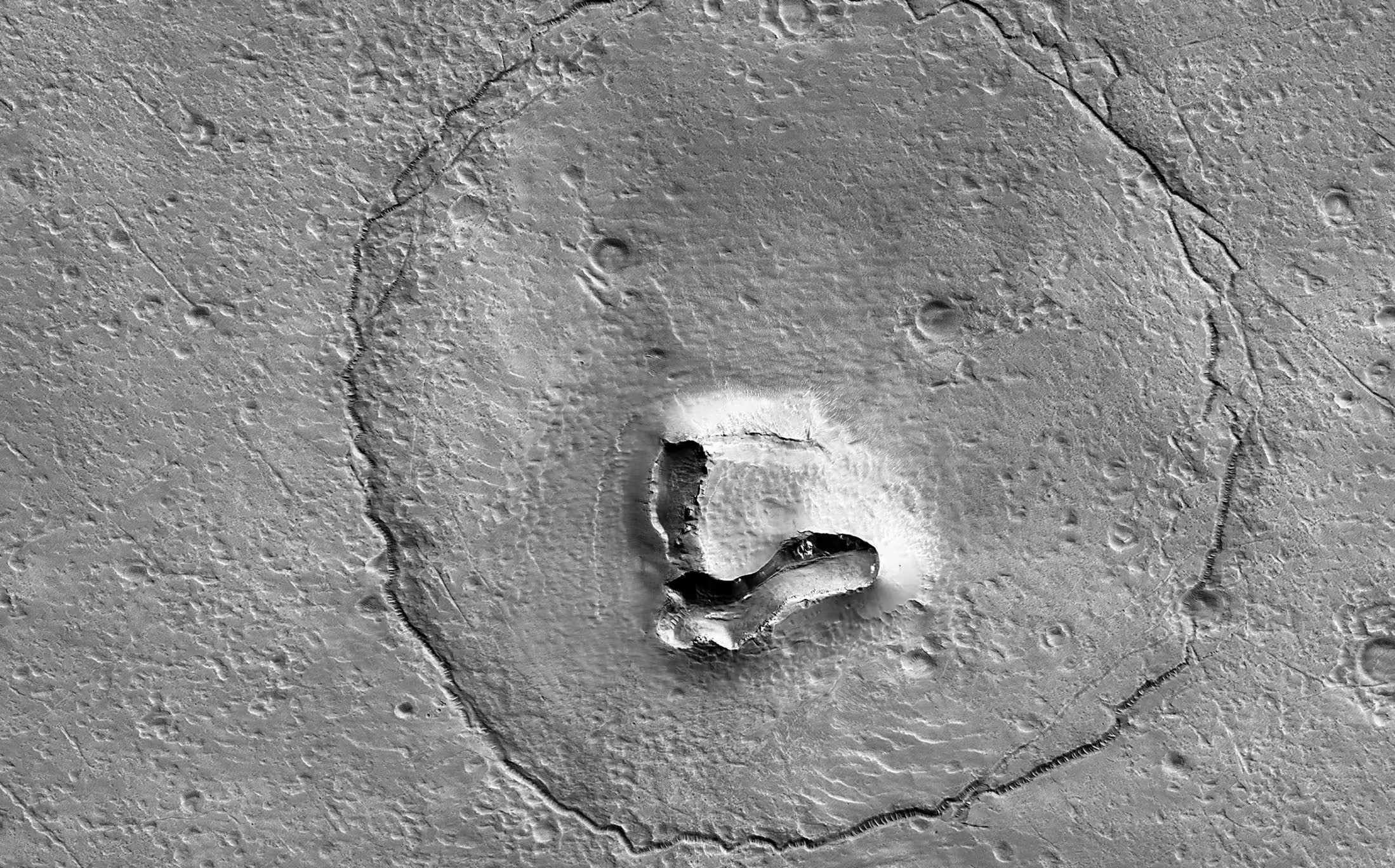
Why is there a bear’s face on Mars?
This is a curious one case of pareidoliathat is, a psychological phenomenon whereby we happen to see human faces, animal shapes or other recognizable shapes in objects or on surfaces. This is an illusion and happens due to a natural mechanism of our brain, which is led to trace random patterns (such as those of a cloud, a rock) to familiar shapes.
This can also happen, for example, inobservation of patterns on irregular surfacesincluding those of stars and planets observed thanks to images sent by probes and satellites. We have collected the most famous and curious cases, the result of erosions, impact craters, the behavior of some icy surfaces and particular lighting conditions which can accentuate some plays of shadows, as in the case of this bear’s head spotted by Mars Reconnaissance Orbiter (MRO, with HiRISE camera), in December 2022: it is natural to see two eyes in place of the craters, a snout in the V-shaped collapse of a rock structure and the shape of a head in the circular fracture.
The face of Cydonia on Mars
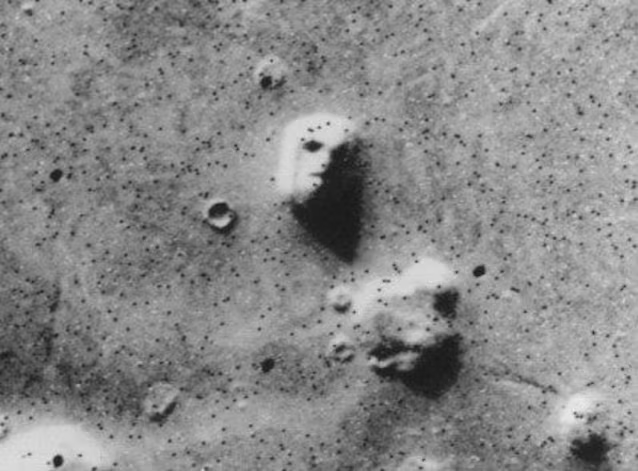
It is one of the best known cases of pareidolia and dates back 50 years: the image of the surface of Mars, in the Cydonia regionwas taken in 1976 by NASA’s Viking 1 probe, which portrayed what may appear to us as a face. According to conspiracy theorists, this hill of completely natural origin instead testified to the existence of life forms on the planet. However, it was about a lucky play of light and shadow: Several years later, in 1998, the denial came thanks to the image provided by the Mars Global Surveyor probe. With different lighting, the face was no longer recognizable.
In the same region, there is a mountain that resembles the profile of Benito Mussolini in the images collected by the Mars Global Surveyor probe. The coordinates to find it on Google Earth are latitude 33° 12′ 6.75″ N and longitude 12° 56′ 24.14″ W.
Martian spiders
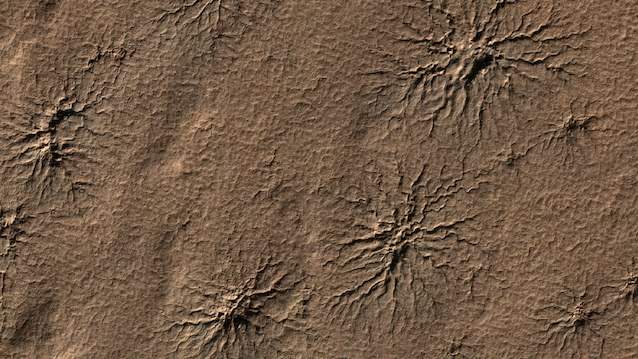
What we seem to see in this image are giant spiders with hundreds of “legs”, portrayed thanks to the Mars Reconnaissance Orbiter probe in 2009 and 2018. These are branched formations in the southern hemisphere of Mars, up to 800 meters long, called araneiform terrains. As demonstrated through studies and simulations in the laboratory, in which scientists managed to recreate the temperatures and atmospheric pressure of the Red Planet, they would be the result of the action of carbon dioxide gas, according to the so-called Kieffer model: in spring, when sunlight passes through transparent sheets of ice and warms the ground below, it generates pressure and releases gas, causing the ground to pass directly into a gaseous state (sublimation) and bringing dark dust to the surface. As NASA explains, what remains are spider-shaped scars.
The “shark fin” and the “crab claw”
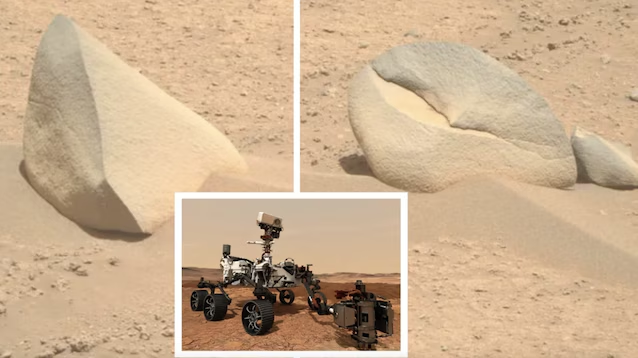
In these images, also from Mars, the Perseverance Rover sighting rocks in the shape of a shark fin and crab claw. The images were taken on August 18, 2023, and depict rocks shaped by wind erosion.
The alien figure
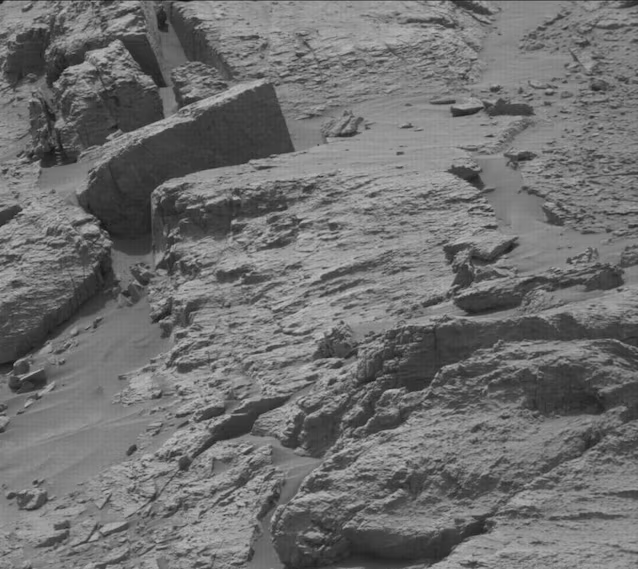
The image above is one of the frames returned by the Curiosity rover in August 2023: part of the NASA exploration mission to Mars launched on November 26, 2011, the rover arrived at its destination on August 6, 2012, landing in Gale Crater to study Martian geology and climate and evaluate the planet’s habitability. The image has recently become popular again, going viral. NASA has not provided a definitive explanation: the most accredited explanation is not, as in other cases, an optical effect on a terrain formation, but a possible camera artifact, as it is present on only one frame. Some experts talk about a possible impact of a cosmic ray on the sensor or an error in image transmission/processing.
The smiling sun
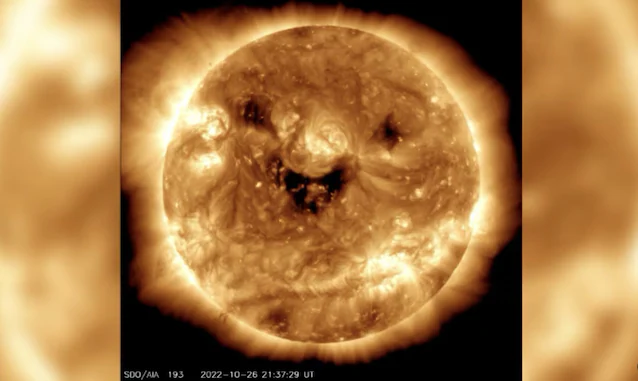
It looks like a smiling emoticon, but it is the sun immortalized by NASA’s Solar Dynamics Observatory (SDO) in October 2022: seen in ultraviolet light, these dark spots are known as “coronal holes”. These are regions of the solar corona from which high-speed solar wind currents flow into space.
