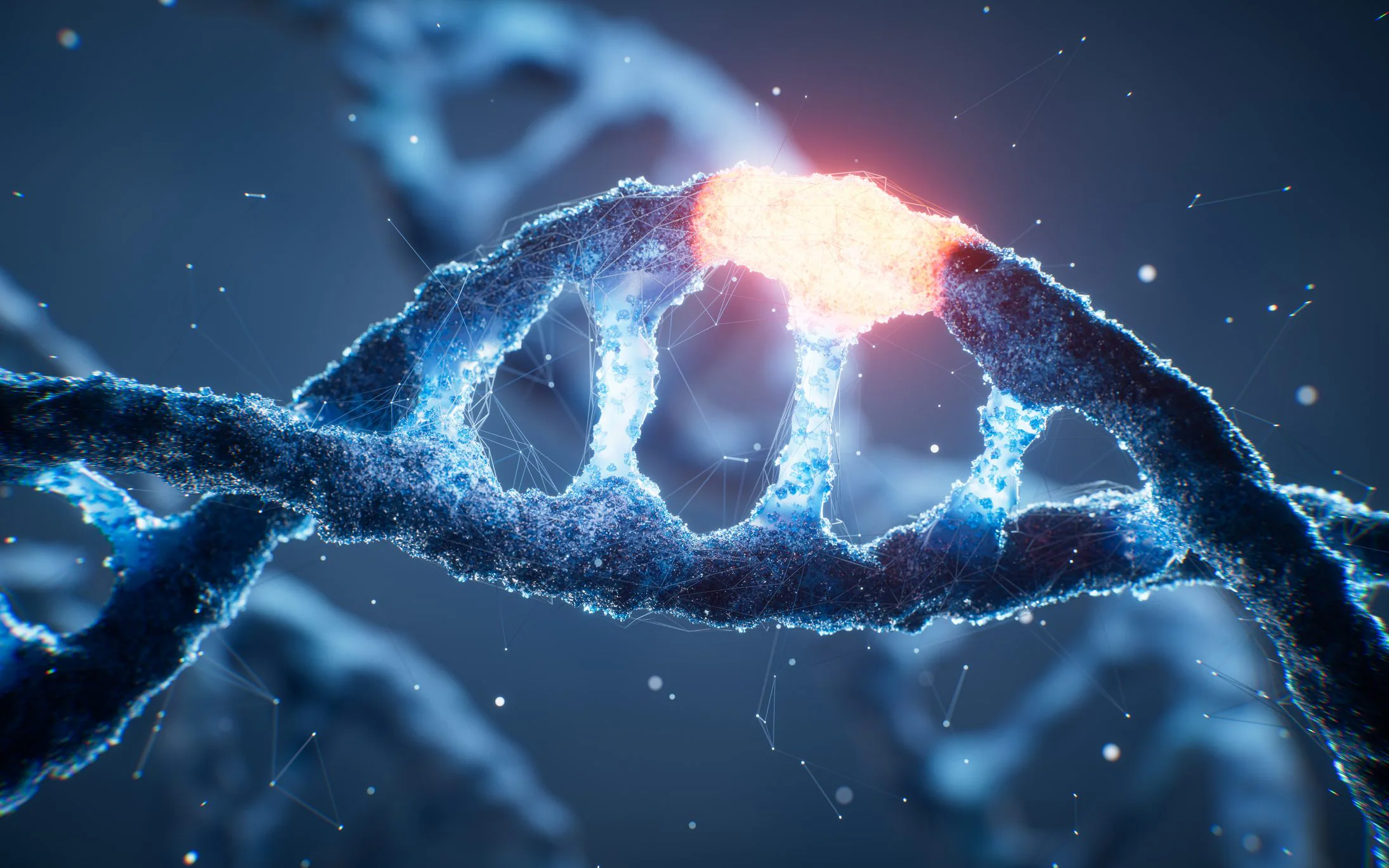
In the 1963between the pages of The X-Men #1the most famous mutants from comics made their first appearance. Unlike other Marvel heroes, they were not bitten by radioactive spiders, hit by gamma rays or enhanced by experimental serums: the X-Men were born like this. In their DNA there is a specific variant, the Gene Xwhich “turns on” during puberty giving extraordinary abilities. In reality, however, genetics follows very different rules: A single gene cannot contain the instruction “shoot optical beams” or “teleport”. Complex traits depend oninteraction of dozens of different genes and, above all, they remain bound to the laws of biochemistry and thermodynamics. However, when cells divide and DNA duplicates, there may be transcription errors in the “letters” that compose it which can lead to mutations.
Mutations are writing errors
Let’s imagine our genome as immense instruction manualwritten using an alphabet of only four “letters”: A, T, C and G, from the respective nitrogenous bases (adenine, thymine, cytosine and guanine). These bases, combined with a pentose sugar (with 5 carbon atoms) and a phosphate group, form i nucleotidesthe fundamental units that make up DNA.
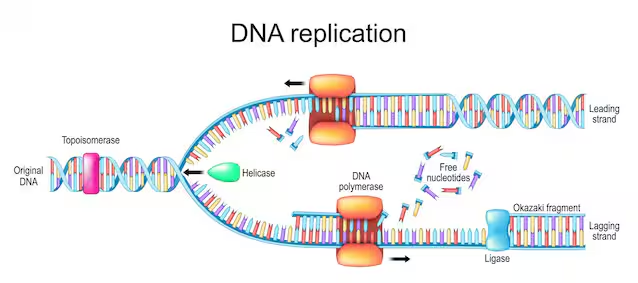
Every time a cell divides it must duplicate its entire genetic heritage (DNA), and during this process errors, i.e. variations in the sequence of nucleotides, can occur. When this happens, we find ourselves faced with a mutation.
There are various types of mutations that can lead to more or less serious consequences. The most common are:
- Point mutations: a single letter is exchanged for another (like reading DOG instead of BREAD).
- Insertions and deletions: the addition or loss of a letter or two. Since the code is read in groups of three, an omission or addition shifts the entire reading grid, changing the meaning of all the text that follows.
- Chromosomal or genomic abnormalities: macroscopic-scale mutations affecting the structure or number of chromosomes. In this case large portions of DNA they can be duplicated, inverted or deleted, or the overall number of chromosomes in the cell can vary.
Over the course of evolution, our cells have developed extremely efficient “proofreading” mechanisms, capable of identifying and repairing DNA lesions. But even these control mechanisms, working at a rapid pace, can sometimes miss a typo or even make a mistake during the repair itself.
How spontaneous errors arise and the DNA corrector
If we exclude radiation, chemicals or smoke, where do these mutations come from? The answer is simple, from the ordinary administration of the cell: they are in fact called spontaneous mutations, unlike those induced by external agents.
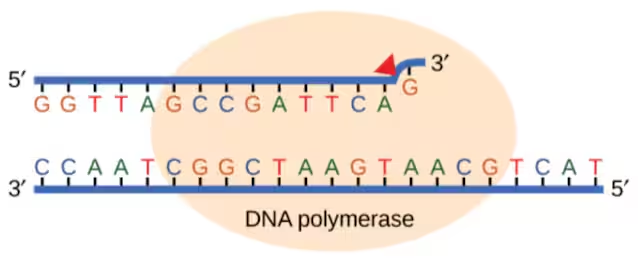
Every time one of our cells must multiply to replace worn tissue or make us grow, it must copy all the letters of our genome. The enzyme responsible for this work is called DNA polymerasea sort of very high-speed biological photocopier.
DNA polymerase is very precise and also has a “proofreading” function: if it makes a mistake in inserting a nucleotide, it backtracks, removes the wrong letter and inserts the right one. Despite this filter and the intervention of other repair complexes, the system is not perfect and can still make errors.
Not all typos change the story
What happens when a typo escapes control? In most cases, nothing visible. This can happen for two reasons:
- Non-coding regions: much of our DNA does not contain direct instructions for synthesizing proteins (so-called non-coding DNA). An error in these regions often has no functional repercussions.
- The genetic code is “redundant”: in the regions of DNA that contain instructions for making proteins, the text is read in blocks of three letters at a time, called codons (or triplets). Each triplet corresponds to a precise amino acid: by binding together in long chains, these “bricks” form proteins. Fortunately, multiple different triplets can indicate the same amino acidwhich is why it is called “redundant”. For example, if the word GAG and the word GAA both indicate the same amino acid, the substitution of the last letter is completely invisible: it is a silent mutation.
However, when the typo falls at a critical point in a key gene, the resulting protein can stop working, leading to genetic diseases.
But there is a third way, much rarer than the others, the one in which a random error reveals itself advantageous.
The “powers” of the human genome
If the X Gene of comics does not exist, in the human population there are spontaneous variants that recall traits of Marvel heroes, such as:
- Unbreakable Bones (LRP5): A rare mutation in the gene LRP5 prevents the normal resorption of bone tissue, resulting in very high bone mineral density. Individuals with this variant do not develop osteoporosis and have skeletons that are almost impossible to fracture in normal accidents. A sort of reinforced Wolverine-style skeleton, without the need for alien metals.
- Natural Divers (PDE10A): the people of Bajausea nomads from South-East Asia capable of holding their breath for several minutes at considerable depths, have a genetic variant associated with a spleen that is on average 50% larger than neighboring populations. A larger spleen acts as a natural “oxygen tank,” putting more oxygenated red blood cells into the blood during diving.
These variants were not donated by a serum or generated by a nuclear explosion: they arise from random mutations in the DNA of one of our ancestor. Transmitted from generation to generation, those errors proved useful in certain environments, being “rewarded” by natural selection.
Sources:
A. J. F. Griffiths, S. R. Wessler, S. B. Carroll, J. Doebley. Genetics, principles of formal analysis Ilardo MA, Moltke I, Korneliussen TS, Cheng J, Stern AJ, Racimo F, de Barros Damgaard P, Sikora M, Seguin-Orlando A, Rasmussen S, van den Munckhof ICL, Ter Horst R, Joosten LAB, Netea MG, Salingkat S, Nielsen R, Willerslev E. Physiological and Genetic Adaptations to Diving in Sea Nomads. Cell 2018 Apr 19;173(3):569-580.e15. doi: 10.1016/j.cell.2018.03.054. PMID: 29677510. Boyden LM, Mao J, Belsky J, Mitzner L, Farhi A, Mitnick MA, Wu D, Insogna K, Lifton RP. High Bone Density Due to a Mutation in LDL-Receptor–Related Protein 5. N Engl J Med. 2002;346(20):1513-1521. doi:10.1056/NEJMoa013444
