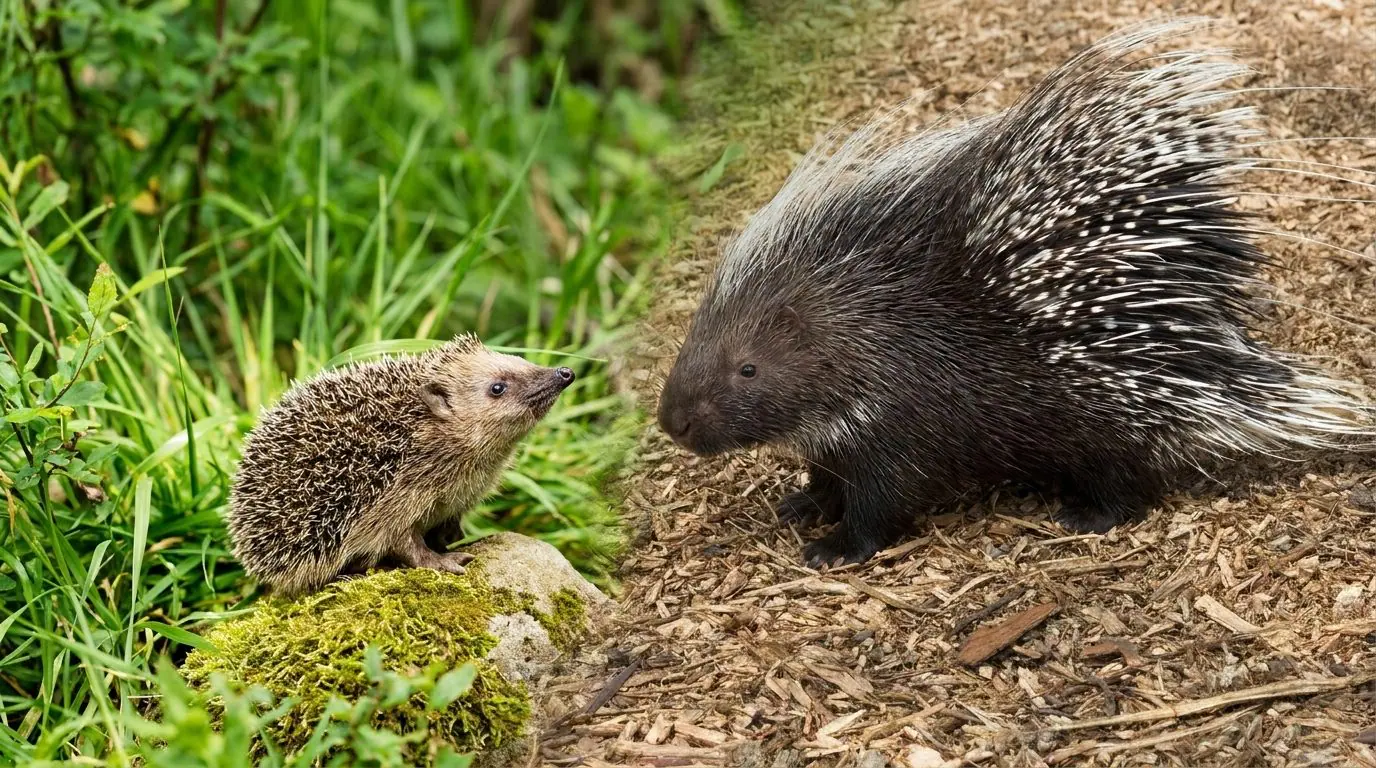
They both have bodies covered in quills and for this reason they are sometimes mistaken for one another, but hedgehogs and porcupines are not even related: they belong to two different orders of mammals. The European hedgehog (Erinaceus europaeus) is a small one insectivorous related to moles and shrews which hibernates in winter, while theporcupine (Hystrix cristata) – also known as porcupine – it’s a rodent cousin of mice and squirrels. If you go beyond the thorn analogy, everything is very different: from diet to size to the way of defending oneself.
How to distinguish them at a glance: weight and size
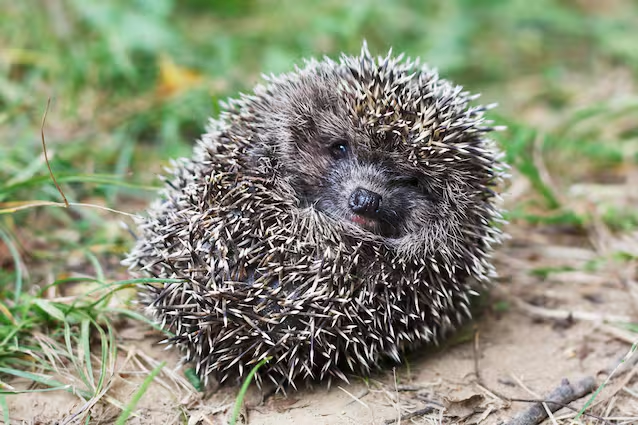
The most immediate difference is size. The hedgehog, belonging to the order of eulipotyls (Eulipotyphla), is small and compact and, as an adult, measures approximately 20-30 cm and typically weighs less than 1kg reaching 1.5 in the period alone pre-hibernation. It has a stocky, flattened build, with short legs and small ears. The muzzle is short and pointed with the sides of the body covered in thick curled fur mixed with small thin spines.
The porcupine (order Rodentia, family Hystricidae) is the largest rodent present in Italy, it can weigh up to 15-20kg. The length of its body exceeds 60-70 cm to which the tail is added. It is massive and stocky, characterized by an elongated snout, clearly visible ears and very sharp claws.
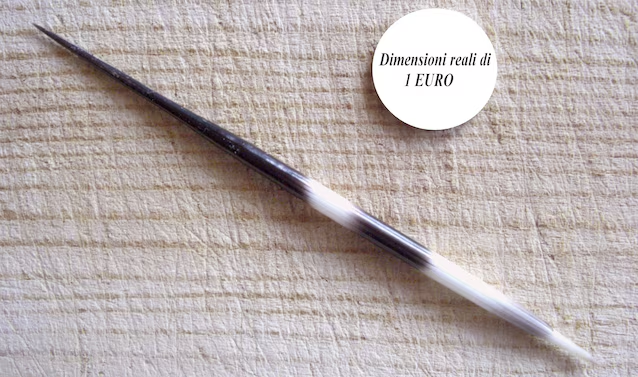
The quills are also different, those of the hedgehog are short (1-3 cm), those of the porcupine are showy, white and black, which can reach up to 30-40 cm in length.
Diet and habitat in Italy
THE’Erinaceus europaeus it’s a insectivorous-omnivorous: its diet consists mainly of invertebrates, eggs, carrion and, to a lesser extent, plant material. Beetles, earthworms and snails are among his favorite “dishes”. The porcupine, on the other hand, is a herbivorous and burrowing rodent with a diet composed mainly of roots, tubers, bark and fruits. Thanks to its strong nails it digs into the ground in search of bulbs and rhizomes or gnaws the bark of trees. In the same way, by gnawing abandoned bones and horns, it manages to file its powerful incisors which continually grow.
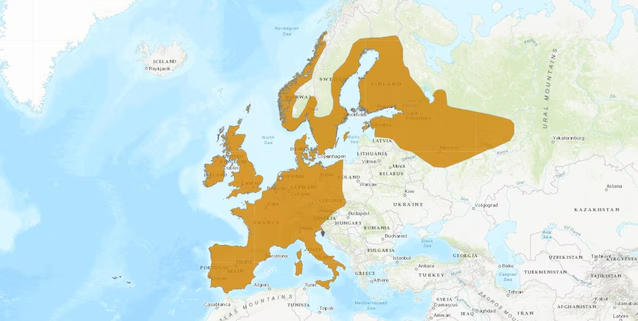
In our country it is possible to meet both. The hedgehog is widespread throughout the peninsula and on the major islands and is increasingly found in urban environments such as parks, gardens and roadsides.
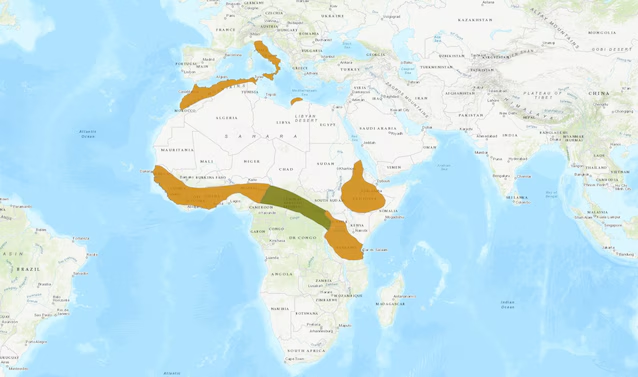
The porcupine, native to northern and central Africa, was historically linked to central-southern Italy but in recent decades has shown an expansion northwards, from the Apennines to some areas of the Po Valley as explained by the study published by the University of Siena in the journal The Italian Journal of Zoology.
What are thorns and spines used for: defenses compared
The spines of these animals are hair modified and hardened by keratin. The fact that such distant species have developed the same “armor” is an example of convergent evolution (when different animals independently arrive at the same solution to answer the same problem, here defending themselves from predators).
The hedgehog doesn’t attack but rolls up. Under the spiny skin it has a large muscular sheet, the panniculus carnosusthickened along the edge into a ring called the orbicularis muscle. When the animal is frightened the muscle contracts and pulls the prickly, movable skin around the entire body, while the thickening at the edge closes the coat around the animal. Furthermore, unlike those of the porcupine, the quills of the hedgehog they don’t come off And they are not poisonous.
The myth that the porcupine “shoots” its quills has no scientific basis. During its defense, it straightens its spines and crest to appear bigger, using – as ISPRA explains – the same type of muscles that cause “goosebumps” in humans. Only if intimidation fails charge backwards: the spines stick into the attacker and come off. They are not poisonousbut the wounds they cause can put predators in difficulty.
What to do if you encounter a hedgehog or porcupine?
In both cases, they are animals nocturnal. As he explains OIPA (International Organization for Animal Protection), hedgehogs are wild animals protected by law and must never be moved or held, except to promptly entrust them to a Wild Animal Recovery Center (CRAS) in case of real emergency. The intervention is necessary when the hedgehog appears injured, staggering, with crusted eyes or infested with larvae and parasites. If you come across a litter, it is essential not to touch anything and move away to allow the mother to return, rescuing the babies only if they appear scattered, suffering or attacked by flies. If a hedgehog is in a dangerous place, such as a busy road (road collisions are one of the main causes of death for hedgehogs that reach residential areas), it can be moved to a safe area but always in the immediate vicinity.
If you encounter a porcupine, the important thing that applies to all wild animals is to stay calm, do not scare it and do not approach it so as not to make it feel threatened or in danger. If the sighting occurs within an urban environment, where the animal could be disoriented or in danger, it is possible to report its presence to the ENPA (National Animal Protection Agency) or to the CRAS of the area.
Regarding the conservation status, the porcupine is classified by the IUCN Red List as “Less Concern” (LC) and has been protected in Italy since the 1970s. The situation is more delicate for the European hedgehog, which in 2024 was reclassified as a species “Almost Threatened” (NT) due to the decline in populations, largely victims of road traffic and intensive agriculture.
