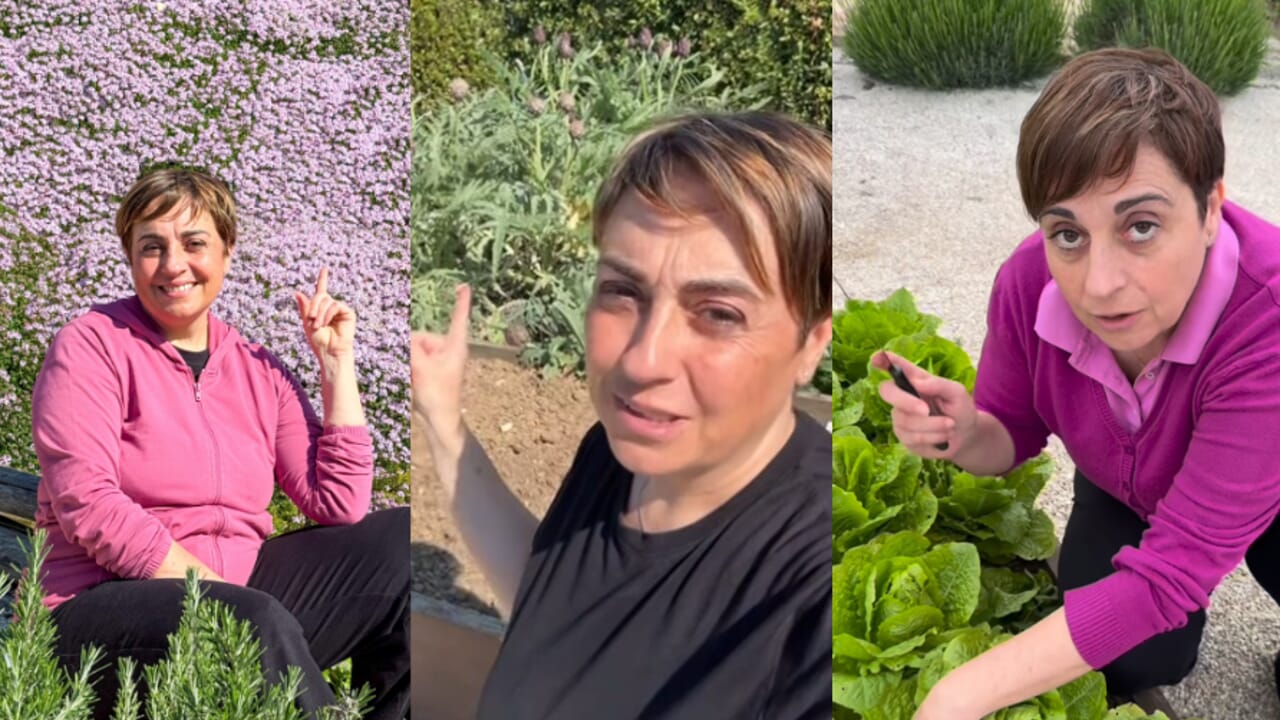
Goodbye chefs, farmers are now in charge: why “garden influencers” are the new stars (as Benedetta Rossi demonstrates)
If you don’t also feel that unstoppable desire to plant tomatoes, create a mini garden on your one-square-meter terrace or, better yet, abandon your apartment for a prefabricated house surrounded by land to cultivate, well done: you’ve managed to remain immune to the charm of garden influencers.
As we know, just one view, one like is enough to be profiled and end up in the infernal circle of “suggested for you”. And so, in the middle of the night, when you should just be sleeping, you find yourself reading about neem oil and soft soap which are perfect for preventing – and treating – the attack of aphids and also some fungal pathologies of plants that you don’t have and perhaps will never have. Not to mention the black thumb-proof advice on how to grow peas and cucumbers at just the right time for transplanting.
This is the power of the social media showcase: if something interests us, the algorithm offers us continuous stimuli, to the point of leading us – sooner or later – to follow advice or purchase a product. What if we don’t care? The feed insists, recalibrates, until it transforms even the most distracted user into an aspiring gardener.
There are more and more garden influencers, and not just in Italy
Thousands of people are making their way into the gardening market on social media. Something similar to what has already been seen with food influencers and with all the complications that this has brought about is happening: from the fixation on buffalo mozzarella, to pistachio, to everything that has been ‘food-porn’.
Gardening, however, is more complex. It requires space, consistency, time. Yet these aspects in viral content tend to disappear. The result remains: lush plants, tidy vegetable gardens. The illusion is created that little is enough, that everything is simple, almost immediate. But that’s not the case. The risk of simplifying a profession, just like for chefs, is around the corner.
Benedetta Rossi saw us long (and green)
This green turn is not surprising. For years we have noticed a growing intolerance for urban life and the desire to return to a slow life in greener spaces. And those who have been able to intercept this need are reaping the benefits.
Once again Benedetta Rossi appears among the trailblazers. Thanks to her university education, she has a degree in Production and health of aquatic organisms, Rossi has been giving advice for some years on how to grow plants, flowers and how to organize the vegetable garden. In his blog the first article on ‘green’ dates back to 2022, but on Instagram his advice is probably earlier.
“Green” reels – from growing tomatoes to propagating pothos – get results in line with, and sometimes surpass, those of the recipes. The video on harvesting and preserving lettuce reached 6.7 million people, the one on multiplying garlic reached nearly 2 million. Obviously, Benedetta starts from a solid base of followers, who also appreciate her for the lifestyle she shows. But it is indicative that she, who was the pioneer of the food sector in Italy, understood how important it is to also talk about gardening.
The community of garden influencers
Rossi obviously isn’t the only one. There are many specialized profiles: agricultural companies that use tutorials to advertise, agronomists who give advice and sponsor their latest book. And then there are nurseries, florists or gardening enthusiasts who have managed to carve out a social space for themselves, perhaps by specializing (focus on succulents, equatorial plants, orchids, etc.) and who today have active paid sponsorships.
To better understand the trend, it is also worth looking at the numbers. Among the profiles that struck me is “Nina the plant mum”. An Anglo-Saxon neophyte who went viral thanks to the video of her reaction to the first potato harvest (over 3 million views). In the space of a month, between March and April, he gained over 20 thousand followers, going from around 30 thousand to more than 50 thousand. Yet she is not an expert: she is an enthusiast who documents her own journey. It shows without filters the effort of cultivating, the beginner’s mistakes, but also the satisfaction of the results. And it is precisely this authenticity, combined with a light and accessible tone, that makes it different and therefore engaging.
At an international level, figures such as Nicole Johnsey Burke stand out, who has transformed gardening into a real business model made up of courses, books and digital content. But its arrival on Netflix also demonstrates that gardening is becoming more and more mainstream. “This Is a Gardening Show” starring Zach Galifianakis, known for films like The Hangover, will be available April 22, on Earth Day. In the program, Galifianakis meets industry experts who teach him the basics of gardening, in a story that mixes irony and disclosure.
The risk of aesthetics: the obsession with order
Yet, behind this growth, a contradiction emerges. Thinking about plants refers to something natural, but between selected seeds, pesticides and increasingly invasive human interventions, there is very little “spontaneous” left. In the social story of greenery, the obsession with order dominates: weeds eliminated, perfectly defined flowerbeds, surfaces covered with decorative gravel often positioned on layers of plastic, right there where there used to be a lawn. Imperfection disappears, replaced by a clean, controlled, replicable aesthetic.
If shortcuts were once the prerogative of industrial agriculture, today the same logic also creeps into domestic gardening. Control becomes the main goal. The garden thus stops being a space to live in and becomes a space to show. But in this case, as with physical appearance and homes, following the perfect influencer garden means chasing something that, in most cases, is unachievable – or sustainable only with a large investment of time and resources.
And then the question becomes inevitable: are we really returning to nature, or are we building a filtered and perfect version of it only on the screen? The data, also in this case, speak clearly: greenery is a luxury good and where income decreases, the possibility of enjoying green and tree-lined areas is also reduced. And if domestic gardens also become tools of representation, the risk is to further widen this gap.
The paradox is evident: while the desire to return to the land grows, the relationship with it becomes increasingly mediated. And here comes a challenge for garden influencers: will they also be able to talk about imperfection, waiting and failure, or will they continue to show an idea of nature designed to be looked at?
View this post on Instagram
