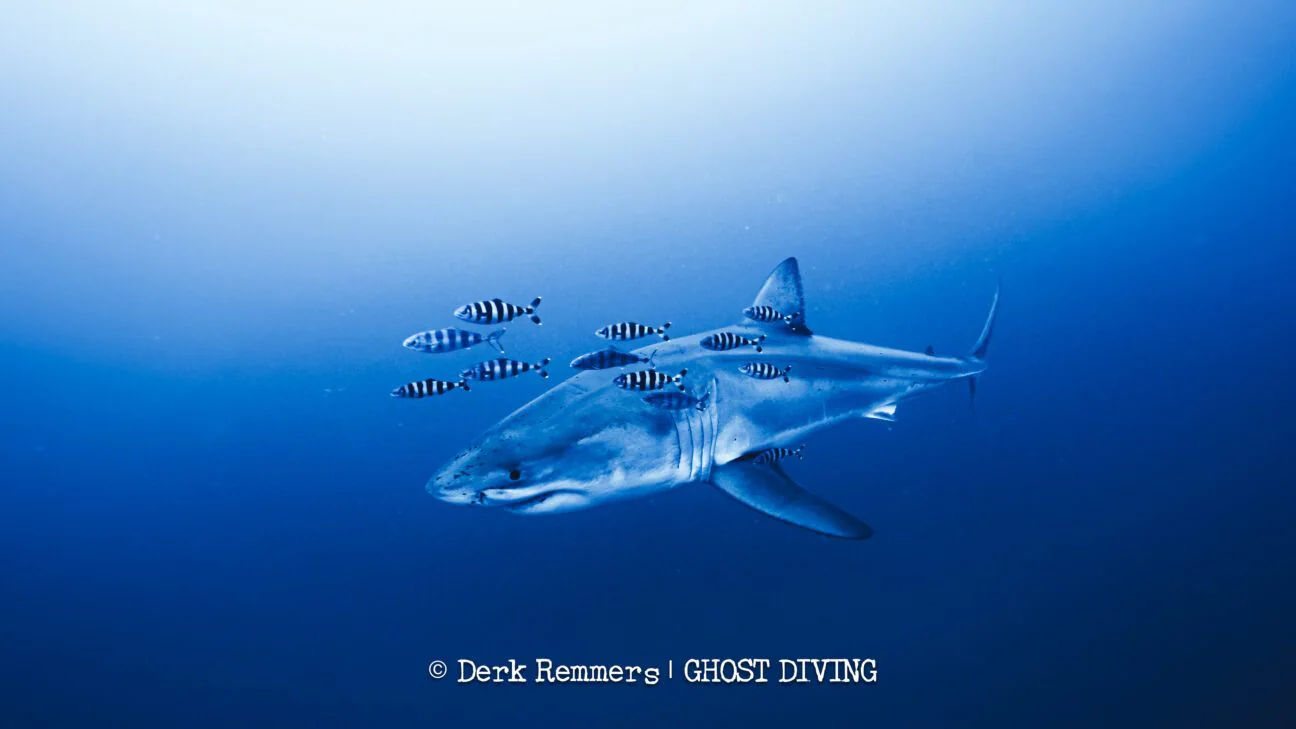
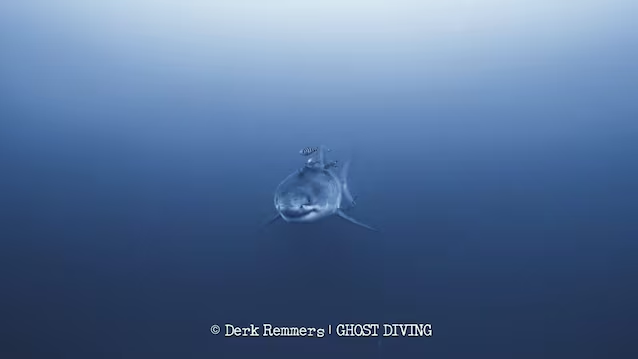
For the first time in history, a adult great white shark (Carcharodon carcharias) was filmed directly underwater by a group of divers in the heart of the Mediterranean Sea. The face-to-face meeting, as reported in a press release, took place off the coast of the Sicilian Channel. The event was documented by a team of divers during an environmental mission: the researchers were operating on behalf of the Healthy Seas Foundationin collaboration with Ghost Diving And SDSS (The Society for Documentation of Submerged Sites)with the aim of removing “ghost networks” (abandoned fishing gear) entangled on a wreck located right in the Sicilian Channel, between Italy and Tunisia.
Suddenly, the huge predator appeared from the deep blue, swimming peacefully around the group and allowing the volunteer Derk Remmers to immortalize the moment in unprecedented videos and photographs. As a confirmation Carlo Cattano of the Anton Dohrn Zoological Station, the sighting is important as it represents the first video testimony of an underwater encounter of a white shark in the Mediterranean and will therefore be of extreme importance for obtaining information on biological and behavioral aspects of the species.
The great white shark spotted in Sicily
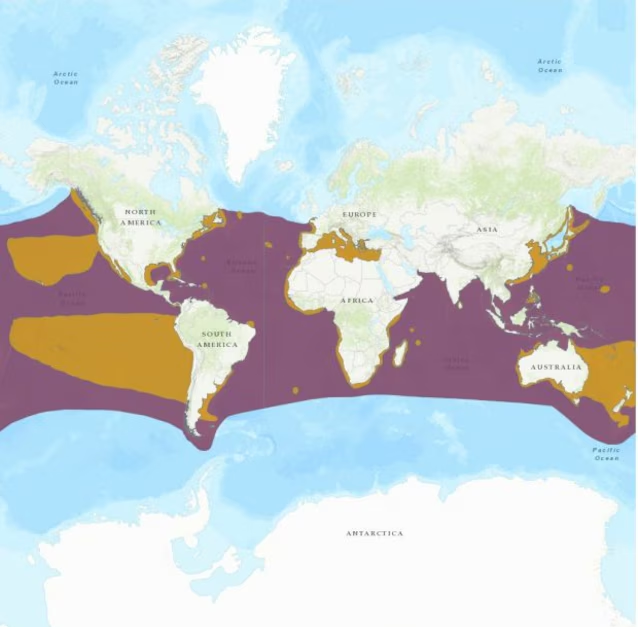
The great white shark (also called carcharodont or sometimes simply white shark) is, from a biological point of view, a cartilaginous fish of the Lamnidae family that is found in the coastal surface waters of all major oceans at temperatures between 12°C and 24°C. It is a formidable creature, which can overcome the 6 meters long and reach 2 tons in weight.
But let’s get to the question that everyone asks when faced with these images: how dangerous is the white shark for us? Well, although cinema has often portrayed him as a “monster”, science tells us the exact opposite. The experts of Natural History Museum they clearly explain that the white shark it does not attack humans to feed itself.
The human being It is absolutely not part of his usual diet (made of marine mammals and large fish). Although this species is involved in the greatest number of accidents with humans, such encounters are extremely rare and unintentional. Most bites, in fact, are the result of a dramatic “error of judgment”. As documented in the study A shark’s eye view: testing the ‘mistaken identity theory’ behind shark bites on humansseen from bottom to top (for example against the sunlight), swimmers and surfers paddling on their boards visually and impressively resemble the silhouette of seals or sea lions, which are the usual prey of the large predator. Sharks, driven by natural curiosity and deceptive sight, often make a simple “exploratory bite” and then release the victim as soon as they realize the mistake.
Furthermore, as he points out Carlo Cattanoit is essential to remember that we are not faced with an alien “invader” that suddenly appeared in the Mediterranean, but with one of its historic inhabitant. Obviously, being a wild predator at the top of the food chain, at sea you must always relate to these animals with great respect and the right amount of attention, but avoid giving in to uncontrolled and unjustified fears.
In fact, the expert highlights a crucial detail in the researchers’ video Ghost Diving: the shark, after a short passage, moves away, in all likelihood frightened by the bubbles emitted by the divers’ equipment. This reaction confirms what marine biologists have observed for some time: if disturbed by an intrusive human presence, sharks tend to abandon their aggregation sites. Precisely in order not to alter the behavior of such vulnerable animals, Cattano’s team is carrying out its monitoring (also in the area of this sighting) using exclusively remote and non-destructive sampling techniques. An ethical approach to be able to study safely and without disturbing the rare specimens still present in the area.
Where they are found in Italy: Mediterranean and local seas
Seeing a great white shark in Italian seas may seem absurd, but the reality is that the Mediterranean Sea has been its home for millions of years. This geographical area historically represents one of the most important ranges for the species globally. However, his survival today hangs by a thread: as he explains Carlo Cattanoresearcher at the Anton Dohrn Zoological Station, if the white shark is classified as “Vulnerable” from the IUCN Red List, the Mediterranean population is instead considered in “Critical Danger” (Critically Endangered). The main reason for this dramatic decline is largely linked to human activities, in particular bycatch (bycatch) in fishing nets and habitat degradation.
Historically, presences have been recorded in most of our basins: from the Tyrrhenian Sea to the Ionian Sea, even going up along the coasts of the Adriatic Sea. But that’s exactly it Strait of Sicily to play an ecological role of primary importance. This stretch of sea is a real biodiversity hotspot for most Mediterranean species, including the white shark. Here, in fact, specimens have historically been observed extremely vulnerable life stagesi.e. juvenile or newly born individuals. This data is fundamental because it confirms that the Strait of Sicily is a vital area for the birth and reproduction of the species.
Exceptional encounters like the one that occurred off the coast of Sicily, therefore, should not generate alarm, but represent testimonies that remind us of the priceless and fragile biodiversity hidden beneath the surface of our seas.