Next, the newsletter of Europa Today which every Monday morning tells you what will happen in the European week
Top of the agenda
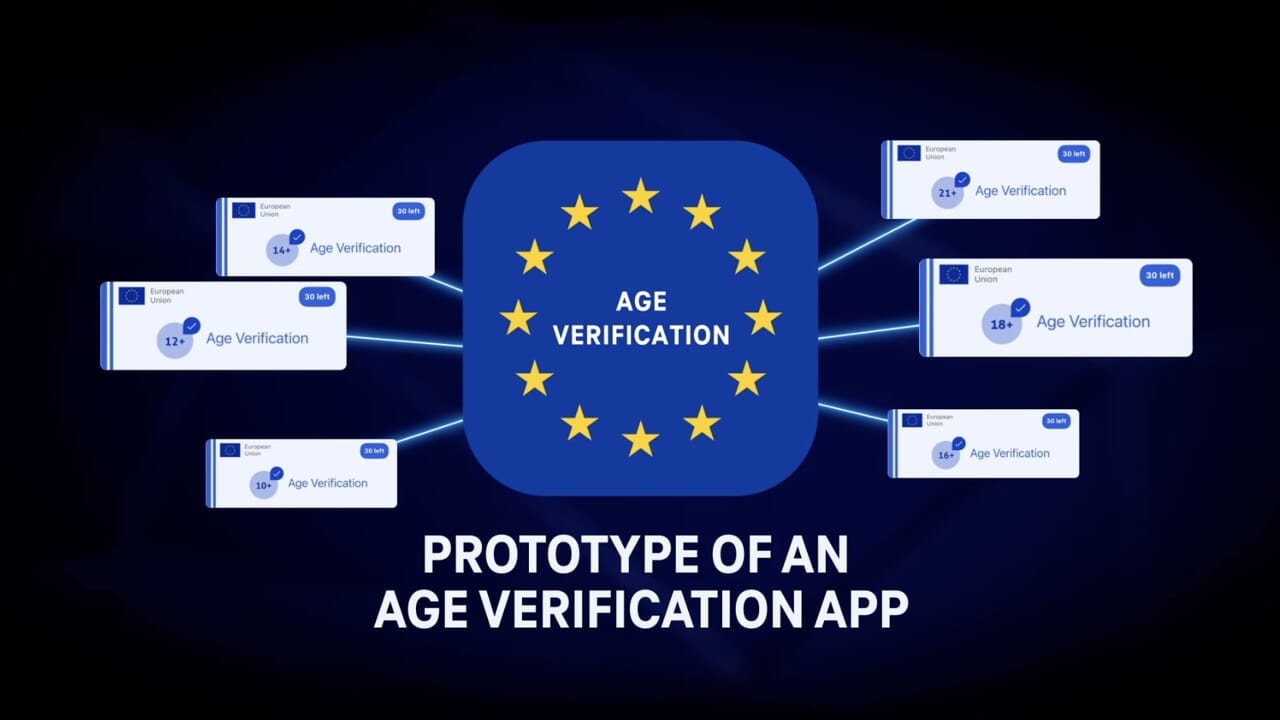
Recommendation announced – The recommendation of the von der Leyen cabinet on age verification was included in the agenda of the College of Commissioners on Tuesday 28 April, i.e. the proposal to Member States for a coordinated approach across the Union on the protection of minors online from content prohibited under the age of 18. The recommendation follows an acceleration in particular on the free Green Pass-style app.
A fragmented market – The Commission’s objective is to try to bring order to the growing fragmentation of the EU digital market on restrictions for minors on the use of social networks (if there is a restriction at national level) and sites reserved for adults, given that more and more Member States are proceeding in no particular order. Italy, France, Denmark, Greece, Spain, Cyprus and Ireland have already implemented a digital verification system, while Portugal has banned access to certain platforms and sites under 13 years of age. In Brussels there is a fear of a proliferation of national approaches as was the case in the first phase of the Covid-19 pandemic, when travel restrictions within the EU varied from country to country.
An app for everyone – Just as in 2020 the Commission brought order through a digital system – the Green Pass – equal for all, to protect the mental health of minors uniformly throughout the Union, today the EU executive is working on an accessible age verification application on all digital devices, which will be released to the public “in the coming weeks”. Following President Ursula von der Leyen’s announcement on April 15, the recommendation is now expected to outline the proposal for the 27 capitals in black and white.
How it should work – The first indications were given by the Commission’s number one. “It’s free and easy to use: you download and set it up with your passport or ID card, then you prove your age when you access online services.” But above all, like the Green Pass, it is anonymous, can also be used by partners outside the EU, and users cannot be tracked: “It respects the highest privacy standards in the world, users will prove their age without revealing any other personal information”. At this point, digital platforms – both social networks and pornographic ones – “have no more excuses, they can rely on our age verification app”, von der Leyen made clear.
But there is still work to be done – At the moment the app is not on the market, but only the programming phase has been completed. However, the Commission immediately had to take action after von der Leyen’s announcement, when some developers identified flaws in the system that allow software protection systems to be bypassed in just two minutes. The detection was made possible thanks to the ‘open source’ feature of the app, meaning the code can be checked by anyone and communities of researchers can test it and report potential problems. The source code is again being updated compared to the demo version.
Digital wallets and certifications – Once the app is ready, some EU countries will integrate it into their national wallets, others will use national systems made available by third-party suppliers, which however will have to be certified by a system developed by the Commission (exactly as in the case of Green Passes). The first case is that of Italy, where the age verification system is already active. “By the end of the summer, the function for accessing adult and pornographic sites will be available on the digital wallet of Italians, through the IO application”, announced the commissioner of the Communications Regulatory Authority (Agcom), Massimiliano Capitanio.
Social media prohibited for minors, the European green pass style app arrives. How it works
Other hot topics
Legislate better – The Commission’s communication on improving regulation and enforcement is also expected on the same day, Tuesday 28 April. Otherwise known as ‘Better Regulation’ – the ‘Better Regulation’ agenda – it is a strategic approach to ensuring that EU laws are high quality, evidence-based, transparent and easy to apply. The Commission’s objective is to ensure that European legislation achieves its aims while minimizing administrative burdens for businesses and citizens.
The state of the climate in Europe – The European Copernicus Institute will present the report on the state of the climate in Europe in 2025 on Monday 27 April. According to forecasts from the same European Earth monitoring programme, last year global temperatures remained close to historic highs, making 2025 the third warmest on record and confirming long-term warming trends.
Speaking of climate – At the Agriculture Council on Monday 27 April, EU ministers will discuss not only the proposals relating to the post-2027 Common Agricultural Policy (CAP) – in particular on measures to support farmers’ income – but also on how agriculture and sustainable forest management can strengthen the prevention of forest fires. Also on the table is the situation of the agricultural market in Europe, both with respect to the impact of the war in Ukraine and that in the Middle East.
The impact of war on transport – After the informal video conference on 21 April, the 27 EU Transport ministers will meet in Nicosia for an informal Council scheduled between Tuesday 28 and Wednesday 29 April. The meeting will serve in particular for an update on the general situation of the European transport sector – in particular the aviation sector – affected by the energy crisis and the stoppage of fossil fuels from the Strait of Hormuz. Another point on the agenda will be that relating to the strategic challenges and priorities of the maritime sector.
Digital issues – The informal summit of telecommunications ministers will be held in Nicosia between Wednesday 29 and Thursday 30 April, focusing on the issue of accelerating the large-scale deployment of reliable artificial intelligence, strengthening the protection of minors in the digital environment and improving Europe’s critical infrastructure.
Monetary policy – The meeting of the Governing Council of the European Central Bank (ECB) on monetary policy in the euro area is expected for Thursday 30 April. Markets expect rates to remain unchanged, but the ECB could give the first signs of a possible increase, given the sharp surge in inflation caused by energy prices that have skyrocketed following the ongoing closure of the Strait of Hormuz. “The uncertainty regarding the duration of the shock and the extent of its transmission effect leads us to gather further information before drawing definitive conclusions for our monetary policy,” President Christine Lagarde made clear.
Flights canceled due to fuel shortages: the “extraordinary circumstances” to have the ticket refunded
From the European Parliament
The European Parliament is divided over the management of the Israeli dossier. The proposal to include in the plenary agenda a debate on the Israeli law that introduces the death penalty for Palestinians accused of terrorism and on settler violence in the West Bank was rejected by the EPP People’s Party, allied with the right. In its place, a debate on the fight against anti-Semitism was inserted. The left, supported by socialists, greens and liberals, also wanted to put pressure on EU governments to suspend the association agreement with Israel, a measure already blocked in the Council by the opposition of Germany and Italy.
EU budget – For the rest, the week of the Plenary in Strasbourg revolves around the long-term budget of the EU: the deputies adopt the negotiating mandate on the Multiannual Financial Framework 2028-2034, with a proposal worth 1,780 billion euros, 10% more than the Commission, thus paving the way for negotiations with governments.
Energy crisis – On the international front, the plenary discusses the crisis in the Middle East and the repercussions on energy prices, with the closure of the Strait of Hormuz in the background, and in a separate debate the situation in southern Lebanon, where MEPs are calling for a sustainable ceasefire and greater humanitarian access.
War in Ukraine – Ample space also for issues of justice and values: a resolution is voted to ask for responsibility and compensation for Russian crimes in Ukraine, and two reports on the situation of fundamental rights and the rule of law in the EU, with critical issues highlighted in the judiciary, media and civic space. Also on the agenda is a debate on the risk of normalizing relations with Russia through the participation of Russian athletes in international sporting events.
Legislative votes – Among the legislative votes, the new EU rules for the protection of dogs and cats, the reform of the Generalized System of Preferences for developing countries and the changes to the market stability reserve for ETS2 stand out. We also vote on the EU definition of rape based on consent, on proxy voting for MEPs on maternity leave and on unfair competition from non-European operators.
Dialogues with commissioners – On Monday 27 April, in the margins of the plenary work, members of the Committee on Employment and Social Affairs (Empl) will hold a structured dialogue with the Commissioner for Equality and Crisis Management, Hadja Lahbib. The members of the Committee on Environment, Public Health and Food Safety (Envi) will do the same with the Commissioner for the Environment, Jessika Roswall, and those of the Committee on Constitutional Affairs (Afco) with the Commissioner for Trade, Maroš Šefčovič, on the same day.
Read the presentation of the main topics under discussion and vote in the Plenary
Royal Corner
Royal Cornerthe newsletter that every two weeks tells you the most important news on the European Union’s regional and cohesion policy
At the informal European Council in Cyprus, the discussion on the EU’s next Multiannual Financial Framework (MFF), the seven-year budget 2028-2034 worth around 1,800 billion euros, an increase of 367 billion compared to the previous cycle, came to life. The structure of the new QFP is simplified from seven to four headings, on the Pnrr model. It is precisely on the first heading, which groups together cohesion, agriculture and rural affairs with a budget of 946 billion, that the most heated conflict between the member states is concentrated.
Italy wants to defend the cohesion funds and the common agricultural policy. “It is a very difficult negotiation”, admitted Giorgia Meloni, who indicated these rumors as indispensable “red lines”. Germany, on the contrary, is pushing to cut them and divert resources towards what Berlin considers Europe’s new priorities. “We will also have to reduce spending in other areas,” Chancellor Friedrich Merz said, categorically ruling out any increase in debt.
The other main news of the week on EU cohesion and regional policy
