
Building on Mars without transporting tons of concrete from Earth or consuming huge amounts of energy is one of the crucial challenges for future human colonies. A team of researchers from the Hong Kong University of Science and Technology developed the Martian Living Building Material (MLBM), an advanced bio-building material obtained by mixing inert sand with a gelatin and yeast-based hydrogel (Saccharomyces cerevisiae) genetically engineered.
To date, extraterrestrial construction projects have provided for the casting or sintering of sand and local minerals (the regolith) at temperatures above 1,000 °C. This approach requires dedicated industrial plants and high energy consumption, which is difficult to sustain in the early stages of a human settlement.
Biotechnology may offer an alternative. In a study published in Cell Press the researchers employed genetically modified microorganisms to synthesize binders directly on site and at low temperatures. The energy savings are significant: to manufacture one cubic meter of bio-material, the energy generated is needed in less than an hour from a common solar panel operating on Mars, compared to the several days or weeks of continuous power required by high-temperature fusion processes.
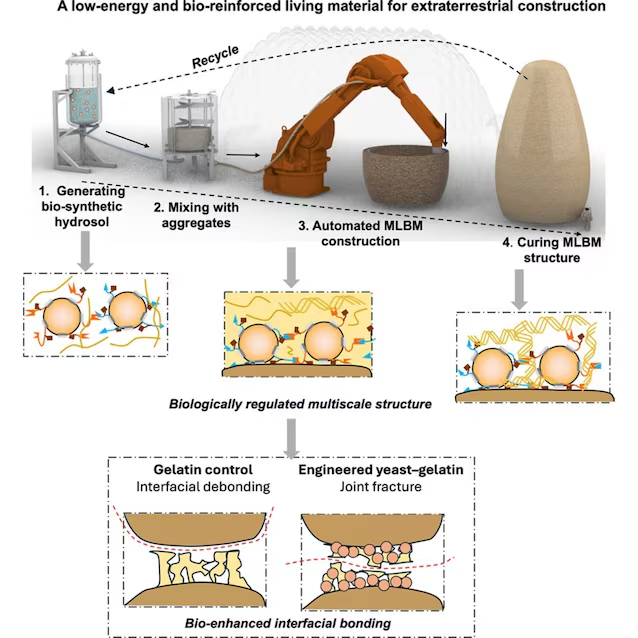
The key to the process lies inyeast engineering Saccharomyces cerevisiae, modified by exploiting the AGA1/AGA2 surface expression system. Three biological components with specific tasks have been inserted on the external wall of the cells:
- manage freezing: the AGA2 surface protein interacts with water in a similar way to antifreeze proteins, avoiding the formation of large internal voids and creating a uniform micropore structure;
- bind the yeasts together: a molecular anchoring system (SpyTag/SpyCatcher) creates direct covalent bonds between neighboring cells, increasing the internal cohesion of the gel.
- adhere to the sand: adhesion proteins inspired by those of mussels allow the biological gel to bond to the surface of the grains of sand.
The manufacturing of this “Martian” gel is divided into four sequential phases:
- Gel synthesis: the biological hydrosol is produced inside closed bioreactors using water extracted from Martian ice.
- Mixing: the biological binder (the gel of water, gelatin and yeasts) is combined with local sand.
- Robotic 3D printing: the material is deposited in layers while maintaining the extruder nozzle at approximately 37 °C to preserve the fluidity of the hydrogel.
- Environmental hardening: Direct exposure to Martian ester conditions, where cryogenic freezing and rapid sublimation of water transform the fluid mixture into a rigid porous structure.
The researchers validated this entire process in the laboratory by printing a small-scale model inside a climate chamber set to Martian atmospheric conditions (-30 °C and 0.01 atm).
The bio-material guarantees solid mechanical performance: it reaches a compressive strength of approximately 12 MPa and a flexural strength of approximately 6 MPa. Its high toughness allows it to deform and absorb the energy of impactsa key feature for resisting violent Martian sandstorms. In addition to resistance, bio-cement stands out for its total recyclability. At the end of their life, the decommissioned blocks can be crushed, rehydrated and heated to just 45°C to dissolve the biological matrix and print new elements. Laboratory tests have shown that the material can be recycled for 4 successive generations maintaining its robustness unaltered and preserving the vitality of the yeast cells.
The experimental formulation still uses a portion of terrestrial-derived porcine gelatin as a support, but tests conducted on 100% cellular samples confirm that the engineered yeasts can consolidate the sand even in the absence of gelatin. In future Martian infrastructures, this material could constitute the load-bearing external protective shellwhich will need to be supplemented by sealed internal membranes to ensure the maintenance of pressure and a habitable atmosphere for the crew.
