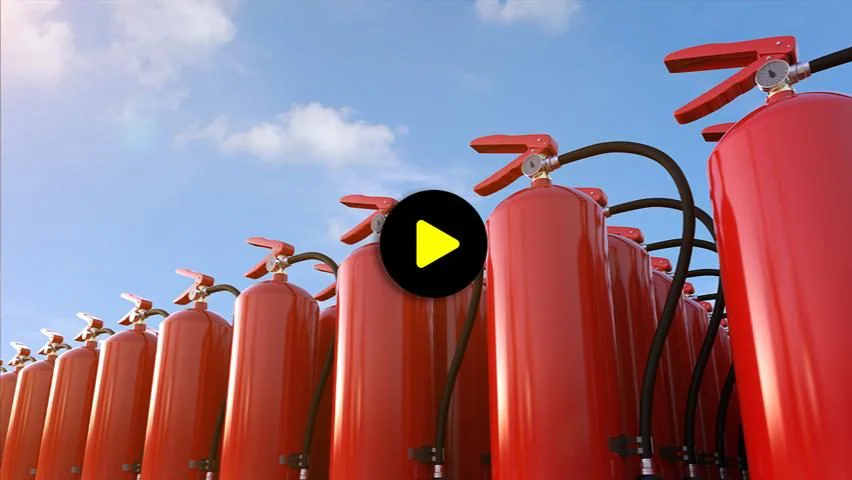
We were guests of Central Command of the Milan Fire Brigade for a video in which, together with the officers, we tried all types of fire extinguishers in safe conditions. The objective is to explain how these tools really work, which ones to choose depending on the type of fire and how to use them correctly.
The starting point is chemistry: fire is a combustion reaction that can occur when they are present (simultaneously) fuel, oxygen and heat. By removing one of these three elements, combustion can be stopped. Each fire extinguisher acts precisely on these factors, but in different ways, because not all fires are the same.
Indeed, they exist five classes of fire:
- TO for solid materials such as wood, paper and fabrics;
- B for flammable liquids such as petrol and solvents;
- C for gases such as methane and LPG;
- D for combustible metals such as magnesium and sodium;
- F for cooking oils and fats.
Knowing which class a fire belongs to is essential, because using an unsuitable extinguishing agent can be ineffective or even make the situation worse.
THE’ABC powder fire extinguisheramong the most widespread, can be used on class A, B and C fires, and therefore on solids, flammable liquids and gases: the extinguishing powder, expelled thanks to a pressurizing gas such as nitrogen, removes oxygen from the flames and blocks the combustion reaction, but can damage electronic equipment and surfaces.
THE‘fire extinguisher a CO₂recognizable by the characteristic dispensing cone, uses compressed carbon dioxide, which works by reducing the concentration of oxygen around the flames, contributing to cooling. It leaves no residue and is therefore particularly suitable in the presence of electrical and electronic equipment. It must be held carefully, only with the appropriate handle, to avoid cold burns, and in small and closed environments the risk linked to the accumulation of CO₂ must be considered.
THE’waterfall, which acts mainly by cooling, remains effective on class A fires involving solid materials, but should not be used on cooking oils and fats and reactive metals such as sodium and potassium. Some water-based extinguishers can be used on electrical equipment up to certain voltages and distances, but only if this possibility is expressly indicated on the extinguisher label.
Foam extinguishers they are generally indicated for classes A and B: the foam forms a layer on the surface of the fuel which acts as a barrier and isolates it from the air. It also limits the escape of flammable vapors and contributes to cooling. Also in this case, use in the presence of electrical equipment is only possible when explicitly provided for on the label.
Class D dust it is intended for rare but possible fires of combustible metals (e.g. magnesium, sodium, potassium and titanium), typical of foundries and laboratories.
That of the class F fireswhich involve cooking oils and fats, is particular: if a pan full of oil catches fire, under no circumstances should you pour water on it. Its very rapid vaporization could project the boiling oil into the environment. If the fire is still limited and it is possible to intervene safely, oxygen can be removed from the flames by covering the pan with a lid or using a specific class F extinguisher.
To use any fire extinguisher, it is good to remember the technique which is summarized inacronym PASS: Pullthat is, remove the safety; Aimaim at the base of the fire; Squeezepress the lever firmly; Sweepmove the nozzle side to side in a sweeping motion.
Every fire extinguisher must be subjected to periodic checks and maintenance. The “deadlines” relating to maintenance change based on the type of extinguisher and the manufacturer’s instructions: therefore there is no single duration valid for everyone, even if the maximum technical life limit is 18 years from the date of manufacture. A fire extinguisher that is not properly maintained, just when you need it, may not work as intended.
