
THE’“Amerigo Vespucci” airport in Florence it is one of the most complex airports in Italy, penalized by limited spaces, unfavorable winds and record cancellations. But how to renovate a ninety-year-old structure without blocking flights and integrating with the territory? In this video we talked about the historical critical issues of the airport and the engineering solutions of the Masterplan 2035, from the rotation of the runway to the reduction of the acoustic impact.
Florence airport today: the runway, the winds and the noise
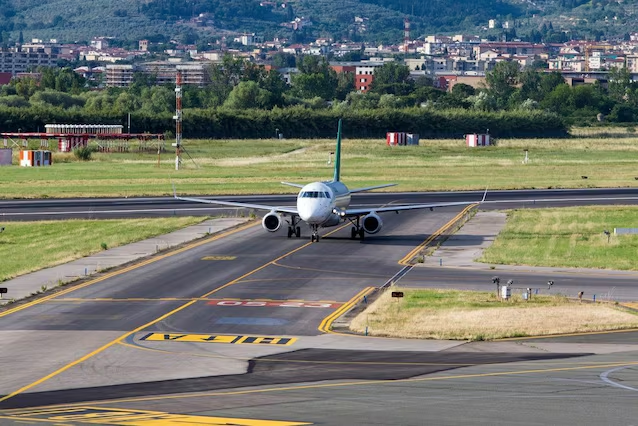
Looking at the map of Florentine portthe main cause of the problems appears evident: the track is located between Monte Morello, the A11 motorway and the residential areas. This very small spaceclearly, forces the planes to have very narrow margins for maneuver.
In fact, of the approximately 1,800 meters of total asphalt strip, planes can use less than 1,000 on one side and 1,455 on the other for landing, imposing strong limitations on weights, passengers and operable aircraft models.
In the video we showed how the situation is complicated by three other factors:
- the winds and the fog: the wind blows mainly along the axis of the runway, often forcing planes to take off or land with the tailwind (one of the most critical conditions in flight). Furthermore, the proximity to the Arno (just 2.7 km away) promotes the formation of banks of fog along the landing route.
- Noise pollution: the flight path flies directly over several residential neighborhoods at low altitude.
- The limits of the terminal and taxiways: the airport does not have a real taxiway, and for this very reason every landed plane must travel backwards along the main runway to reach the terminal. By doing so, however, any other take-off or landing is blocked. Added to this is the presence of only 8 parking spaces for scheduled flights.
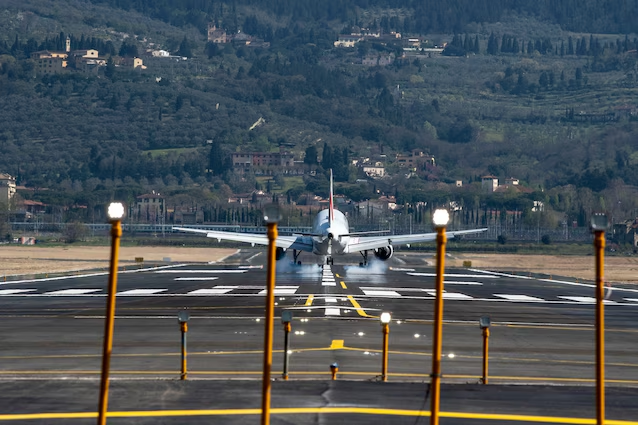
All these critical issues are given by the fact that the structure was designed way back in the 1930swhen traffic volumes were completely different than today.
The Masterplan 2035: rotate the runway to transform the airport
After evaluating and discarding various alternatives – such as closing the airport in favor of Pisa or lengthening the runway (an impractical idea due to lack of space) – we arrived at the engineering solution of the 2035 Masterplan: not lengthening the runway, but rotating it!
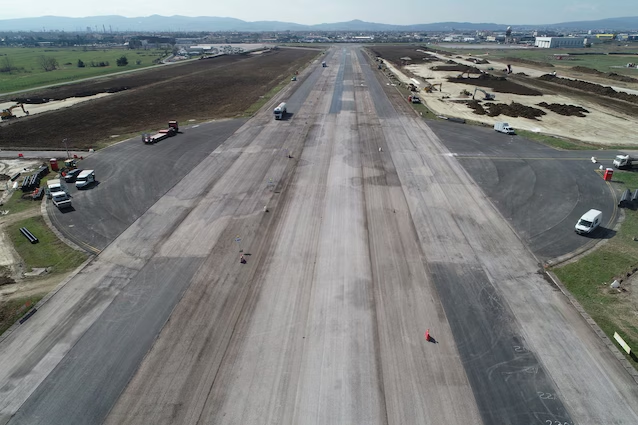
In the video we show you step by step what this change of orientation consists of and the benefits it will bring:
- Today planes all take off and land on one side, where there are fewer houses: in this way the planes are already oriented in the right direction, i.e. close to the gate, both when they arrive and when they leave. But in this new landing and take-off mode there is also another advantage, which is to avoid flying over population centers in the lowest phases of the flight (simulations indicate a 99% reduction in the population exposed to the highest levels of noise).
- New Terminal and connections: a terminal of over 55,000 square meters will be built (compared to the current 18,000), integrated with the tram network and designed with architectural forms recalling the city.
- Air traffic efficiency: the main objective is not a reckless increase in flights (+10% estimated by 2035), but the operation of fully loaded planes without the current restrictions, bringing the airport’s capacity to around 5.8 million passengers.
The case of Florence is that of many other historic European airportsbuilt in an era when air flows and the size of aircraft were decidedly smaller. When it is not possible to expand further or build plants from scratch (due to high costs), therefore, what can be done is optimize and rethink existing infrastructures.
