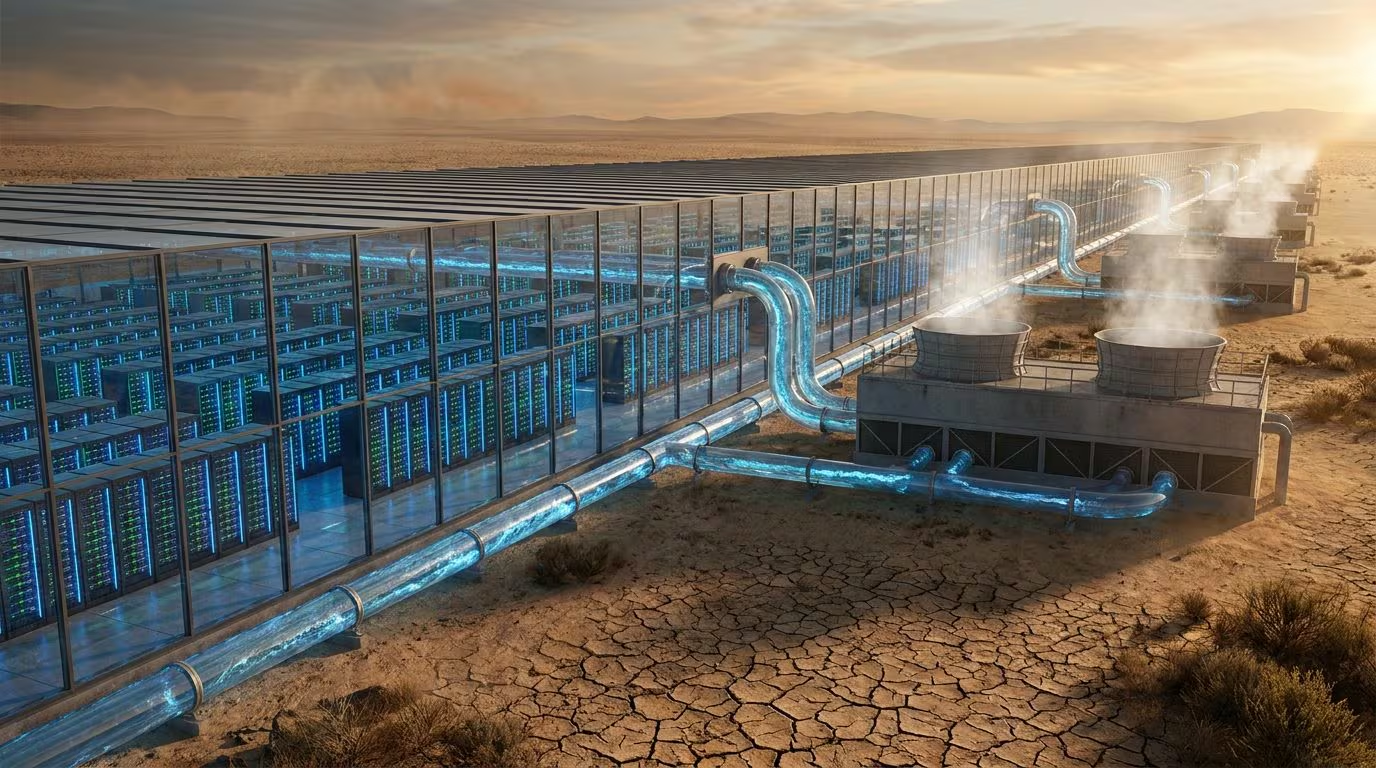
We know: the use of AI requires much greater amounts of energy and water than normal web searches. A text prompt envoy to GeminiGoogle’s AI, consumes on average 0.24 Wh of energy, releases 0.03 grams of CO₂ and takes approx 0.26 milliliters of waterthe equivalent of five drops. Apparently negligible numbers. But when you shift your focus on GPT-4 of OpenAI, the picture changes radically: how do they estimate the Washington Post and the University of Californiagenerate a single 100-word email requires 0.14 kWh – enough to feed 14 LED bulbs for one hour – and absorbs 519 milliliters of waterlittle more than a half liter bottle.
We must specify, however, that determine the actual ecological cost of every single request sent to the AI is an operation extremely complex to be completed and that these estimates do not take into account the most recent models, but are based on a standardized level of complexity which inevitably varies depending on the different calculation methodologies and the architecture of the systems examined. What it seems like now
Why AI consumes so much
Every time we type a request and send it to the AI, the models perform billions of calculations to process it and return a response. This process generates heatand to avoid the processor overheating data centers use large water cooling systems: the liquid absorbs heat and disperses it into the atmosphere through evaporation towers.
Until recently, large technology companies have remained extremely secretive about their consumption. Google broke its silence just under a year ago, publishing a report containing data on Gemini’s efficiency based on 12 months of analysis. To obtain a representative value, the researchers calculated the so-called “median prompt” – the request at the fiftieth percentile of consumption – including not only the energy used by the chips, but the entire hardware ecosystem: from CPUs to RAM, through ventilation systems and even machines in an idle state.
The limitations of the study
The study has some though limits. It excludes image and video generation models – among the most computationally demanding – and for which universally shared metrics do not yet exist. Experts also point out that comparing a traditional web search with a generative query is very misleading: the interaction dynamics are too different.
The 0.24 Wh of a simple prompt appears modest, but the real weight emerges when considering theentire conversation session: as the questions become more complex and the contextual memory required from the server grows, consumption increases. With beyond 900 million active users per month (data updated as of May 19, 2026) and constantly increasing traffic volumes, it is clear that the single query data is only a fragment of a much larger picture.
On ChatGPT the estimates – developed by Washington Post and from University of California – they speak of decidedly higher consumption. Projecting the data on a global scale, it is calculated that the system can absorb approximately 39.98 million kWh per day: the equivalent of the simultaneous charge of eight million smartphonesor the annual energy needs of entire low-consumption nations. On the water front, a daily consumption of approximately 39.16 million gallons of fresh wateran amount comparable to the simultaneous flushing of the toilets of the entire population of Taiwan.
Training, inference, and the parameter race
Experts distinguish two phases in the environmental impact of AI: theinitial training of the model andinferencei.e. processing responses in real time. In traditional search engines, the largest share of energy was tied to the final answer. With modern language models, however, the internal parameters have grown exponentially, making each single processing increasingly expensive.
This technological escalation clashes with the fragility of global water resources. One fifth of US data centers draw water from basins already under water stressand many of the new plants planned in Europe are located in areas at high risk of drought.
To contain the impact, Google has adopted workload flexibility strategies, moving the heavier processing in the time slots in which the network is less stressed or renewable energy is available. In arid regions like Arizona, he chose the air cooling instead of water coolinggiving up a 10% electricity saving, to preserve local reserves. More than a quarter of the plants already use recycled or non-potable water.
A balance still to be found
Optimizing energy efficiency through new hardware components requires significant investments, often overshadowed by the commercial rush to market. There are those who argue that AI itself will, in the future, optimize the management of planetary resources, a prospect which at the moment, however, could seem far too optimistic and not entirely risk-free. In the present, the priority is probably another: monitor with rigor and transparency the real impact of each of our digital interactions. This is a task that is far from simple to complete.
