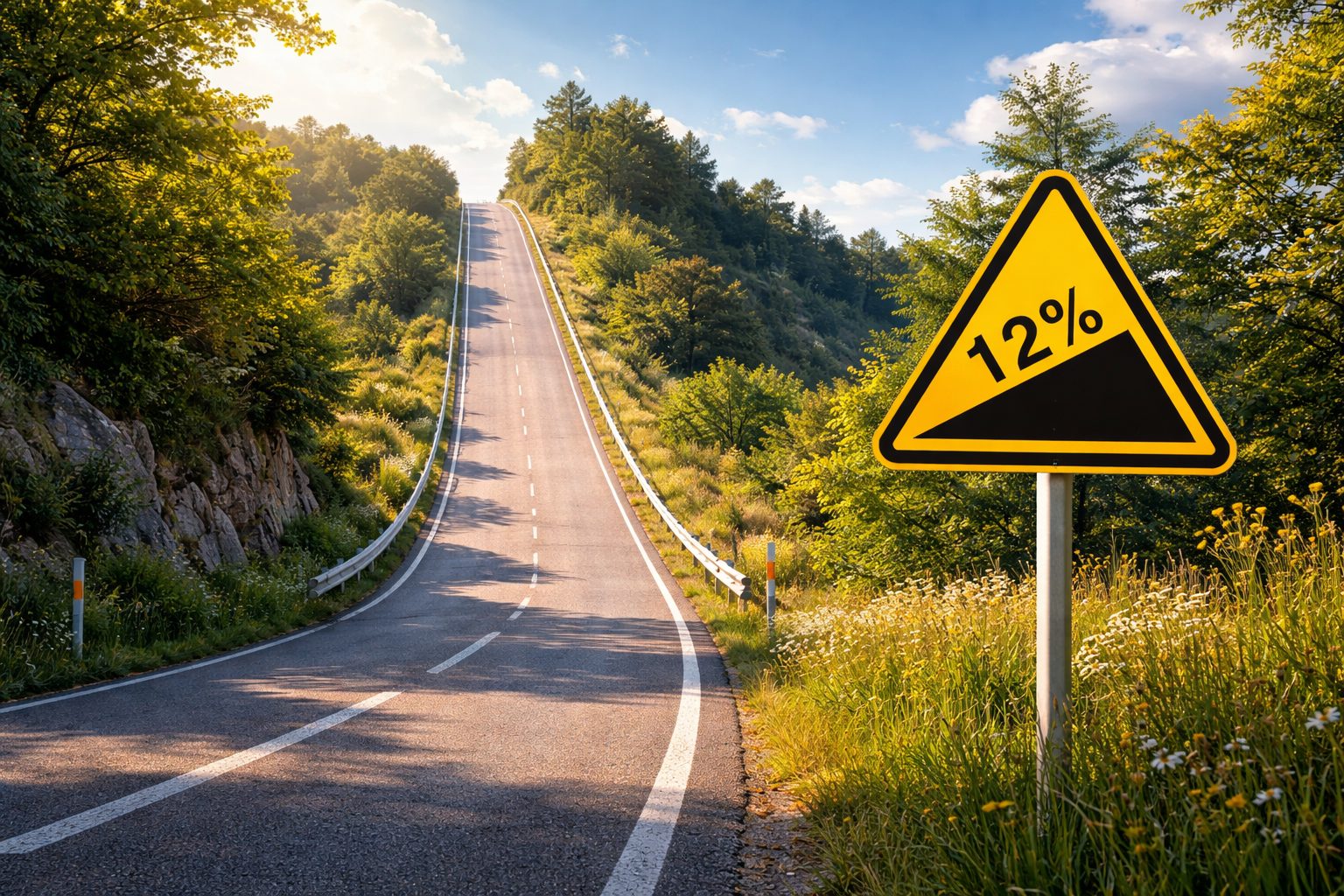
Who hasn’t happened to see, especially in the mountains, a road sign with a percentage which indicates the slope of the road? But what exactly does that number mean to us? How is it calculated, and to what angle does a 100% slope correspond? Let’s see the mathematical answers to these questions and what slope the steepest road and funicular in the world have.
To calculate the slope of a road, which for simplicity we assume is straight, we need to know the height difference (or vertical deviation) and the horizontal distance (or horizontal projection) travelled, if you have this information just use the formula
Slope = Difference in altitude ÷ Horizontal distance × 100
From a geometric point of view it is a matter of calculating the relationship (division) between vertical leg (difference in height) e horizontal leg (horizontal distance) of a right triangle whose hypotenuse corresponds to the road actually travelled. In the example in the figure (below) we have calculated that in the case of a climb with altitude difference 10 km And horizontal distance 16 km there slope turns out to be from 62.5%.
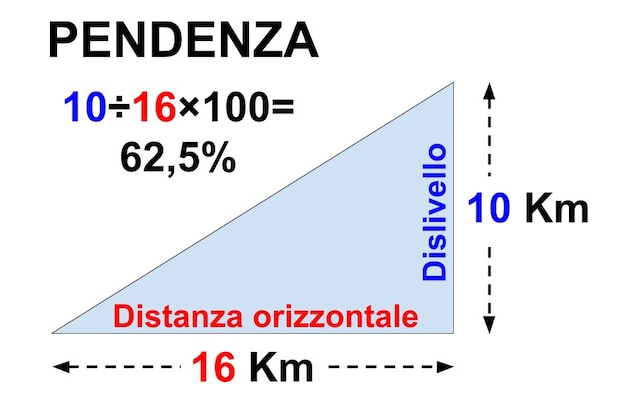
According to this formula, therefore, a 10% slope sign it means that you climb a difference in altitude of 1 km for every 10 km of horizontal distance travelled.
But what does it mean when a sign indicates a slope of the 100%? No, this is not a perfectly vertical climb, but rather one rise that forms an angle of 45° with the horizontal planesee figure below: to obtain 100% the difference in height and the horizontal distance must be equal so that the division gives the result 1, which multiplied by 100 gives 100%.
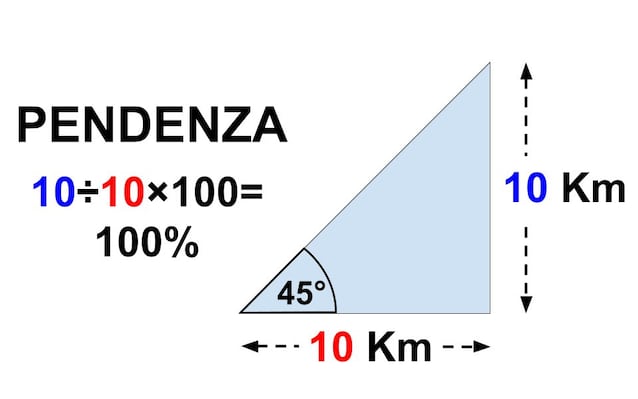
A 100% gradient climb is not vertical, but it is still very steep given that, according to the Guinness Book of Records, the steepest road in the world is Baldwin Street, in the town of Dunedin in New Zealand, with a slope of 34.8%. But if a 100% slope corresponds to an angle of 45°, how many degrees is Baldwin Street inclined?
We can calculate it takes a little trigonometry, a branch of mathematics that deals with the study of angles, but don’t worry, if we have a scientific calculator available (the mobile phone one is fine too) we can get by even without knowing trigonometry, just follow this simple procedure:
- Before we divide the slope by 100in our case we calculate 34.8 : 100 = 0.348.
- then we first press the “2nd” key (or “shift” depending on the calculator) and then the “tan” key, in this way the calculator will provide us with the desired angle, which in our case turns out to be approximately 19.2°.
Viewed from the angle formed with the horizontal (only 19.2°) Baldwin Street would not appear so steep. In fact, there are steeper uphill routes than these, perhaps with a gradient greater than 100%, but generally these are not roads passable by car. This is the case, for example, of steepest funicular in the worldlocated in the tourist resort of Stoos in Switzerland, which reaches a 110% slope forming an angle of approximately 47.7° with the horizontal plane.
