Around the mochaover time, different beliefs have arisen: there are those who prepare the classic “mound” of coffee in the filter, those who insist that the powder must be pressed and those who swear that the flame must be very low. But what do the studies say about how to prepare the “perfect” mocha? To obtain correct extraction you need to fill the water only up to the safety valve and put the coffee in the filter without compressing it. In fact, if the powder is pressed, the water encounters more resistance and the extraction flow becomes less uniform. The flame also matters: too intense heating favors the passage of steam, causing the characteristic gurgling final and a more bitter extraction. For this reason various studies, in particular an Italian study conducted by the University of Trieste and published inApplied Thermal Engineeringthey recommend one medium-low flame and to turn off the stove at the first warbles.
Filling the moka with water without exceeding the valve: scientific research

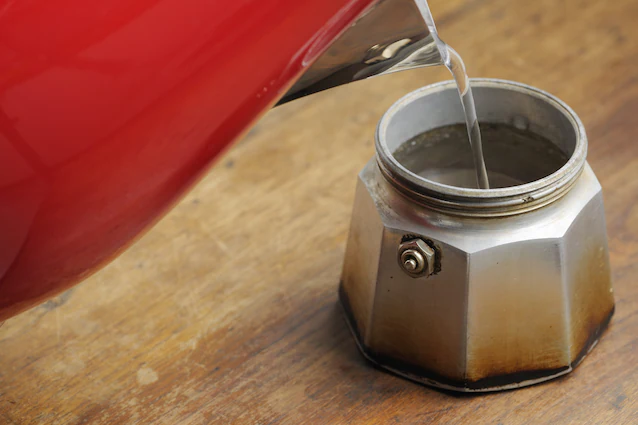
The moka we use today is made up of three parts: the lower boiler, which is filled with water, the funnel filter, where we insert the ground coffee, and the upper collector, where the coffee accumulates. First of all yes fills the boiler of water, up to the valve, leaving a small air chamber at the top. This, which is one of the most widespread indications, is in fact also one of the most correct: the water must be filled up to the level of the safety valve, without ever exceeding it. This not only allows you to have the air chamber in the upper part, essential for the functioning of the moka, but also prevents possible malfunctions.
The valve is an important device, a sort of small metal button that protrudes from the external wall of the boiler and which communicates with the inside. It is essential for release steam in the event of overheating, as confirmed by various patents and by a study by Warren King onAmerican Journal of Physics. Under normal conditions it should never come into operation, but if the filter were to become blocked – for example, as we will see shortly, in the case of excessively pressed coffee – the pressure in the boiler would increase until the valve opens, which releases accumulated steam preventing damage to the coffee maker. If it were covered by water it would not be able to expel excess steam.
Don’t tamp the coffee powder: what Darcy’s Law says
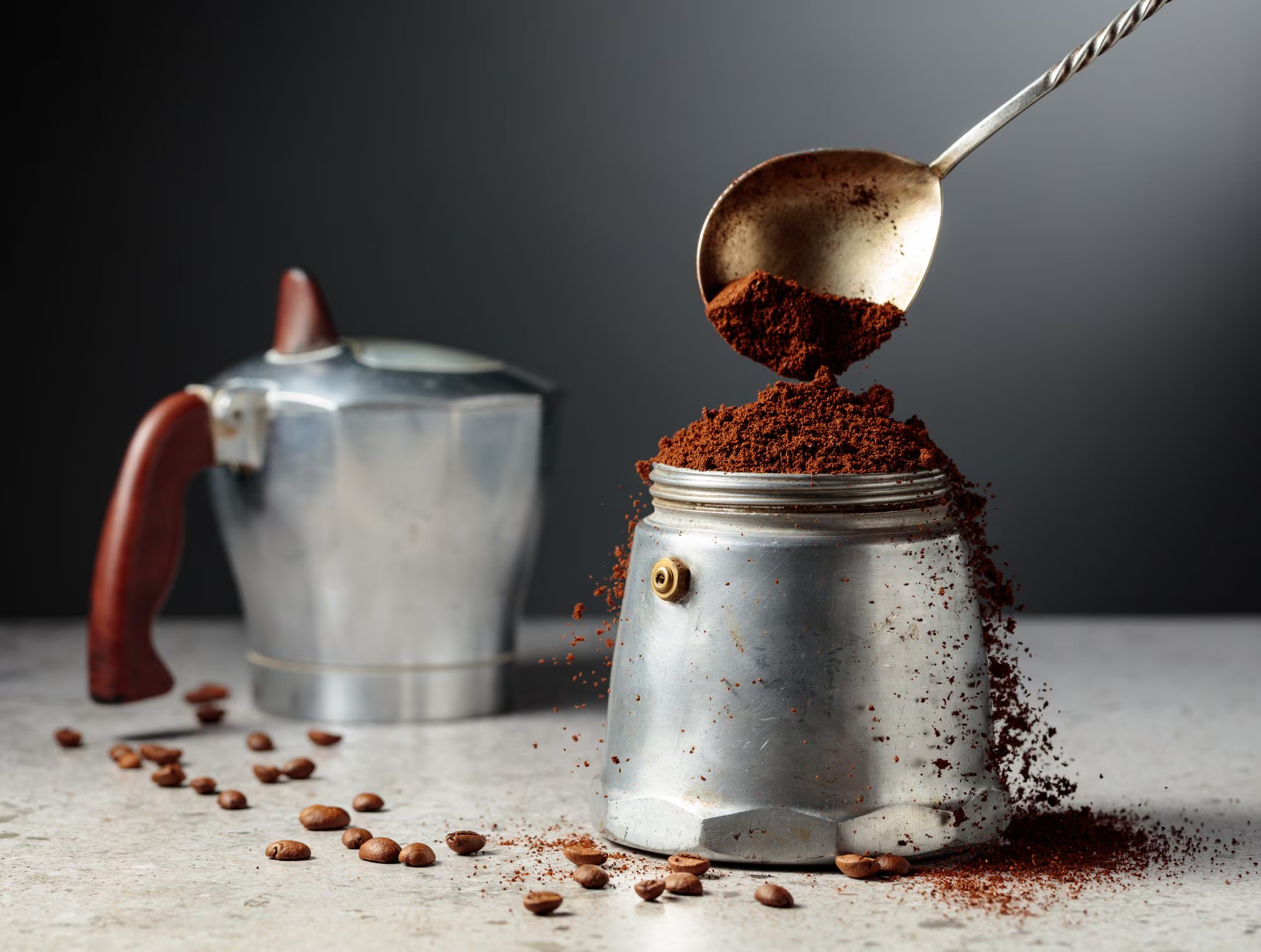
Next, you enter the funnel filterequipped with a cannula that remains almost entirely immersed in the water, and the coffee is added. Here too, science suggests a very precise procedure: the funnel filter must be filled to the edge and the coffee must simply be leveled, without pressing it.
In a study published in 2007 onAmerican Association of Physics Teachers it is said that the reason is described by the Darcy’s lawa physical equation that explains the behavior of a fluid (in this case hot water) passing through a porous material (the bed of ground coffee that we put in the filter). The more the coffee is compacted, the smaller the spaces between the grains and consequently the greater the resistance that the water encounters during its passage. Therefore pressing the powder too much risks making theless uniform extraction and, in the most extreme cases, can also lead toobstruction of the filter.

Cooking must be over low heat: the Italian chemistry study
At this point we close the moka with the upper part and move it to the stove. As the temperature rises, the air trapped in the boiler expands and a small portion of the water evaporates. Both of these phenomena increase internal pressurepushing the water downwards and then making it rise up the cannula of the funnel. At this point the hot water will pass through the ground coffee contained in the filter and extract it aromatic molecules transforming into coffee, and then reaching the collector.
Our grandmothers had no doubts: coffee it must rise slowly, over a low heat. And, at least in part, science seems to prove them right. A flame that is too intense heats the boiler very quickly, causing the internal pressure to increase in a short time. In the final phase of the process, this also favors the passage of steam into the collector, giving rise to the characteristic gurgling of the mocha. Studies by the Italian chemist Luciano Navarini and his colleagues have shown that this phase, called Strombolian phase (in honor of the Sicilian volcano Stromboli), can worsen the quality of the extraction, favoring the release into the coffee of more bitter compoundsoften described from a sensorial point of view as similar tosmoked/burnt.
So no: the water does not necessarily have to reach 100°C. To make a good coffee you can use a medium-low flame, and above all it is advisable to remove the moka from the burner as soon as it starts to make the first warbling noises.