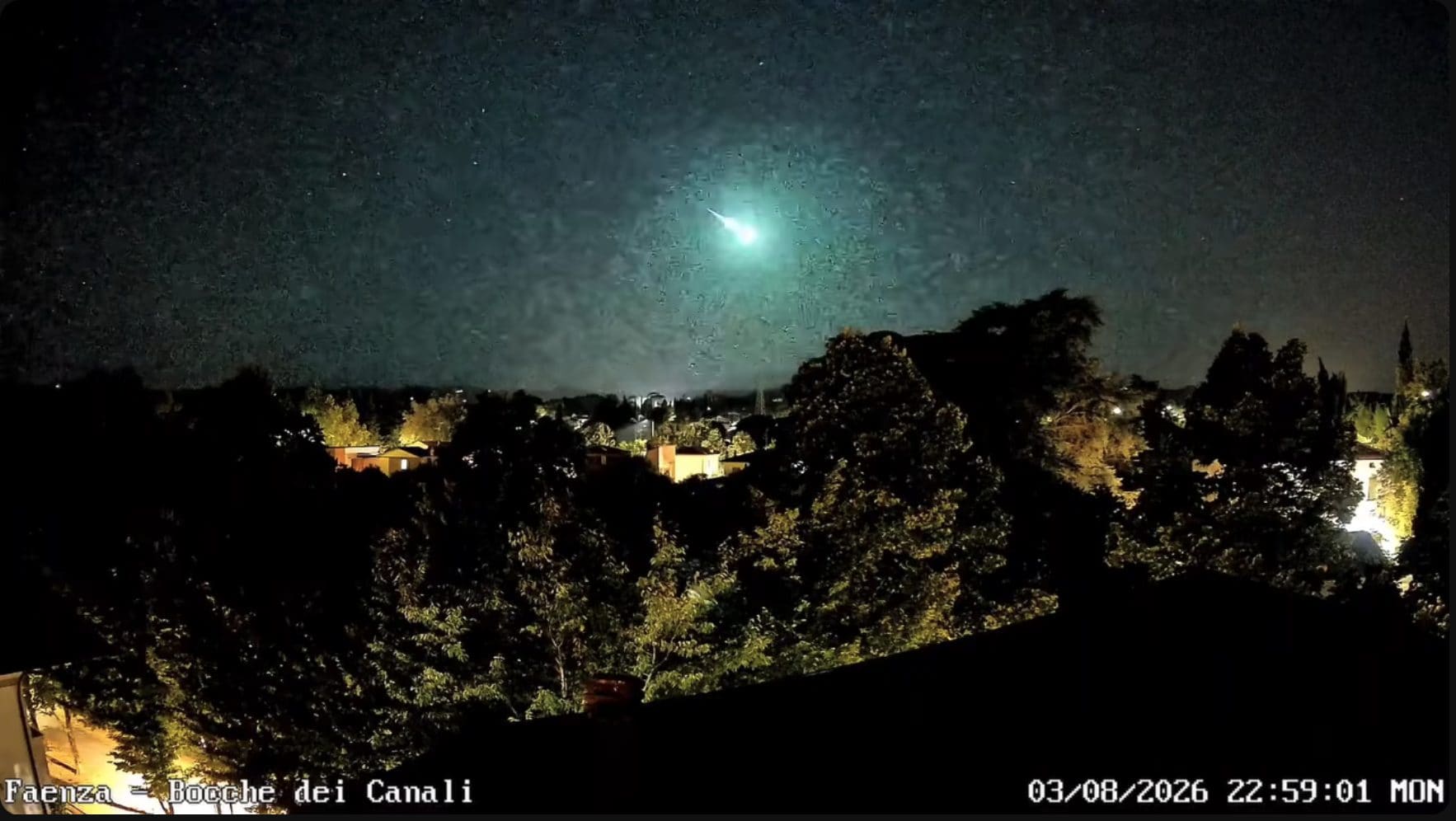
In the evenings of Monday 3 and Tuesday 4 August Numerous reports of sightings in the sky have arrived from different parts of Italy. On Monday 3 August, many reported a sudden emerald green flash that illuminated the sky for a few seconds at around 10.59pm, while on Tuesday many reported the sighting of a trail of perfectly aligned lights that remained visible for several seconds.
On Monday 3 August, at approximately 10.59pm, numerous witnesses from north to south Italy (with reports from Lombardy to Sicily) reported the sighting a very bright meteor which crossed the sky and then faded with an emerald green hue. The event was officially recorded as 6141-2026 by the network PRISM (First Italian Network for the Study of Meteors and the Atmosphere) and collected almost 500 reports in just a few hours.
This “fireball” (a non-scientific term with which we usually indicate an extremely bright meteor, brighter than normal shooting stars) is a block of rocky or ferrous material (meteoroid) that travels in space and when it comes into contact with the Earth’s atmosphere at high speeds it undergoes very strong friction, which generates enough heat to vaporize the object, creating a very visible light trail.
When the meteoroid overheats, the elements that compose it evaporate and emit light at specific wavelengths: green, in particular, tells us that the object contained a high percentage of magnesium. Below, a video shared by Perugia Meteo, in which the meteor of the evening of August 3rd is visible, taken from a webcam in Via dei Filosofi in Perugia.
On Tuesday evening, however, many spotted it a “train” of point lights move in a straight line with almost unnatural precision. In this case it was SpaceX’s Starlink satellites, which periodically launches groups of satellites with the aim of bringing broadband internet around the world. Just recently, two close launches were carried out: the Starlink batch 17-52 (launched between Friday 31 July and Saturday 1 August) and the Starlink batch 17-53 (launched on Tuesday 4 August).
When released from the Falcon 9 rocket, these satellites are initially at a low altitude, all close together and aligned in the same orbit. This is why in the first days after launch they appear like a tight row of luminous pearls: they do not shine with their own light, but reflect the light of the Sun. For this reason we can only see them at specific times: shortly after sunset or just before dawn, when it is already dark on the ground but hundreds of kilometers above sea level the satellites are still hit by the sun’s rays, without entering the Earth’s shadow cone.
As the days pass, the satellites fire their engines to reach the operational orbit at around 550 km, moving away from each other and becoming much less visible to the naked eye. To observe them, there are several platforms where you can monitor the times of the passage of satellite trails by entering your geographical coordinates and location.
We are approaching the peak of the Perseidsthe so-called shooting stars, or “tears of Saint Lawrence”, which will take place on August 12, on the same day as the solar eclipse and the alignment of six planets. We can expect then an intensification of meteor activity in the coming dayswith potentially new fireballs visible and therefore new sightings.
