
The nightmare of mosquitoes is now constant given that they frequent our homes for many months and proliferate everywhere, favored by climate change and resistence that are developing against insecticides, making them less effective. The best strategy to implement is the combination of multiple methods which, as a whole, manage to mitigate the proliferation of these annoying insects, controlling them in the different phases of the life cycle (egg, larva, pupa and adult). It is therefore useful to combine repellents, plant barriers with aromatic plants on balconies and terraces, preventive measures, biological control methods and physical devices, such as mosquito nets.
How to control the first stages of development: eggs and larvae
Mosquitoes lay their eggs in waterfall and they all need the presence of this element and warm-humid conditions for hatching (optimal temperature of 20 °C – 30 °C). Each species has its own technique: the common mosquito (Culex pipiens) lays its eggs in groups, forming rafts at the surface of the water where there is organic debris, the tiger mosquito (Aedes albopictus) also manages to exploit damp surfaces such as leaves, stones, tire tires left outdoors and saucers, finally, theAnopheles it lays its eggs in the still waters of ponds, rice fields and swamps. In urban environments all are adapted to lay their eggs in ornamental tubsmanholes and drains, waste water pools, water containers and saucers. The subsequent stages of larva and pupa always need water to survive and the metamorphosis is rather rapid to reach the development of the adult mosquito. Let’s see what we can do to control these stages.
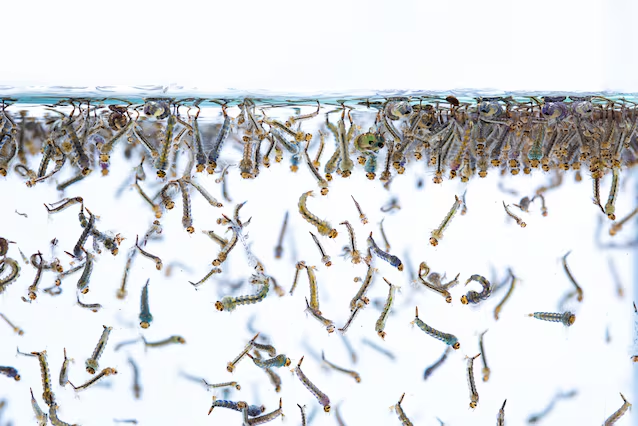
- Eliminate stagnant water: the first important measure is to reduce the availability of water on terraces and balconies as much as possible, frequently emptying saucers and containers of all kinds. The water must not stagnate!
- Biological fight against larvae: there is a bacterium, the Bacillus thuringiensis serovar israelensis (Bti), which is now present on the market in various formulations as a mosquito larvicide. It is a method of biological struggle as, the Bacillus Bti produces toxins that are highly toxic to the larvae. It is for sale in granules or tablets to be added to wells, drains and stagnant water following the instructions on the package. However, there is concern that the bacterium, which is absolutely harmless to humans and other mammals, may also have effects on other non-target insects, such as harmless aquatic insects. They are also experimenting the larvicidal powers of coffee grounds. One study in particular tested the mortality rate of yellow fever mosquito larvae (Aedes aegypti) when exposed to solutions containing coffee (arabic blend) and it was verified that, for 34 g/L of coffee grounds solution, the mortality rate for the larvae of this mosquito was 69.17%.
How to control adults
The real problem is represented by adult females of mosquitoes that live up to 6-8 weeks in optimal conditions and that bite us for their blood meal, attracted by carbon dioxide (CO2) that we emit when exhaling. You can use in “combo”:
- Natural organic repellents: some substances, such as pyrethrins and pyrethroids, chemically interfere with the neurons and receptors located on the antennae of mosquitoes and inactivate them, “weakening” their prey-hunting powers. Wanting to reduce the use of synthetic repellents (the classic mosquito sprays), it is possible to use natural organic repellents. According to a systematic review published in 2022, the oil extracted from the tree is effective Lemon eucalyptus (Eucalyptus citriodora) which, in some experiments, significantly reduced tiger mosquito bites even 240 minutes after delivery in a closed environment. Essential oils of lemongrass, cinnamon, rosemary and above all ginger they are excellent repellents. THE’neem oil (Azadirachta indicates), is effective in reducing the number of eggs laid by females. The problem, however, is that essential oils can be irritants and/or photosensitisersthat is, if applied to the skin, they can cause skin irritation once exposed to the sun: products containing them should therefore always be used following the instructions on the packaging.
- The “green barrier”: by exploiting the scent and substances emitted by some plants, it is possible to build a sort of mosquito barrier on terraces and balconies, with aromatic plants such as rosemary, lemongrass or basil which, in addition to being ornamental, help to ward off mosquitoes thanks to their smell;
- Ultrasound: these repellents, now very widespread on the market, use high frequency sound waves (above 20 kHz) which are not audible to humans, but which they disorientate mosquitoes and other insects to keep them away. Some studies have demonstrated their effectiveness particularly when combined with ventilation systems.
- Mosquito nets and fans: in addition to the classic mosquito nets to be placed on doors and windows, the use of fans has also proven effective, in particular those that are fixed to the ceiling. Experiments conducted in rural areas of Gambia, where the malaria mosquito claims victims, have shown that houses equipped with a ceiling fan had a 91% reduction in mosquito entry compared to homes without a fan.

Mosquitoes have developed resistance to insecticides
To date, synthetic insecticides are still the most common and widespread system in the fight against the proliferation of mosquitoes, also for the disinfestation campaigns of public areas carried out by the Municipalities. However, recent studies highlight that the populations of these annoying dipterans are evolving progressive resistance to many chemical agents which, among other things, have a high impact on the environment especially during the production phase. For example, the active ingredient contained in many repellents (diethyltoluamide or DEET) chemically interferes with neurons and the receptors located on the antennas, but its effectiveness is decreasing over time and can also present side effects on humans, such as skin irritation, disorientation, dizziness: it is in fact essential to use them following the instructions carefully shown on the packaging. With these repellents, what happens with antibiotic resistance is happening a bit, so over time, while increasing doses and administration cycles, mosquitoes survive because they have adapted genetically or have developed defense mechanisms that make entire classes of insecticides less effective.
