Small round holes that hide tunnels under the surface: wormholes, as well as ruining the appearance of the wood, they can hide structural damage not recently. These holes are produced by woodworms, small ones xylophagous beetles (wood eaters) who have found an invaluable source of nutrition in our domestic furniture and in the beams of ancient houses. Since most of their life cycle is in the form of larvahidden under the surface of the furniture, noticing an ongoing woodworm infestation is not easy. However, there are methods to treat and prevent woodworms, such as permethrin treatments or the use of sealant. In the case of antique furniture, the holes can even testify to its authenticity the history of these objects.
The life cycle of woodworms and how they are made
There are numerous species of houseworm that share a similar life cycle. The most common is Anobium punctatum, The common furniture worm. Adult insects lay their eggs inside crevices on the surface of furniture and beams. After about 10 days, the egg hatches and the larva begins to dig into the wood, gnawing it with its mandibles and obtaining nourishment from the fibres, resin and fungi present there.

The Development of woodworm larvae is very slowfrom one to five years: during this period, they dig tortuous tunnels several centimeters long in the pulp. These tunnels are usually concentrated in the superficial part of the woodbut if this is particularly old, damp and affected by fungi, the tunnels also develop in depth with a greater probability of structural damage and possible collapses in the case of trusses.

When the larva has reached maturity, it pupates for a few days and the adult insect – a small brown beetle with an elongated shape – emerges from the wood, creating an exit of approximately 1-2 millimeters in diameter. The hole of a woodworm therefore does not correspond to the animal’s entry into the wood, but rather to its own exitand it is often possible to find a small one on the floor in correspondence with the hole mound of sawdust pushed out by the insect. The adult life of woodworms is much shorter than the period spent as larvae inside the wood: shortly after finding a mate, the woodworm lays its eggs on the wood and begins a new life cycle.
Other wood-eating beetles
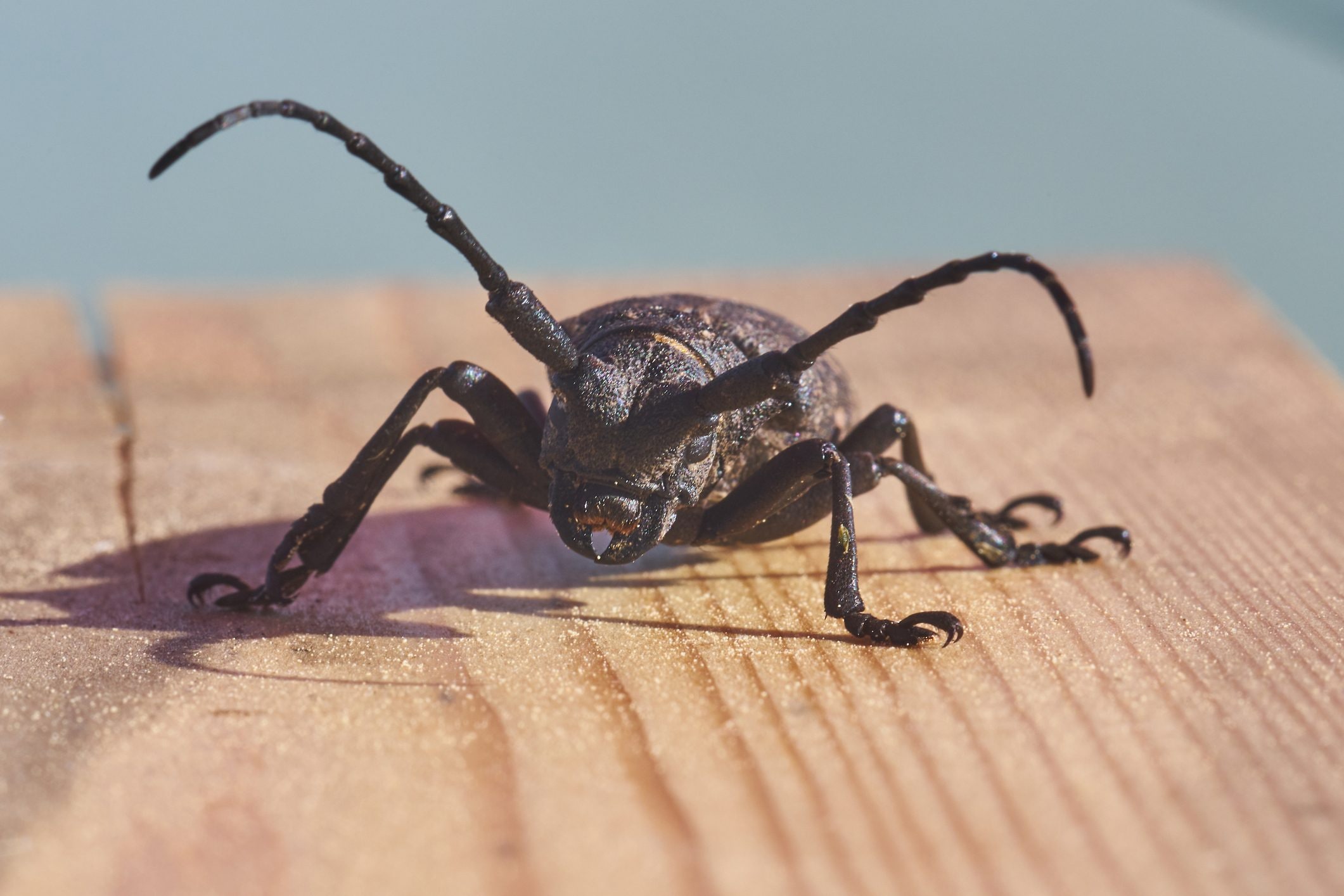
THE Cerambycides they are another family of xylophagous beetles that can infest homes. They are easily distinguished from woodworms by their larger size (up to 2 cm as adults), more elongated shape, and very long antennae divided into segments. Generally, long beetles prefer outdoor environments: their larvae mature under the superficial part of the bark of trees. For this reason their presence in the home is often incidentalusually caused by a larva present in a pile of firewood that is transported from outside. However, there is a species that has made the domestic environment its chosen place and whose presence can cause considerable damage, particularly to the rafters. THE’Hylotrupes bajulus, also said Capricorn of the housesis recognizable by its black color and relatively short antennae compared to other long beetles.
Present on Italian territory (in South Africa it is in fact called Italian beetlebecause it arrived in the country via wooden packaging from Italy), theHylotrupes it is among the most harmful xylophagous weeds. The larva prefers coniferous wood, takes several years to mature and burrows very deep, keeping the extent of the damage in the dark for much longer, and being much larger than that of a woodworm, it leaves exit holes up to 10mm wide. This species can cause extensive structural damage which if ignored can result in collapses: in addition to holes and piles of sawdust, it is sometimes possible notice the presence of the larvae by the noise. By placing your ear against the wood, it is in fact sometimes possible to hear the gnawing of their jaws.
How to get rid of woodworms in the house
Having evolved to consume rotten wood in woodland environments, woodworms have a preference moist wood rich in fungimuch easier to gnaw: for this reason treated and well dried wood is unappetizing for them. Even the smooth surface or covered with plastic films is a good deterrent against egg laying. In case of infestation, there are several methods to get rid of woodworm larvae. The most widespread is the use of products based on permethrina common insecticide, through the application of sprays or resins that penetrate the surface of the wood. The treatment anoxic does not use pesticides but requires more time: the furniture is wrapped in plastic covers or sealing substances and the oxygen inside is effectively eliminated suffocating the larvae. Effective for even the most precious objects microwave treatmentswhich through special machinery heat the wood deeply without damaging it but killing the larvae present beneath the surface. In any case, the best strategy is prevention, choosing specially treated wood and reducing humidity as much as possible in the domestic environment.
Because finding signs of woodworms on antique furniture is positive
A wormhole ruins the surface of a piece of furniture, but sometimes this damage can be considered as a guarantee mark. If the piece of furniture is ancient, in fact, the probability that during its history it has not been affected at least once by woodworms is almost impossible, and in this case one or more holes represent clear evidence of the history of furniture. The presence of wormholes does not increase the value of an antique piece of furniture – it is still an obvious damage – but can therefore corroborate its authenticity.

For this reason, unscrupulous counterfeiters or antique dealers sometimes practice fake wormholes using drills or props to try to make a recently built piece of furniture look antique, and thus increase its selling price. In 2011, for example, a German art dealer used this technique on frames to make counterfeit works of art more convincing, defrauding collectors of around 16 million euros. Forgers aside, fake wormholes are also used in a declared way, to “antique” furniture and floors for aesthetic purposes. Distinguishing between a real wormhole and a fake wormhole is quite simple thanks to the help of a pin. The exit holes of the woodworms are at the end of long tortuous galleries, into which it is not possible to insert a pin, while the fake wormholes made with tools proceed straight for a few millimetres, allowing the pin to enter easily.
