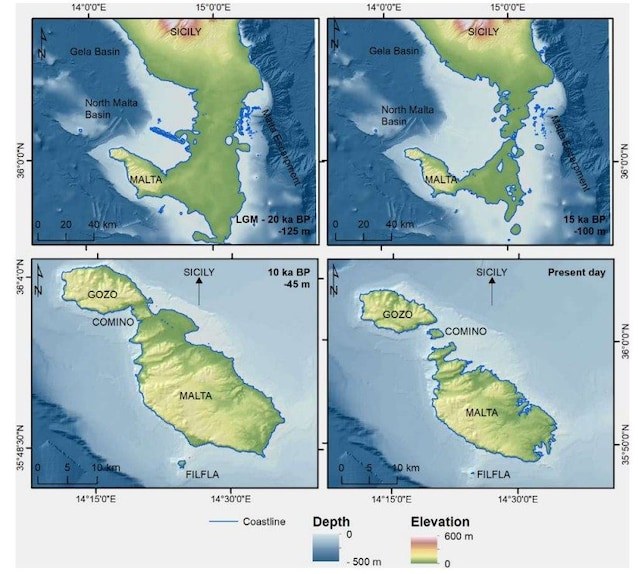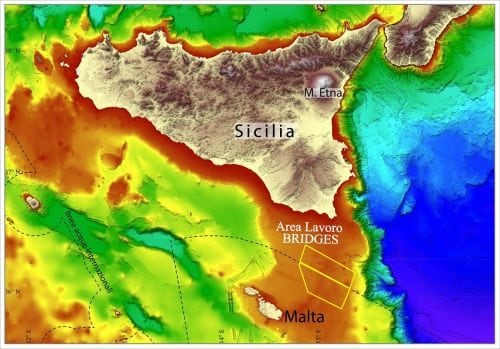
It took place BRIDGES shipping of the Gaia Blu research vessel of the CNR (National Research Council). His goal was to identify submerged evidence of the land bridge which 22,000 years ago, during the last ice age, connected the South-eastern Sicily to the Maltese islands. At that time the sea level was about 120 m lower than today and this strip of land could emerge, facilitating the movement of animals and human beings. The BRIDGES expedition, carried out between the end of December 2025 and the beginning of January 2026, was born from the collaboration between the Institute of Marine Sciences of the CNR, the National Institute of Oceanography and Experimental Geophysics (OGS) and the University of Malta. Thanks to the advanced technology of Gaia Blu we will be able to obtain a landscape reconstruction subject of a much more detailed investigation than that developed so far.
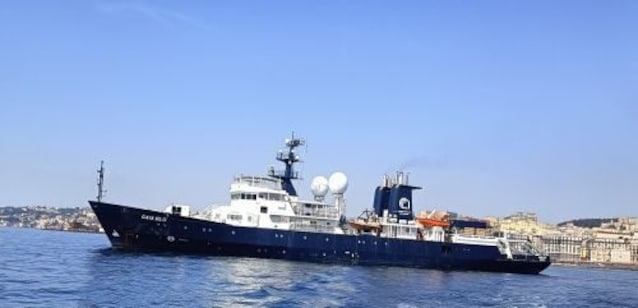
The BRIDGES expedition on board the Gaia Blu ship
The researchers operated on board the Gaia Blu research vessel, 84 m long and with a tonnage of over 2000 tons, which has dozens of scientific expeditions behind it. The ship is a real jewel from a technological point of view, in fact it has bathymetric survey equipment capable of reconstructing the morphology of the seabed in an extremely detailed way. It will thus also be possible to identify the ancient coast lines and identify the elements of the emerged landscape from 22,000 years ago, such as valleys and reliefs. The result will be a faithful three-dimensional model of that now submerged environment. During the expedition the researchers also collected from the seabed sediment samples which will be used to understand how long the land bridge remained above ground and to identify any traces of the passage of living organisms.
Italy of the last ice age and the Sicilian-Maltese continental bridge
During the coldest phase of the last ice agebetween 25,000 and 19,000 years ago, temperatures in our peninsula were approximately 4-5 °C lower than today. A ice cap more than 1 km thick, it extended across northern Italy until it reached the Po Valley. Due to the enormous amount of water trapped in the planet’s ice, the Mediterranean level it was 120 m lower than today: this means that many currently submerged areas emerged from the water. In place of the northern portion of the Adriatic Sea there was a plain that connected Italy to the Balkan peninsula. Sardinia and Corsica were united to form a single large island, as was the Sicily And Malta. In particular, the Maltese islands were connected both to each other and to Sicily by the so-called Sicilian-Maltese continental bridge. This emerged strip of land served as a passage for large quadrupeds, whose remains have been found in some caves on the Maltese islands. The evolution of the continental bridge over time has been documented, but so far it has been difficult to find detailed evidence due to the limited availability of high-resolution bathymetric data and sediment cores. Now, with the results of the BRIDGES expedition, we will finally be able to fill a gap in our knowledge of that submerged landscape.