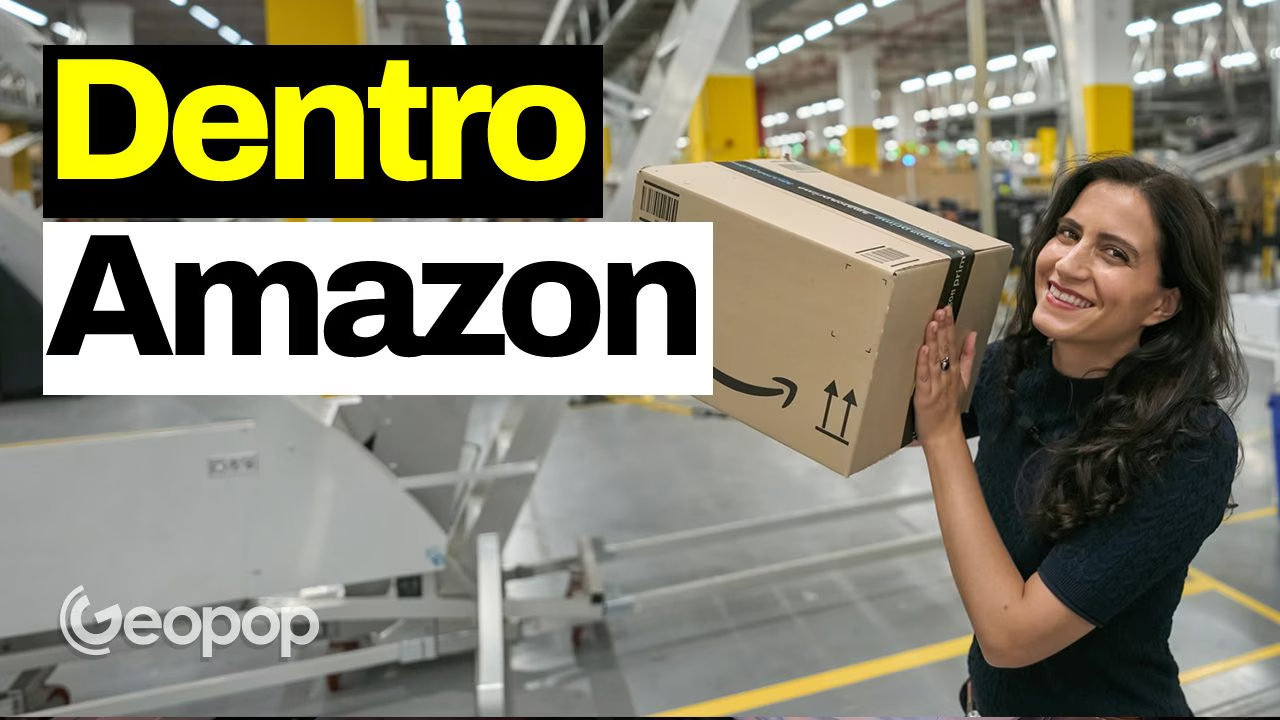
It has happened to many of us: we place an order on Amazon and the package arrives for delivery within a few hours or a few days. Behind these timing there is a logistics that combines the work of hundreds of people with a high level of proprietary technologies And optimized warehouses. In fact, forget the traditional idea of a warehouse, with corridors of fixed shelves and operators who walk along them. In the so-called “robotic” Amazon distribution centers the principle is reversed: objects move, not people. A choice made possible by one internal research and development networkwith three large centers which, in collaboration with Universities and Polytechnicsdesign new technologies, software and machinery dedicated to logistics.
But now, let’s find out what happens immediately after we place an order on Amazon!
What happens immediately after the click
When a customer confirms an order, the system automatically identifies the nearest warehouse who has the product available. There logistics structure of Amazon has a configuration that could be defined pyramidal: at the top there are i supply centerswhich act as a “warehouse of warehouses”. From there the goods reach one of the 9 distribution centers present in Italy and then move on to smaller centers, sorting centersand finally reaches the sorting depots which complete the capillary distribution of the last mile up to the final customer.
The picking stations: assistive technology, lights and random logic
As soon as the order arrives, the collection of products takes place in dedicated stations, where it is not the operator who goes towards the shelf, but the opposite: it is the shelf that reaches the person, carried by small mobile robotic units. A light automatically signals in which cell the requested product is located, eliminating dead times in the search. This system was also designed to guarantee greater safety and ergonomics: the operator works in a fixed position, without having to move along corridors or lift loads in awkward positions. A detail that might surprise you: in every cell completely different products coexist with each other, without any apparent product criteria. This random arrangement responds to two specific needs. The first is reduce the risk of error: if there were two similar variants of the same product in the same cell, the possibility of confusion would rise; by mixing heterogeneous objects, the risk is eliminated. The second reason concerns theoverall efficiency of the system: by uniformly distributing the products throughout the warehouse, the shelves statistically travel shorter distances, instead of concentrating traffic towards a few areas. For security reasonsthe mobile shelves area is fenced off and accessible only to authorized personnelwho wears harnesses equipped with sensors: they communicate with the central system and cause nearby shelves to slow down or stop. Before entering, each operator records the path he will follow on the tablet, so that the system keeps the shelves away from that trajectory.
How the goods arrive: a predictive system
Before ending up on the shelves, each product passes through areception areawhere mechanical arms equipped with suction cups and conveyor belts assist operators in unloading boxes. A non-intuitive aspect concerns the nature of this merchandise: these are not products already ordered by customers, but items that Amazon’s IT systems predict will be purchased. It’s a predictive approach which allows you to have a large part of the catalog already available and physically stored in the warehouse, ready to be shipped as soon as the order arrives. Every object comes scanned and inserted into standardized containers called TOTEunits around which the entire warehouse infrastructure is designed: it is these containers, and not the individual products, that travel along the approximately 20 kilometers of conveyor belts. The maximum manageable dimensions correspond approximately to those of a pod coffee machine; for bulkier items or household appliances, there are dedicated and specialized warehouses in Italy.
Packaging, sorting and shipping: where the human factor becomes central again
In the’packing areathe packages that the end user will receive are created. Here orders are managed on two separate lines, depending on whether they contain a single item or multiple products together. Here too, technology guides the process: the system automatically suggests the most suitable box size for each order. Despite the level of automationThe human contribution remains decisive even in this phase: the operator carries out a quality control which no automatic system is able to replicate, intervening in the event of damage or anomalies to the products before shipping. Once packaged, the package receives the label with the shipping information via an air system designed not to damage the contents and protect customer privacy, and is then automatically sorted towards the final destination via the warehouse’s intricate network of conveyor belts.
From here, the journey inside the center ends and the journey towards delivery to the customer begins.
