Films, comics, video games and novels have accustomed us to think about jet pack (literally “backpack-jet“, often also known by synonyms such as rocketpack) as a relatively common tool for navigating the skies. But what is it, exactly? Generally speaking, a jetpack is one special jet backpack which allows a person to lift themselves off the ground and fly autonomously using a very strong upward thrust. This propulsion is generated by expelling hot gases downwards at very high speed or, in its famous aquatic variant, powerful jets of high-pressure water.
The question therefore arises spontaneously: do they really exist in reality or are they just science fiction? The answer is yes, they exist. Over the decades, various models have been developed, although they are often devices still in the experimental phasewith limited autonomy or intended for very specific applications.
Rocketpacks
Let’s start with rocketpackthe oldest models, such as the famous one Bell Rocket Belt of the 60s. In this case the propulsion is entrusted to real rockets. In fact, there is some in the backpack propellant (such as hydrogen peroxide) that is pushed against a silver catalystgiving rise to a violent chemical reaction. This produces superheated water vapor at around 700°C, which is expelled from two lateral nozzles at supersonic speed and generating a strong upward thrust.
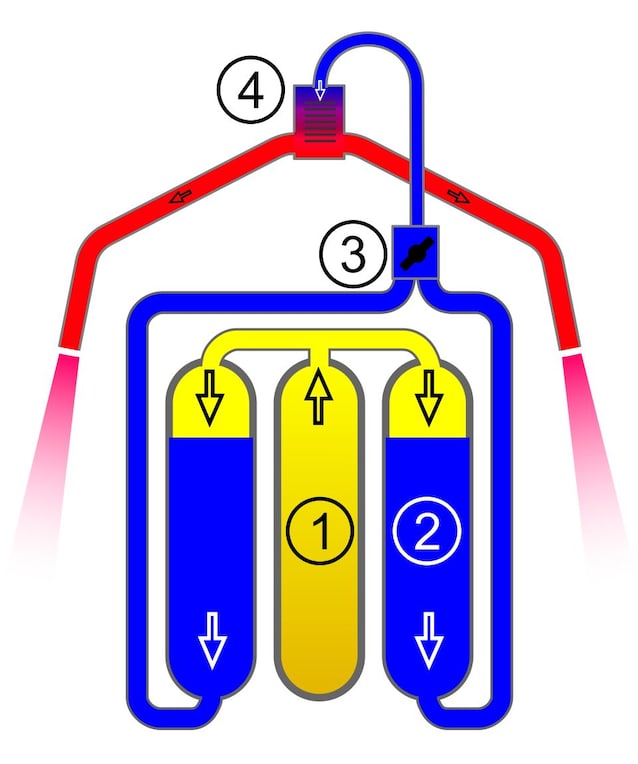
The problem? That reaction is so violent that burning fuel at an absurd rate. About 20 liters of hydrogen peroxide were consumed in just that 20-21 seconds of flight. For this reason the next evolutionary step of these backpacks was the jet pack.
Jet packs
Jet packs are backpacks equipped with real turbines miniaturized. The system draws in air from the environment, compresses it, mixes it with liquid fuel (such as kerosene) and burns it. The high-energy gases rotate the turbine – which powers the compressor – and are then expelled generating thrust. The great advantage is that here the mass of the necessary propellant is reduced and this technology allows you to fly for several consecutive minutes.
For a long time the main limitation of this system was the stabilization during the flight phase but, fortunately, to date they have been integrated systems automatic which are able to manage all turbulences and instabilities in flight, making control much simpler and safer.
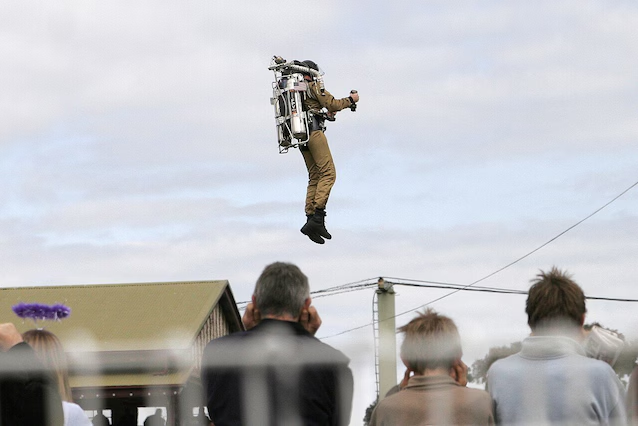
Of course, we shouldn’t expect that from one day to the next we will find our skies full of flying people – they still remain instruments in the testing phase and intended for specific applications in the future. One of these is emergency medical aid in hostile environments: with the jetpack it is technically possible to easily reach injured people in the mountains, for example, bypassing hours of walking and avoiding the use of helicopters. Other applications may be in the industrial and military fields, although everything is still in the experimental phase.
Water jetpacks
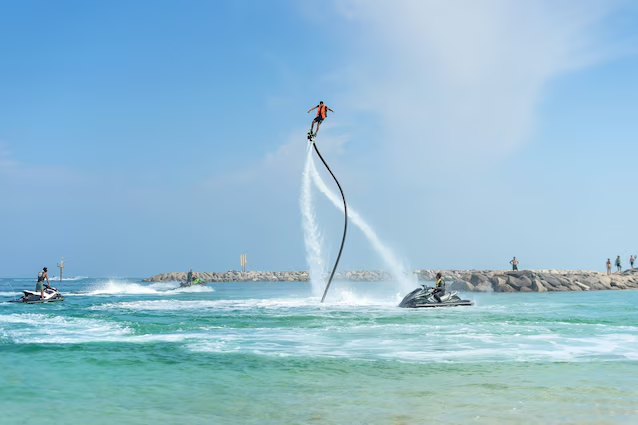
However, there is one last type of jetpack that is worth mentioning, namely i water jetpack or flyboard. As the name suggests, these are tools that exploit thewaterfall: specifically, the backpack is connected via a long hose – like that of the firefighters – to the exhaust of a jet ski, which acts as a pump and pushes the water into the tube at impressive rates: up to 60 liters per second. The water is then shot downwards from two nozzles at around 15 meters per second, or over 50 km/h.
Clearly it is a system where theRider balance is crucial: it’s easy to fall if you don’t balance your movements well! However, being in the water, it is considered a recreational activity and loved by tourists around the world.