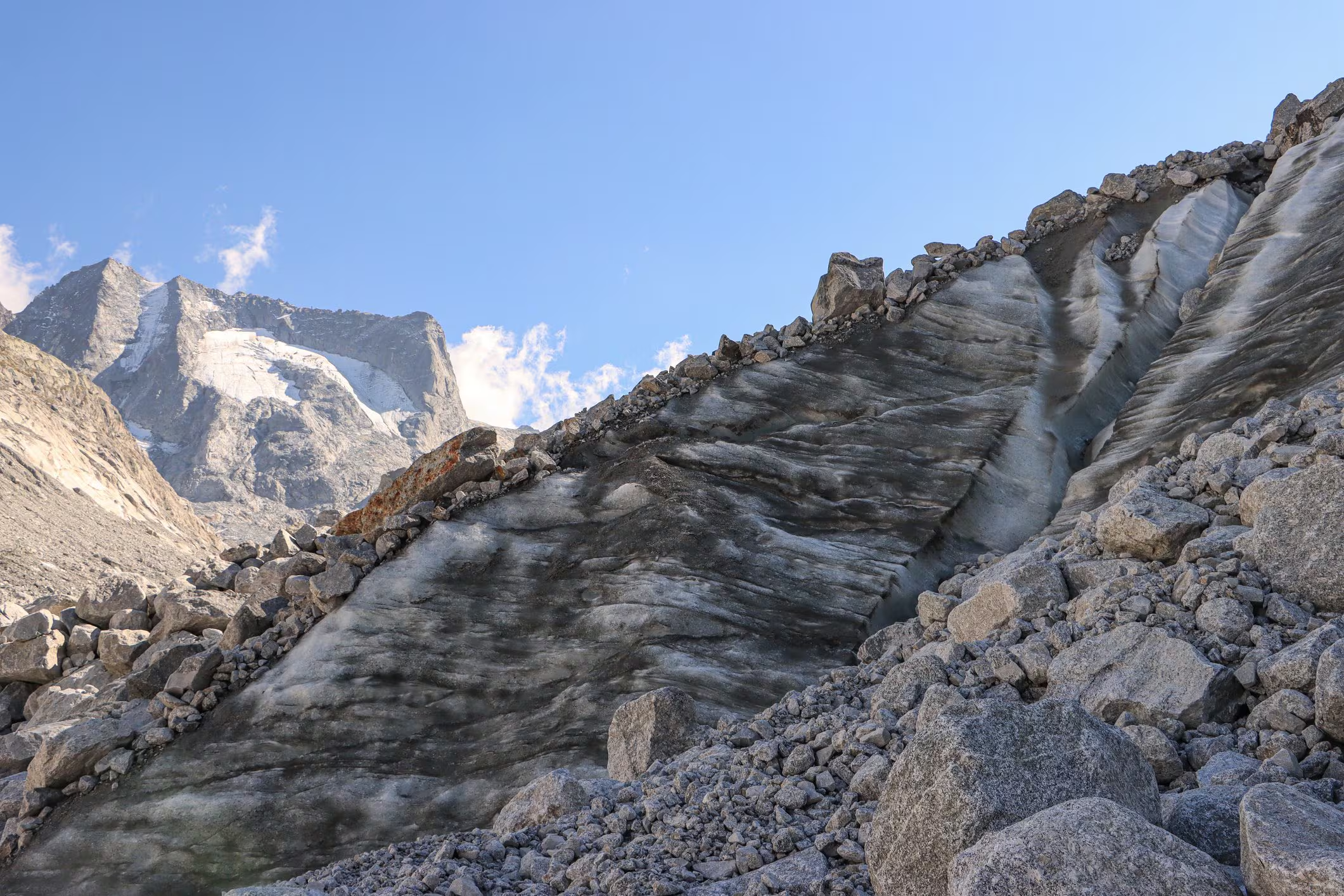
The heat waves that followed one another throughout the summer made the Alps increasingly fragile and potentially dangerous for hikers. The very high temperatures due to global warming determine the accelerated melting of Alpine glaciers and permafrostthe permanently frozen ground which in the high mountains has a stabilizing function on the rocky slopes. The melting of glaciers produces large quantities of water which, without the presence of permafrost, infiltrates deep into the cracks. The result is that the steeper slopes become unstable and increase the landslides. Starting from mid-July 2026 large landslides occurred on the slopes of Matterhorndel Mount Pelmo in the Dolomites and beyond Mont Blancwhich they involved thousands of cubic meters of rock. In some cases, mountain guides have suspended ascents and even independent hikers are asked to pay close attention.
The large landslides of summer 2026 in the Alps: what happened
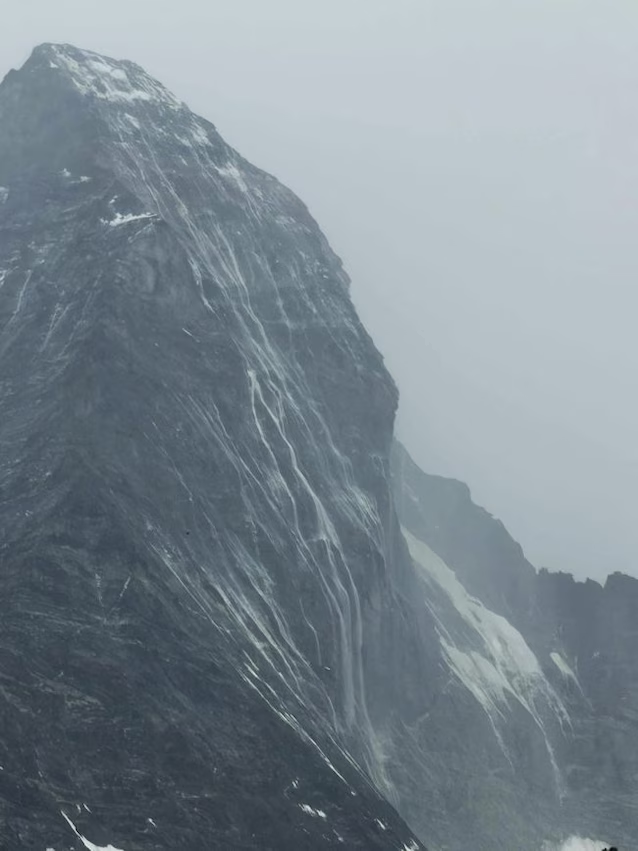
Starting from the month of July the Mount Pelmoin the Belluno Dolomites, was affected by numerous rock collapses on the northwestern side. Among the most significant episodes are those of 23 July, 2 and 8 August. The detachments were accompanied by explosions and clouds of dust and fortunately did not cause any injuries. Even on the French side of the Mont Blanc a major collapse occurred on 12 July, followed by another on 15 July in the Couloir du Goûter area, during which two climbers lost their lives. New collapses were reported in the area on August 7. Another large landslide occurred on August 5 on Matterhorn along the Deffeyes ridge on the south face at 3900 m above sea level. The event did not involve people but still led the mountain guides to suspend the climbs to Gran Becca.
Because the heat causes more collapses in the mountains
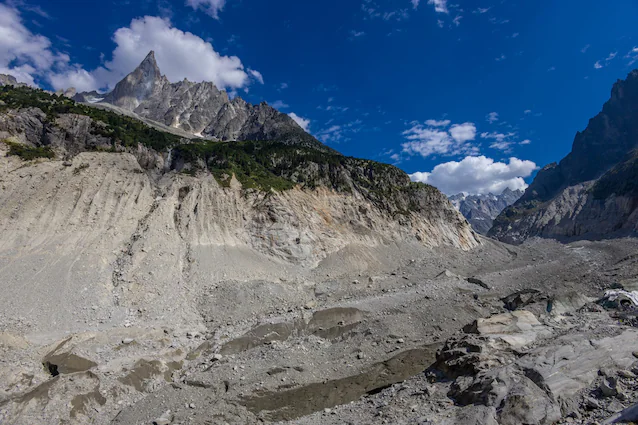
These phenomena are the result of the combination of several factors. Among the causes that predispose the Alpine territory to landslides are thehigh slope of the slopes, thehigh degree of fracturing of the rocks and the presence of water inside the fractures. During the heat waves that characterized the summer of 2026 I the freezing point has exceeded 4000 m. The high temperatures at altitude, together with intense rainfall on the mountain tops, have led to the increasingly rapid melting of glaciers.
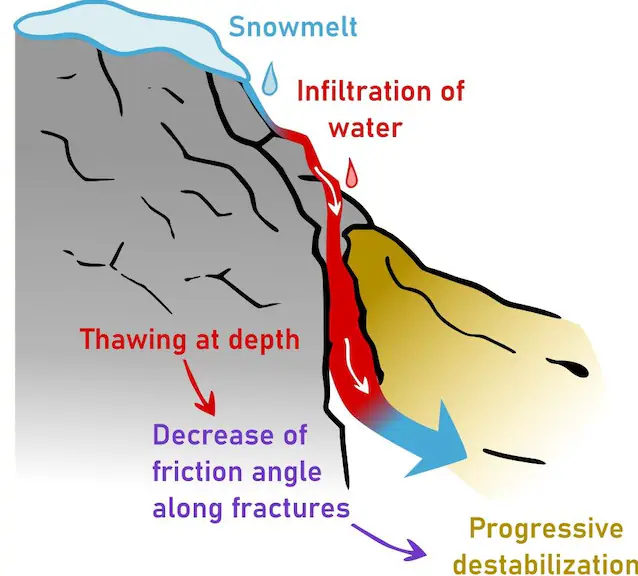
In the presence of these conditions, the already scarce snow that has accumulated during the winter tends to disappear very quickly without having time to turn into ice. The water produced by fusion infiltrates the fractures of the rocks very easily because these are no longer sealed by the permafrostwhich is also degraded by global warming. Permafrost is the permanently frozen terrain (consisting of soil, debris, rocks) found high in the mountains and which maintains a temperature equal to or lower than 0 °C for two or more consecutive years. Only its surface layer (active layer), which in the Alps has a thickness varying between 0.5 and 8-10 m, thaws in summer, and then refreezes in winter. Now, however, with global warming, the active layer is deepening more and more, leading to a accelerated fusion of this precious “sealant”. The permafrost, if intact, has a waterproofing function that hinders the infiltration of water deep into the fractures, where this exerts considerable pressure especially when it penetrates and freezes very deeply. The weaker slopes thus become increasingly unstable, up to generate rock collapses even large ones.
Precautions for hikers
The melting of glaciers and permafrost in the Alps constitutes a potential danger for hikers and mountaineers. For this reason, following the occurrence of landslides in recent months, various mountain guide associations have suspended ascents, also recommending independent hikers to climb with caution and in some cases avoid risk areas. In fact, it is known that these phenomena are favored by high temperatures and intense rainfall, but it is not possible to predict the exact place and moment in which the collapses will occur. The danger does not only affect the more difficult routes, but also the simple itineraries. Before embarking on an excursion it is therefore necessary to check not only the weather conditions, but also whether they exist reports on the conditions of slopes and paths by local authorities or mountain guides. Overall, it’s good leave in the early hours of the daywhen the risk of slope instability is lower (although not zero). At high altitudes it is also advisable do not stop under the steepest walls and pay attention to noises and falling rocks which can anticipate more significant collapses.
