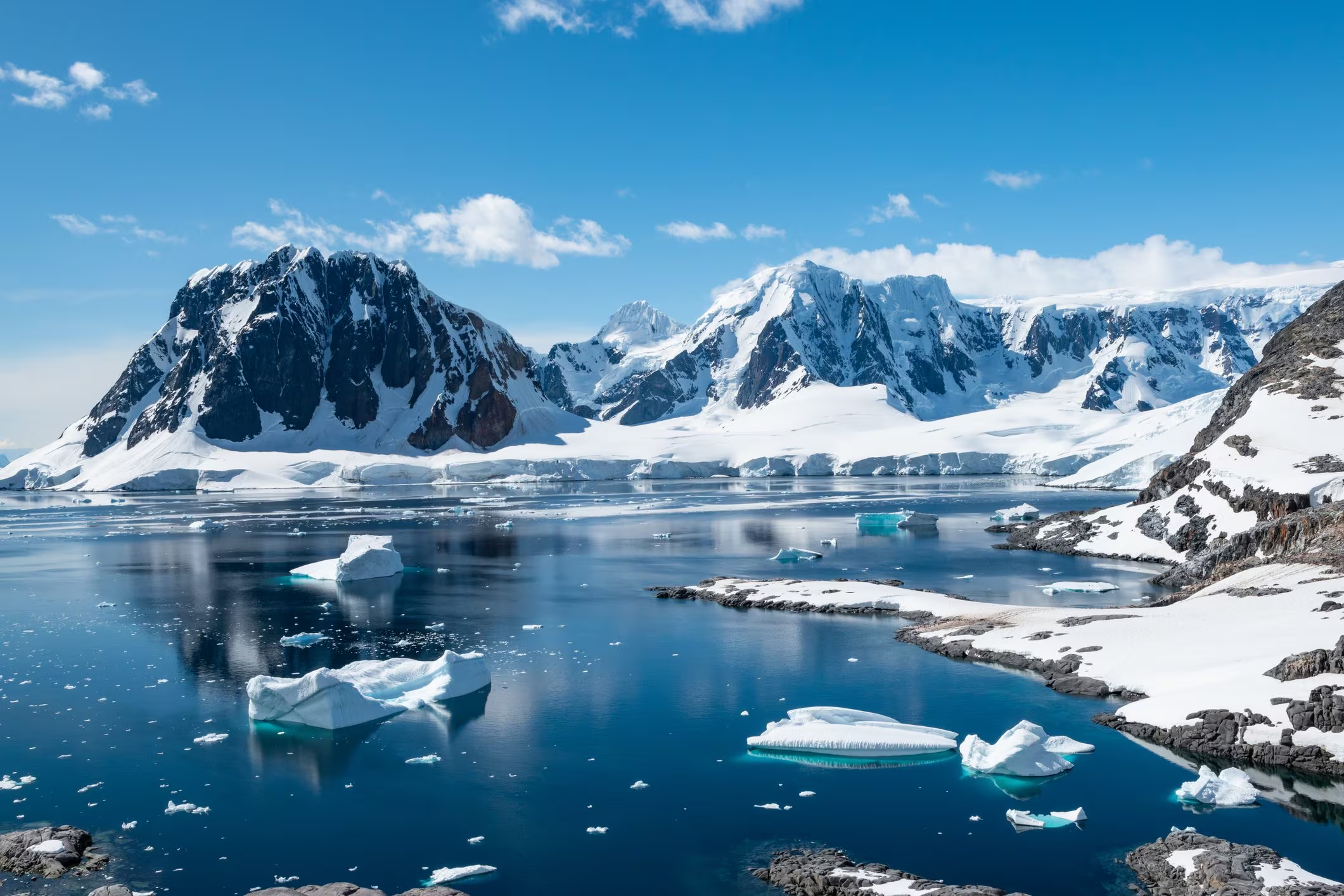
A new scientific study published in the journal Proceedings of the National Academy of Sciences (PNAS), coordinated by Maodian Liu of Peking University, shed light on an environmental dynamic that affects the Antarctic Peninsulaone of the regions of the planet that is warming most rapidly. The researchers analyzed 16 core samples of marine sediments taken along the continental shelf, integrating the data into a model of global mercury cycle. This approach allowed us to reconstruct theevolution of heavy metal accumulation in the last two centuries. The results show that, from the beginning of industrialization to the present, the rate of mercury accumulation in Antarctic sediments has increased by 160%reaching an average value of 93 micrograms per square meter per yearabout double the average observed on continental shelves globally. Now, due to global warming, this mercury trapped inside the ice is being released into the environment, potentially entering the marine food chain.
How does mercury reach Antarctica
To understand how mercury can reach the Antarctic seas in the absence of important local sources of emissions, the authors of the study distinguished two main mechanismsclosely linked to each other. The first is the atmosphere-ocean cyclethrough which mercury emitted thousands of kilometers away, for example from coal burning and other industrial activities, is transported into the atmosphere and subsequently deposited in the waters of the Southern Ocean. The secondso far less considered, is the atmosphere-glacier-land-ocean cycle: over time, the mercury deposited by the atmosphere has accumulated in the ice and, above all, in the terrestrial sediments exposed or influenced by glacial dynamics. With the increase in temperatures, the accelerated melting of ice and the consequent soil erosion favor the remobilization of this mercury “inherited” from the past, which is transported towards coastal waters and therefore towards the open sea. The interaction between these two cycles is radically changing the role of Antarctica in the global balance of pollutants, transforming it from passive tank to active contamination engine.
As he explains Chengzhen Zhouenvironmental scientist at Peking University, first author of the study and coordinator of the research team:
The coupling of these two cycles increased the terrestrial release of mercury associated with melting ice by 550% and the exchange between the atmosphere and the ocean by 350%. Climate warming is therefore turning Antarctica’s large historical mercury reservoir into an active source of secondary pollution, amplifying the risk of mercury contamination in the polar regions.
According to the model simulations, overall this dynamic would have resulted in a estimated 400% increase in mercury exports towards the open waters of the Southern Ocean.
The risks for the food chain and the environment
Release of mercury into the Southern Ocean may pose a threat to Antarctic marine ecosystems. Once present in the marine environment, in fact, mercury can be transformed by some bacteria into methylmercurya highly neurotoxic form that tends to accumulate in organisms and to biomagnify along the food web. The Southern Ocean food chain, from diatoms and krill to fish and apex predators, is particularly sensitive to methylmercury contamination. The authors underline that:
Accelerated mercury enrichment and cycling in Antarctica may increase risks to Antarctic ecosystems.
Recent observations also show elevated levels of mercury in some Antarctic marine species. If other seas of the Southern Ocean had also undergone, after industrialization, an enrichment of mercury comparable to that detected on the Antarctic Peninsula platform, the risk of contamination for ecosystems and fisheries could be even more widespread.
