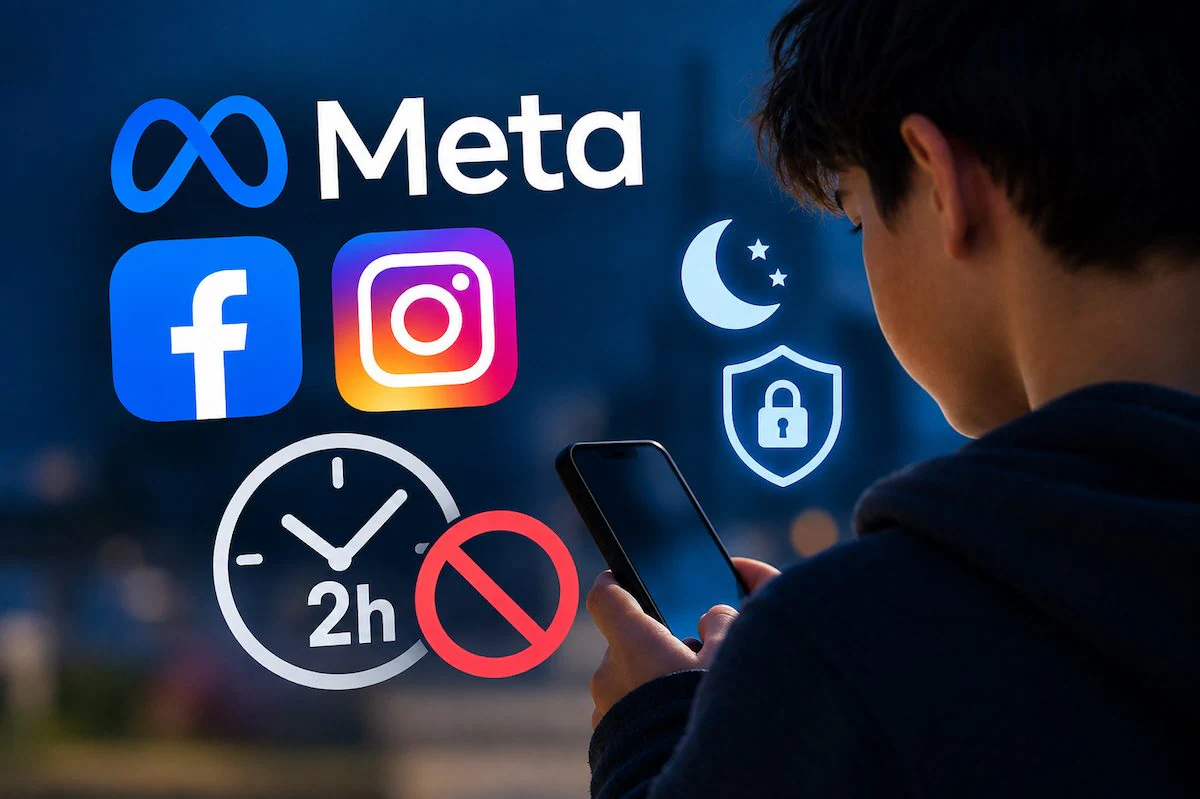
Instagram And Facebook they will change for the minor users in the United States. Following an agreement reached by Half with a bipartisan coalition of attorneys general, precise information will arrive for those under 18 limitations: 2 total hours of use per day, a block during the night, silenced notifications during school hours and more control tools for parents.
The agreement was approved by a federal judge on August 27, 2026 and will cover the states and US territories that have joined it. The new protections will affect not only the time spent on the platforms, but also the methods of use, the contents shown and age verification. The limitations do not concern Italywhere at the moment there is no equivalent system, even if the issue of minors’ access to social media is the subject of a legislative proposal.
How will the limit work: TikTok and YouTube?
The 2 hours spent on Facebook and Instagram will not be calculated separately, but the time will be added. If, for example, a teenager uses Instagram for 1 hour and 30 minutes, he or she will have 30 minutes left before reaching the daily threshold. The count will also include any multiple accounts that Meta manages to trace back to the same person and, to deactivate the cap, a parent’s authorization will be required.
Before stopping, several reminders will appear. Kids will receive an alert after each 15 consecutive minutes of use and further reminders when the total for the day reaches 60 and 90 minutes. This will introduce more interruptions during extended sessions, rather than only intervening once the expected maximum is reached.
The functions of direct messaging they will remain excluded from the daily cap and other time restrictions. It will therefore still be possible to exchange messages with friends and family even when the other sections of the applications are not accessible.
Meta also asked TikTok And YouTube to adopt the same standard. If both adhered to the stipulated conditions, some measures would become more stringent. The limit would drop to 1 hour for each appthe night block would be extended from 10pm to 7am and the commitments under these provisions would increase from 5 to 10 years.
At night the apps will be blocked and notifications will decrease at school
For those under 18 access to Instagram and Facebook it will be automatically locked between 00:00 and 6:00. In that range it will not be possible, for example, to publish content or consult Feeds, Stories, Explore and Reels. This protection can also be removed only with the permission of a parent.
Notifications will follow different times: they will be deactivated by default between 10pm and 7am and, in addition during the school year, between 8:00 am and 3:00 pm. There are some exceptions, including warnings regarding account or user security. The California Department of Justice specifies that the school mode will apply from August 15th to June 15th, in a context in which the relationship between teenagers, smartphones and school is increasingly discussed.
Fewer visible likes, limited filters and more control over content
The news doesn’t just concern the time spent in front of the screen. For younger profiles the number of likes and reactions to posts will be automatically hiddenboth on its own contents and on those published by others. Meta will also continue to prevent the use of filters that simulate cosmetic surgery interventions and it will also block those who apply extreme makeup transformations.
Affected users will be able to choose a default setting non-personalized feedthat is, a sequence of contents that recommendation systems will not adapt based on interests and previous interactions. Parents will be able to make this mode mandatory through supervision tools.
It will then be possible disable autoplayso videos and other contents will not automatically start one after the other and, to view new ones, a voluntary action, such as a touch or a scroll, will be needed. This choice may also be made mandatory for the supervised account.
Another point concerns the age indicated by users. Meta is committed to strengthening the technologies used to identify the profiles of children between 13 and 17 years old even when they declare an adult age, as well as improving the detection and removal of those attributable to children under 13 years of age. The topic of online age verification is equally central in the European Union, where a digital solution has been developed to prove that you are of age without communicating your date of birth to the platform.
Because Meta reached this agreement in the United States
The agreement closes one legal dispute started in 2023 by a coalition of U.S. attorneys general. According to the allegations, the company encouraged excessive use of Instagram and Facebook by children and adolescents, while downplaying the risks associated with the platforms. The complaints also included the collection and use of data from users under the age of 13 in alleged violation of the rules on the privacy of minors.
The trial began on August 18, 2026 in the Federal District Court for the Northern District of California. A few days later the parties reached an agreement, which was then approved by the judge. Most conditions will have to remain in force for 10 years. The daily cap and the night mode are initially foreseen for 5 years. On an economic level, according to the California Department of Justice, they are expected payments of up to $17 billion to the States over the decade.
Compliance with the agreement will also be subject to external monitoring. A independent auditor will verify every year, for 5 years, that Meta respects its commitments.
The new restrictions concern the USA, not Italy
Meta had already introduced Instagram accounts for teenagers in 2024, equipped with automatic protections for teenagers and supervision tools dedicated to parents. These functions therefore already existed before the agreement, which now adds specific obligations related to the use of the platforms in the United States.
In Italy, however, There is no mandatory daily limit comparable to the 2 hours established by the US agreement. However, Italian legislation intervenes on consent to the processing of personal data: based on the Privacy Code, come on 14 years old a minor can provide it independently in relation to the direct offer of information society services when the processing is based on consent. Below this age, in these cases, the role of the person exercising parental responsibility is necessary.
However, the picture could change. The Senate is considering bill no. 1136 on the protection of minors in the digital dimension, the new text of which provides that the activation of accounts on social networks and video sharing platforms is only permitted after 15 yearstogether with the introduction of systems for check the age of users. However, this is a proposal still under discussion in the Commission and, therefore, not a rule already in force.
The question fits into a wider international debate on minors’ access to social media. Australia has already banned the use of social platforms by those under 16, while France has introduced a ban for those under 15. The US model, however, follows a different path: it does not prevent teenagers from accessing Facebook and Instagram, but intervenes in the way in which they can use them, introducing automatic time limits and giving parents greater control over the possibility of modifying them.
