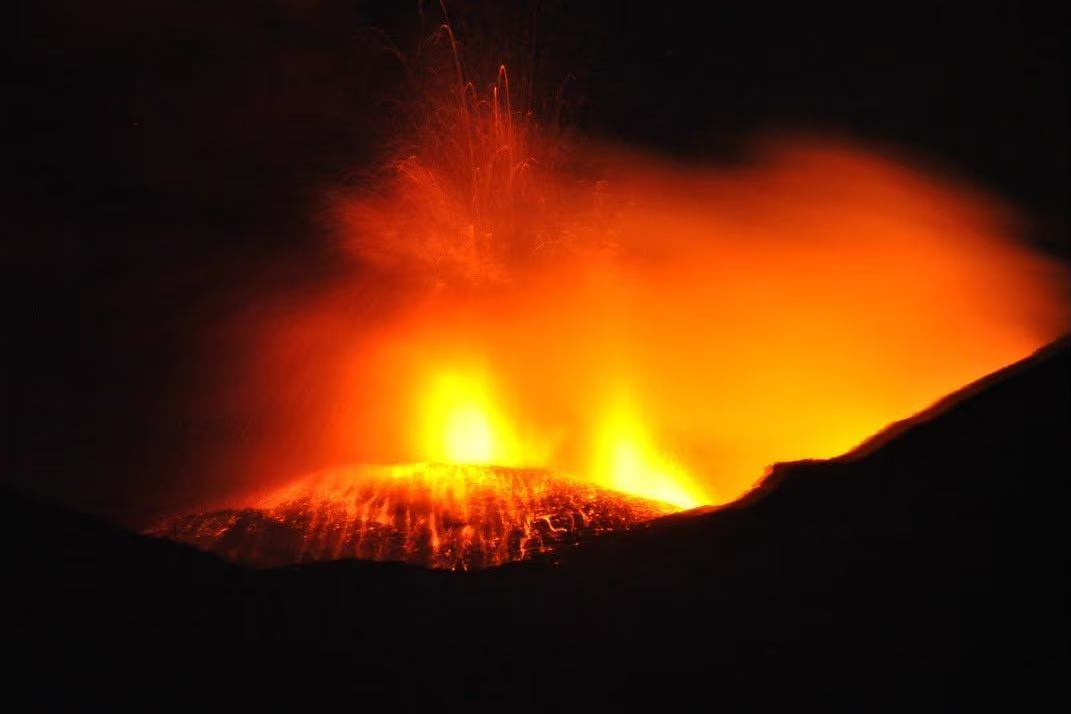
THE’Etna comes back to be heard: the tallest volcano of Europe, among the most active on the continent, recorded a new eruptive episode characterized by ash emissions from the mouth on the high eastern side of the Voragine crater, clearly visible in the video recorded by Vincenzo Modica’s webcam. As reported by the Etna Observatory, the eruptive activity – which began at 07.45 yesterday, Sunday 5 July – intensified around 08.45, generating a eruptive cloud approximately 1.5 km high above the top of the volcano and directed towards the south/south-east sectors.
Meanwhile, a red alert has been issued for civil aviation, with the ash cloud moving towards the south-east reaching 4,500 metres: numerous flights have therefore been canceled at Catania airport. At the moment, the red code is still in force, with several routes to Turin, Milan Malpensa, Linate and Trapani having been canceled in the early hours of today 6 July.
Eruptive activity: cloud approximately 1.5 km high
According to what was reported by the National Institute of Geophysics and Volcanology, through its Etna Observatory, around 05:45 UTC (le 07:45 in Italy) on 5 July ash emissions began from mouth located on the high eastern flank of Voragine craterwhich then intensified towards 06:45 UTC generating a eruptive cloud approximately 1.5 km high above the top of the volcano: forecast models based on meteorological data indicated that the ash would disperse towards the south in the following hours.
The eruption, however, does not represent an isolated phenomenon, but the last chapter of a sequence that began days earlier. In the last few days, in fact, theStrombolian activity to the mouth on the side of the Chasmwhile leffusive activity produced by the vent located at an altitude of 3030 meters (which began on 26 June) had gradually begun exhausted to end on July 4th. Furthermore, during the night of July 2-3 a second, small one had formed lava flow located between the vent in Strombolian activity and the effusive vent, covering just over a hundred meters before stopping on the morning of July 3.
From the point of view of volcanic tremor (i.e. the continuous vibration of the ground linked to the movement of fluids, such as magma and gas, inside the conduit), the INGV has reported that the average amplitude of the tremor remains at high valueswith a constant increasing trend and, in the last few hours, with strong fluctuations.
At 08:30 yesterday the maximum value of this eruptive episode, while the sources of this tremor remain located in the area of the Voragine craterabout 3,000 meters above sea level. The networks that measure the ground deformationsinstead, at the moment Not they detect significant variationsexcept small movements recorded by two summit stations.
As confirmed by Stefano Branca, director of the INGV Volcanoes Department, the Voragine crater has intensified explosive activity following a continuous and gradual increase in volcanic tremor: on the morning of July 5, several aligned vents were active that cut the crest of the Voragine crater, producing both intense Strombolian activity and ash emission from the vents at higher altitudes, with a volcanic plume that headed in a southerly direction, towards Catania.
Because the eruption of Etna is causing flights at the airport to go haywire
Here comes into play the real reason why an eruption of Etna, even if not particularly destructive, can have serious consequences on air traffic due to volcanic ash. INGV therefore issued a code red VONA alert (the maximum level) for civil aviation, signaling an important Strombolian activity with intense ash emission and one volcanic cloud estimated at a height of approx 4,500 meters at the top, moving towards South-South-East. The phenomenon remains under constant observation through surveillance cameras, both in the visible and in the thermal infrared.
Etna’s eruptive activity interrupted all activities as early as the evening of July 5th evening and night flights for arrivals at Catania airport and also for today’s morning, 6 July, the red alert remains in force, with numerous flights diverted to other airports or cancelled. The start of the inconvenience was communicated by the airport management company (Sac), which had ordered the closure of the airspace corresponding to the ash cloud to the South-West and had invited passengers not to go to the airport without first checking the status of their flight with the company.
The emergency should have ended by 5 am on July 6, but the situation has not improved inconvenience yes they are prolonged at least for the next few hours. In particular, the 6am flights to Bologna and Rome Fiumicino, operated respectively by Wizz Air and ITA, were cancelled, and the routes to Turin, Milan Malpensa, Linate and Trapani scheduled between 6.15am and 8am were also cancelled.
