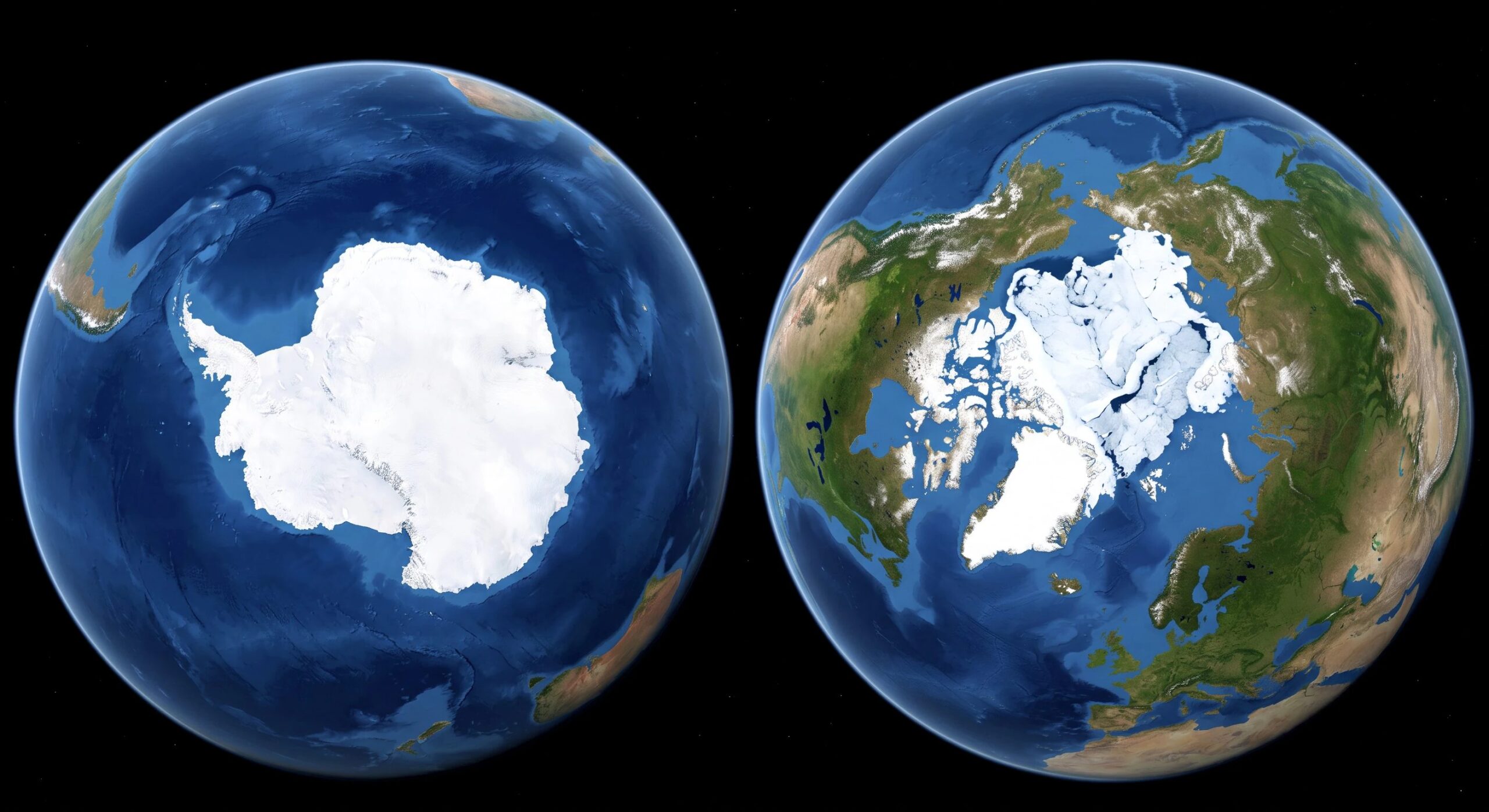
The formation of the ice sheet that covers theAntarcticadating back to 34 million years agohas long been attributed solely to a global climate cooling. However, this does not explain why the Arctic ice cap formed only 5 million years ago. Now a new study sheds light on this geological mystery. Glaciation in Antarctica was favored by uplift of its mountain rangeslinked to the movement of tectonic plates. These created conditions for the accumulation of snow and ice.
To reach these conclusions, the researchers reconstructed the evolution of Antarctica over the course of tens of millions of years. The study, coordinated by a team from the University of Southampton, England, was published in the journal Science.
The rise of the Antarctic mountains
Antarctica hosts the largest expanse of ice on Earth. If it melted completely, global sea levels might rise 52 m. Yet, until 34 million years agoon the Antarctic continent the climate was temperate and the landscape was made up of valleys and plains crossed by long rivers. Then, during the so-called Eocene-Oligocene transitionthe concentration of CO2 in the atmosphere decreased drastically, causing temperatures to drop and ice gradually covered Antarctica. However, if this had been the only factor underlying glaciation in Antarctica, the North Pole should have cooled in the same way; instead the Arctic ice cap was formed only millions of years later. Furthermore, even after the formation of the Antarctic ice sheet, the surface waters of the Southern Ocean remained relatively warm for a very long time.
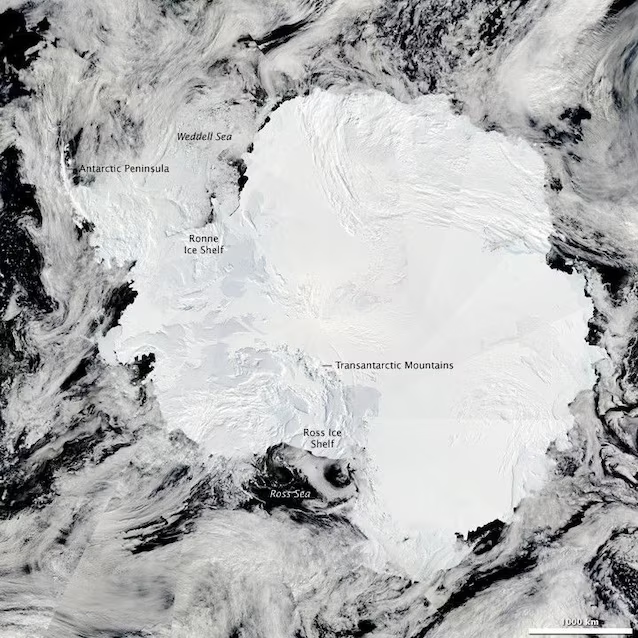
To explain this puzzle, researchers focused on the evolution of tectonic plates. About 170 million years ago Antarctica and Africa, which were united in supercontinent Gondwanathey separated. This fragmentation determined the ascent of hot material from the earth’s mantle, with the formation of the so-called “cloak waves“. These waves propagated for millions of years under the continents, generating slow uplifts of the earth’s crust. In Antarctica, a vast plateau was thus formed over time and mountain ranges were raised like i Gamburtsev Mountains1200 km long and 3400 m high and now buried under the ice. The models show that these mountains up to 50 million years ago had a height of less than 1500 m, insufficient to guarantee large accumulations of snow, while with the uplift they exceeded 2000 m.
The vicious circle that led to the formation of the ice cap
With uplift, the mountains reached altitudes high enough for formation and conservation of glaciers. These thus began to expand over increasingly larger areas. Ice, being clear, reflects much more solar radiation than bare rock. With its expansion, therefore, the quantity of reflected radiation. The result was thelowering of temperatures by 1 °C not just over Antarctica, but globally. Cold air contains a smaller amount of water vapor compared to hot air. Water vapor is a greenhouse gaseswhich helps keep temperatures high. So the presence of colder air over Antarctica resulted in a further cooling. These vicious cycles have allowed Antarctic ice to expand from the mountain tops to the coast, thus forming over time a single ice sheet. Global cooling of 1°C was not sufficient to form a similar ice sheet in the Arctic, since in that area the reliefs were too low. Just about 5 million years agothanks to a further decrease in CO2 in the atmosphere and much lower global temperatures, the Arctic ice cap began to form. Discovering these dynamics has highlighted the profound link between the Earth’s interior and glaciations.
