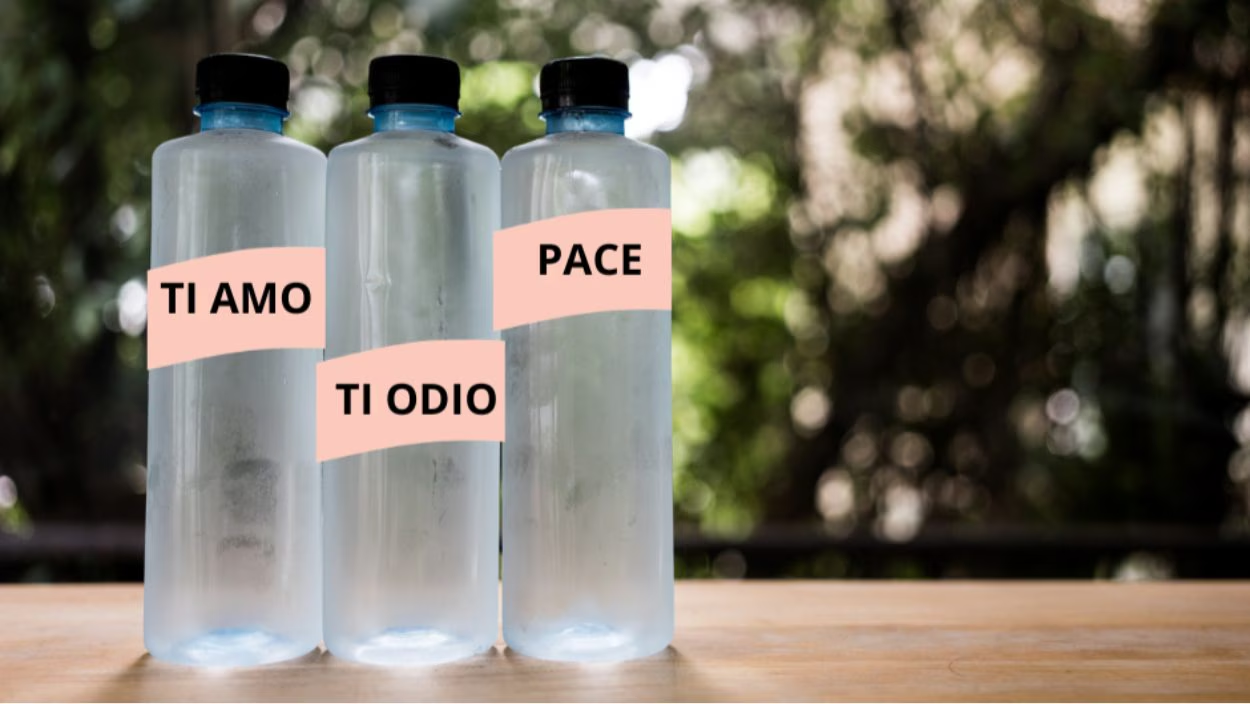
Everyone likes to hear “I love you”, “you’re beautiful”, while no one likes to be called an idiot. Second Masaru Emotoa Japanese pseudoscientist, even water has these “emotional” preferences and would react to our words and “intentions” creating different ice crystals depending on what we tell her. Obviously it is one hoax which has been around since the nineties and which unfortunately goes viral again from time to time. According to Emoto, if we tell a jar of water “I love you” or make it listen to Mozart, once frozen this water forms beautiful crystals. Conversely, if we insult her or make her listen to heavy metal, the resulting crystals would be ugly. Regardless of whether they are beautiful or ugly subjective descriptionsnot universal concepts, Emoto’s experiments and theory do not stand up for many reasons.
First of all, it is established that the shape of water crystals depends on measurable factors such as temperature, humidity, pressure and last but not least the possible presence of microparticles of pollutants, such as dust. And also Emoto he never wanted to conduct experiments in duplicate blindthat is, without the researchers and photographers knowing which jar the crystals corresponded to, nor even subjecting them to external and independent checks. In short, this is not how scientific discoveries are made!
Who was Masaru Emoto and what is the emotional memory theory of water: the experiments
Masaru Emoto was a essayist and pseudoscientist Japanese came to prominence in 1999 with the publication of his book “Messages from the waterInside, there were the results of his amazing experiments with water: photos of crystals of water subjected to praise, loving phrases and classical music, contrasted with those of crystals obtained from water that was insulted and that he had listened to heavy metal. Emoto was not a scientist. He graduated in international relationsthen obtaining a diploma in alternative medicine from a private Indian university and over the years he has published several books on this phantom “emotional memory of water”, up to the last “Messages hidden in the water” of 2004.
The premise of Emoto’s experiments might seem simple: what we say to water changes its molecular structure and the crystals obtained after freezing are affected by the emotions we have transmitted with our words. Sort of emotional memory of water.
In his first experimentsEmoto collected water samples in jars. To some he said “I love you”, “peace” or made them listen to Mozart. To others he said “I will kill you”, or played heavy metal songs. He froze the water at -4°C and then analyzed the crystals that formed. According to Emoto, the “loved” water produced crystals beautifulthe “hated and mistreated” crystals ugly.
A second experimentwhich is often seen on social media, is that of rice. Place boiled rice in jars (alone or with added water) and subject it to the same emotional treatment. This time, however, nothing crystallizes. After 30 days of sweet words or invectives, the rice is respectively fermented, a sign of positive maturation, or rotten.
What does the shape of water crystals depend on: what science says
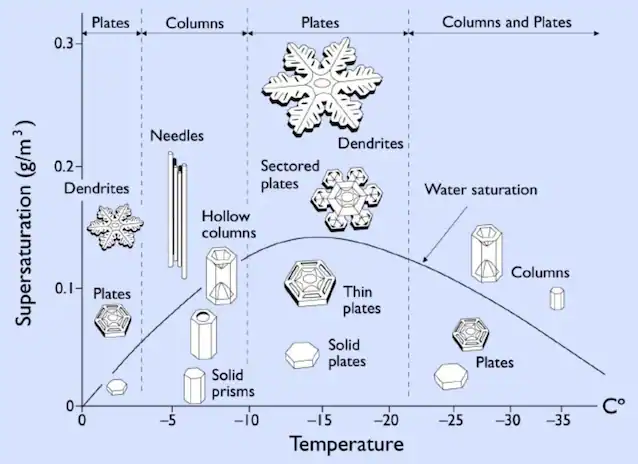
There are scientific basis to Emoto’s experiments? The short answer is No. First, we know exactly what influences the crystal shape: temperature, humidity, pressure, cooling speed, presence of any pollutants, such as grains of dust. The Nakaya diagram and the studies of Kenneth Libbrecht of the California Institute of Technology demonstrate that these parameters are sufficient to explain any observable variation, from flat crystals that form between 0 and –3 °C to branched dendritic structures that appear around –15 °C. A change of just one degree centigrade is enough to radically change the morphology.
Secondly, Emoto he has never published his studies in peer-reviewed journalsnor did he ever agree to undergo analysis independent. As William Reville (biochemist at University College Cork) noted during an interview for The Irish Timesthe fact that the phenomenon has never been published in a peer-reviewed journal almost certainly means that the effect it cannot be proven under controlled conditions.
Furthermore, Emoto’s experiments did not include a control jar and they were not led blindlya research method in which researchers, patients (if it involves drugs or therapies), or in this case photographers, do not know which sample they are analyzing (whether the “treated” one or the control one) until the end of the experiment. Both he, his team members and the photographers knew exactly what to look for: knowing in advance which sample was “good” and which was “bad”. impartiality and objectivity do not exist. A perfect example of confirmation bias, very present in open studies (i.e. not blinded), as also confirmed by a 2015 analysis published in PLOS Biology: By analyzing nearly 900,000 scientific articles, researchers have shown that studies conducted without blinding protocols consistently produce more “significant” results. The bias is stronger the more the measured variable is subjectivehow to decide whether a photo is beautiful or not.
And this is the last point: the aesthetic evaluation of a photograph is not an objective parameter. What is beautiful to one person may be horrible to another. Let’s take an artistic example: there are those who like modern art and those who hate it, preferring classical art. We cannot base a scientific theory on something so abstract and personal.
The psychological biases of Emoto’s theories
It is Emoto’s own words that compromise any validity of his theory. Reading his writings almost gives you goosebumps at the number of obvious compromises and biases in his method. Here are just a couple.
Confirmation bias: choosing only what is convenient for us
In “Messages from the water” Emoto writes “it took me two months to get an image I was happy withAnd already here we can see the confirmation biasbecause he actively searches for something he likes, as in another passage”Our staff, first of all, when they looked at a crystal, knew to look for perfectly hexagonal shapes, as seen in the first photograph. In our experience, we know that any chip or crack is not a good sign. In other words, the judging criterion is if, looking at it, you can perceive whether it is beautiful or not.”
It’s easy to get the results we want if we only choose those that confirm what we already think. Scientific research doesn’t work like that. Science it does not choose which data to keep and which not. He does not allow himself (at least he shouldn’t) to be overwhelmed by subjective evaluations such as “good or bad”.
The ad hoc hypothesis
In his texts, Emoto explains that if the seeker’s mind is confused, skeptical or simply “not pure” these vibrations will prevent the formation of beautiful and harmonious crystals, even if positive words are said. In short, if the experiment fails, it’s the scientist’s fault that he wasn’t convinced or “pure” enough. In philosophy of science, this is called ad hoc hypotheses: we invent an external and unmeasurable excuse to make our theory unassailable. How can you respond to “You don’t believe it enough”? Who measures how much we believe in something?
Blaming the test, the instrument, or the scientist’s intention every time reality disproves the theory is theantithesis of scientific progress. Every scientific theory, according to the philosopher Karl Popperto be considered valid it must be falsifiablethat is, it must be capable of being disproved. It seems counterintuitive, but the more solid a theory is, the more it is exposed to the risk of being proven wrong. If he takes the risk and “survives” the experiments, we consider it valid and robust. A good scientist doesn’t say “I’m right because that’s how it is and if you don’t have the same results as me it’s your fault”. A good scientist also tries to debunk his own theory and his experiments, subjecting them to all situations in which his results may not be true! Paradoxically, this is what makes a scientific theory solid: its ability to be tested!
Attempts at explanation: these also failed
To tell the truth, in 2006 and 2008 the researcher Radin published two studies co-signed by Emoto which introduced blinded protocols for the first time. In the first, 2,000 of Emoto’s followers sent “positive intentions” to water samples in California and 100 judges evaluated the crystals without knowing which ones were “treated.” In the second, three blind levels and 1,900 participants. In both cases the results seemed to confirm Emoto’s theory. But… Both studies were conducted by the same authors’ institutes, without independent verification and the 2,500 judges of the second study they knew they were participating in a study on “intention and water”orienting expectations. Thus, attempts to give scientific dignity to a totally unfounded theory are also refuted.
To paraphrase Uncle Ben from Spiderman: “with great power comes great responsibility”. A revolutionary theory needs solid evidenceto be reproducible, to be open to validation by external bodies. James Randi, an illusionist and science communicator who was part of the team Nature who disproved Benveniste’s water memory experiments, which should have provided a scientific basis for homeopathic theories, wrote a concept to keep in mind every time we are faced with a new and amazing scientific theory:
“If I claim to have a goat in my garden, many of you would have no difficulty in believing me and could be satisfied with the testimony of a neighbor. But if I claimed to have a “unicorn” in the garden, how many would be satisfied with a simple testimony from a neighbor?”
Sources:
Libbrecht, K. G. (2005). “The physics of snow crystals.” Reports on Progress in Physics The Irish Time – The pseudoscience of creating beautiful (or ugly) water Holman, L. et al. (2015). “Evidence of Experimental Bias in the Life Sciences: Why We Need Blind Data Recording.” PLOS Biology Bocconi – The falsificationism of Karl Popper Born RT. Stop Fooling Yourself! (Diagnosing and Treating Confirmation Bias). eNeuro. 2024 ENEURO Radin D, Hayssen G, Emoto M, Kizu T. Double-blind test of the effects of distant intention on water crystal formation. Explore (NY). 2006 Radin, Dean & LUND, NANCY & EMOTO, MASARU & KIZU, TAKASHIGE. (2008). Effects of Distant Intention on Water Crystal Formation: A Triple-Blind Replication. Journal of Scientific Exploration. Maddox, J., Randi, J. & Stewart, W. “High-dilution” experiments on delusion. Nature 1988.
Emoto, M “Memory of water” 1999
