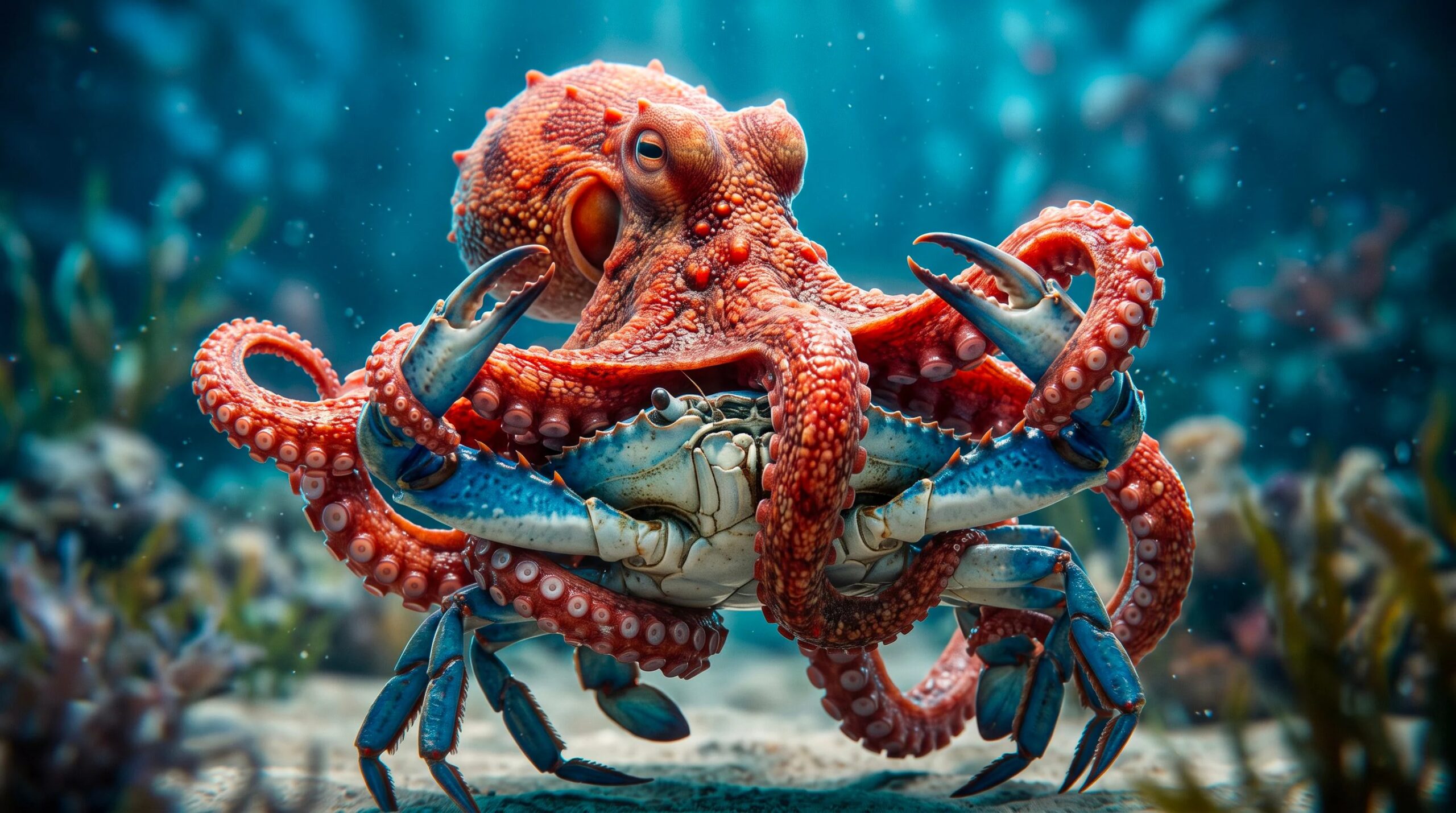
There voracity of an octopus (Octopus vulgaris) could represent a possible solution to contribute to the numerical control of blue crab (Callinectes sapidus), invasive alien species in Mediterranean waters. The project demonstrates this “Octo-Blue” implemented by the University Alma Mater Studiorum of Bologna, promoted by the Emilia-Romagna Region and financed by European Funds. Researchers from the Department of Veterinary Medical Sciences of the University of Bologna, coordinated by Prof. Oliviero Mordenti, have experimented in the laboratory withdiet of octopuses with blue crabs and have started a program for the release of octopuses born in the laboratory along the coast between Riccione and Cesenatico.
Considering that the Adriatic coast, characterized by sandy seabeds, is not particularly suitable for the reproduction and development of octopuses which prefer rocky environments, artificial shelters along the stretch of sea affected by the project thanks to the help of local fishermen. Now the octopuses will be able to implement their blue crab capture strategy, contributing to the control of the invasive. The research group, moreover, is not new to this type of study considering that it has long been involved in captive reproduction of the European eel (Eel eel) and the Cobian sturgeon (Acipenser naccarii).
The study of octopuses in the laboratory and the Octo-Blu project
It all began at the Fish Production Center of the University of Bologna in Cesenatico where Prof. Mordenti’s team started a series of studies on the feeding of the common octopus and its reproductive performance in a controlled environment. Some wild specimens were caught in February by a group of fishermen. The cephalopods, initially destined for the fish market, were delivered in this case to the Cesenatico laboratory, where they were selected by weight and sex.
They were then introduced into a system of completely innovative experimental breeding tanksequipped with a particular water circulation and incubation chambers for the reproducers in order to favor their spontaneous reproduction. The specimens were divided into two groups which were administered two different diets: one mixed fishto the other mixed shellfish. Feeding trials demonstrated that the best performance in terms of growth and reproduction was shown by octopuses fed the crustacean diet. Precisely in this context the researchers verified that i Octopuses are fond of blue crabs and that a diet based on crustaceans significantly increases the growth of individuals and the reproductive capacity of females, which have been shown to double the number of small octopuses they can generate. In essence, they have greater reproductive fitness than females fed fish or other products.
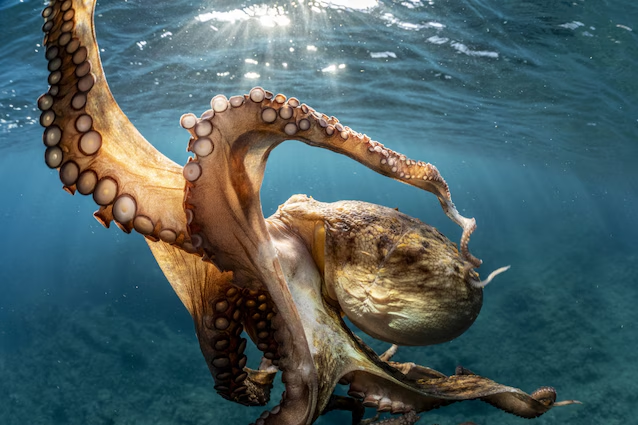
These observations immediately found an application with the project “Octo-Blue” intended for production and release of octopus specimens into the sea who will be able to contribute to the cblue crab numerical control. The first release of around half a million small octopuses will soon be carried out on the stretch of the Romagna coast in front of Riccione and Cesenatico and if the experiment is successful it will continue on other stretches up to Comacchio and Goro in the Province of Ferrara. Some critical adaptation issues for young cephalopods could derive from the absence of natural shelters in a sandy seabed, but the project envisaged the inclusion of artificial brick shelters.
A strategy to control the expansion of the invasive alien species
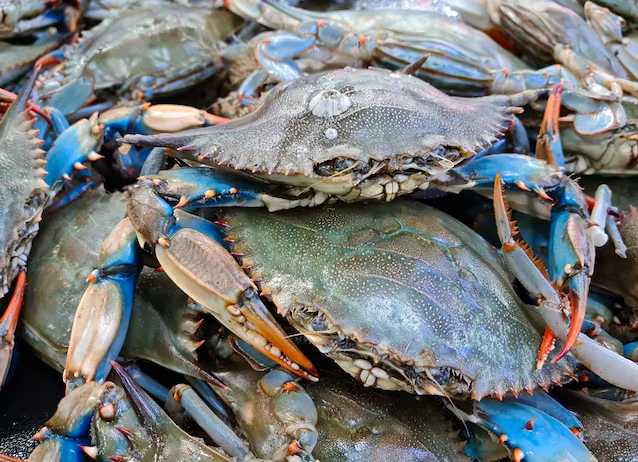
The blue crab (Callinectes sapidus), native to the Atlantic coasts of America and arrived in the Mediterranean with the “ballast water” of ships, is now an invasive species in Mare Nostrum. Provoke serious damage to marine ecosystems and fish resources considering that it is a voracious predator which feeds for about 30-40% of gastropods and bivalves (mussels and clams). One of its natural enemies is the Common octopus (Octopus vulgaris) which preys on crabs immobilizing them with poison produced by its special glands. It is certainly a very efficient predator.
Suffice it to say that a cephalopod weighing 500 g is able to attack and feed on a large crab and that every day it consumes a quantity of food equal to approximately 10% of its body weight. It also has a high reproductive rate with 100,000-500,000 eggs per female and very rapid growth. It could therefore prove to be an excellent ally in contributing to the control of the blue crab.
