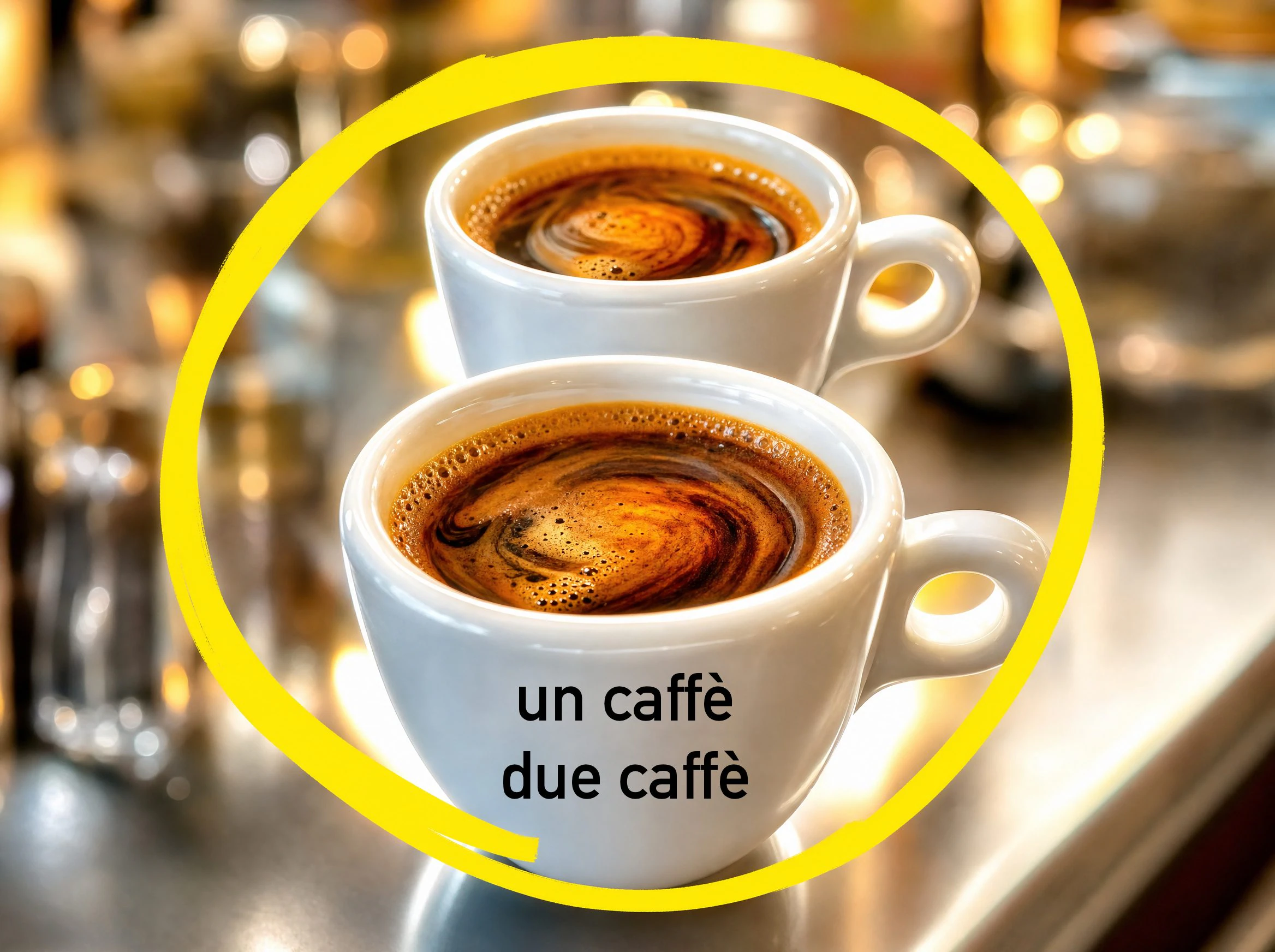
“Sweets, coffee?” asks the waiter at the restaurant. “I’ll have a coffee,” someone replies. «Make two coffees!», another intervenes. The cups increase, but the word coffee remains the same. It happens with everyone invariable namesthat is, those names that maintain the same form in both singular and plural. The same happens for adjectives such as “roast”, which is used for a chicken, but also for multiple chickens.
In Italian the plural is not normally constructed by adding something at the end, as English does with -s (cat, cats), but rather change the final vowel: house becomes houses (the «-a» turns into «-e»), the book becomes books (the «-o» becomes «-i»), the dog becomes dogs (the «-e» becomes «-i»). In regular plurals the word remains the same, but the last vowel – i.e. la ending – marks the transition from one to many. With invariable words, however, the final vowel remains the same: let’s see what they are.
Coffee, city, truncated and imported words: examples of invariable nouns
Let’s go back to the noun coffeewhich is a word truncate (in linguistics it is called oxytone), that is, with the tonic accent falling right at the end, on the last syllable. These words are invariable because they end in an accented vowel: in Italian this class of nouns does not modify the final vowel in the plural. The same therefore happens with some commonly used words such as city, tea, tribe, bonfireand with Monday and all days of the week that end in -day. They are all truncated words. This group also includes many monosyllabic nouns and adjectives, both stressed and unaccented, such as king, blue, gnu and so on.
The case of the color blue also occurs for other colors of multiple syllables, used as nouns or adjectives, such as amaranth, lilac, pink, purple, and so on. Not all colors are invariable: red, brown and orange, for example, also admit the plurals red, brown and orange (and for adjectives, the feminine form).
As for coffee, there is a gem: the word was not born in Italy, but comes from Turkish kahvewhich is from Arabic qahwawhere originally it even indicated wine, or more generally an “exciting drink”. It traveled from the Middle East to Europe with the drink, and stopped with us, bringing with it its “foreign” accent on the last syllable.
And so we arrive at a second group of words, that of nouns that end in consonant. How to change the vowel if a word that has no vowel at the end? There are many of these words foreignismsthat is, borrowings from other languages that entered Italian without adapting: sports, bars, films, computers, gas, buses, trams. As explained by theEncyclopedia of Italian Treccaniin these cases the number and gender “are signaled by accompanying elements” – the article and the adjective – so as to avoid “terminations foreign to the Italian morphological system”.
Associated, compound words that end in -i, -a, -ie
There are other groups of words, equally everyday: the first is that of the words that they already end in -i in the singular. Since the «-i» is precisely the ending that Italian would use to construct many plurals, changing them would not make sense. Here then the crisis And the crisesthe analysis and the analyses, the thesis and the theses, the oasis and the oases, the toast and the toasts (largely words of Greek origin).
Then there is the case of the masculine words that end in -aespecially regarding exotic animals, such as llamas, cobras, gorillas, cockatoos, or words such as executioner, lookalike. The word pajamas can be declined in the plural unchanged, but also with the variant pajamas. As regards feminine words, however, some nouns remain unchanged end in -iesuch as series, species, weather, and feminine adjectives and nouns in -i, such as even, odd, hypothesis, analysis, neurosis.
Then there is the case of shortened words (shortenings or abbreviations). There photo it is photography, the car is the automobile, the motorbike is the motorcycle, the bike is the bicycle, the cinema is the cinematograph. Shortenings normally retain the gender and numeral behavior of the word from which they derive, but have their own form: photo, car, motorbike, bicycle therefore remain invariable. We say photos even though “photographs” would have a regular plural, because in shortening it we cut away the very part that could have been declined.
For i nouns composed of two verbs, or by a verb and a singular feminine noun, such as ashtray, latch, tongue twister, or again, for adjectives preceded by anti- prefixsuch as anti-cellulite or antifreeze, and adjectives composed with second element -well, -little, -waye.g. decent, decent, the same rule applies.
The most discussed case of all: euro
There is an invariable word that has been discussed in Italy for over twenty years: euro. In the plural, is it euro or euri?
The official response, which reports theCrusca Academyis clear: it is said euro, invariable, and it is not a question of our local grammar, but as Crusca reports, it was established by a 1998 European Union directive, which established the invariable form for Italian, English and German. The logic was both practical and symbolic: euro is, as has been said, “the first word of a non-national European language”. The choice also arose from the idea that the single currency should have a common name in the different languages of the Union. The standard form is therefore; the euro form is documented in use, but is not the one foreseen by the official standard.
On gender, i.e. whether euro is feminine or masculine, there would be another discussion to be had. Initially “the word euro was compared to other Italian words ending in -o, therefore attributing the masculine gender to it”. However, already since the early 2000s, cases have been attested in which the term occurs in the feminine: «for our analysis, – says Crusca -, we can identify two groups of uses: a first group in which the feminine appears determined by an ellipsis, or by the omission of a term such as banknote, coin (which explains the singular article); a second in which we refer to the sum (and therefore expressed with the plural article)”.
