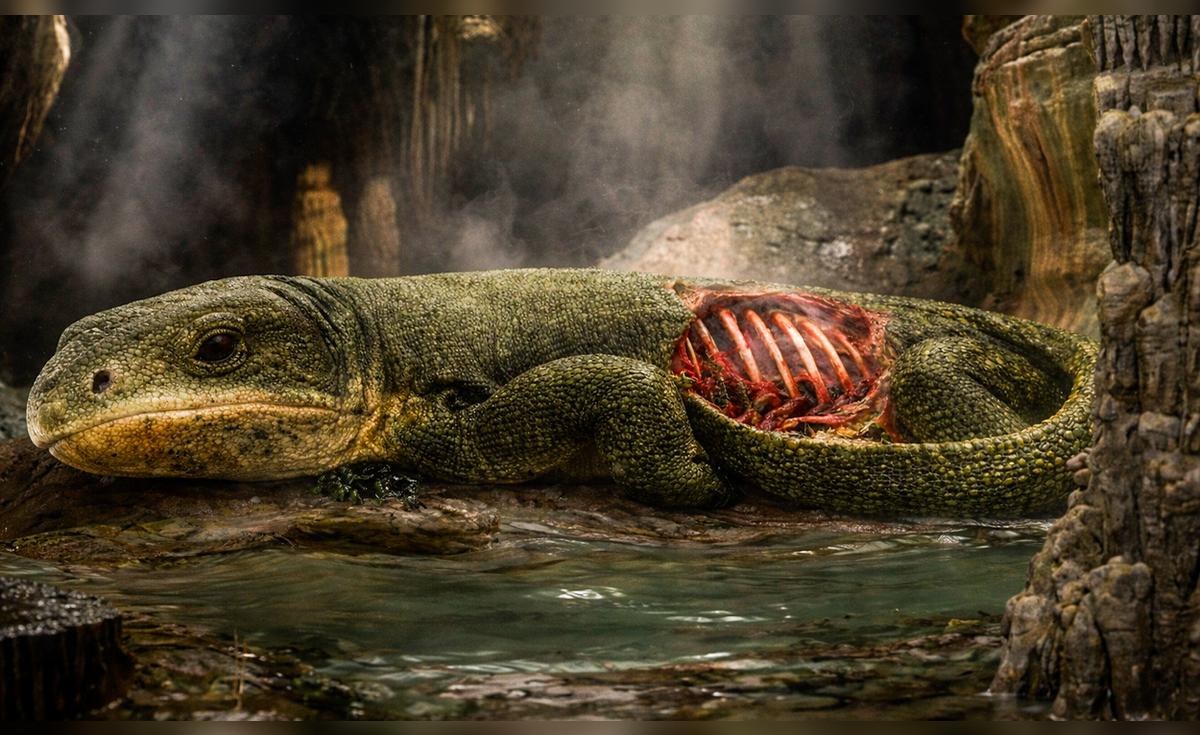
An international team led by scientists from Harvard and the University of Toronto identified an exceptional fossil from 289 million years ago that allows us to understand one of the most important evolutionary processes: respiration in terrestrial vertebrates. The study, published in Nature, describes the oldest known record of a respiratory system based on the movement of the thorax, key to life outside of water.
This finding is placed in the context of the evolutionary transition that began about 400 million years ago, when the first animals began to leave the aquatic environment. According to paleontologist Robert Reisz, the respiratory mechanism identified in this remains “represents the ancestral condition” of the modern inhalation in certain living beings, such as reptiles.
The analysis made it possible to reconstruct for the first time the complete respiratory system of a primitive amniote. Photo: Nature
What is the key fossil to understand the evolution of respiration?
The specimen corresponds to Captorhinus agouti, a small reptile from the Permian period with an appearance similar to a lizard. This species is part of the first amniotesa group that includes reptiles, birds and mammals, and their common ancestors, and that played a key role in terrestrial colonization.
The fossil was found in a cave system in Oklahoma, USA, where particular geological conditions—such as the presence of hydrocarbons, oxygen-depleted sediments, and mineralized water—favored exceptional three-dimensional preservation. These characteristics allowed the body to be practically “mummified,” preserving structures that are normally lost in the record.
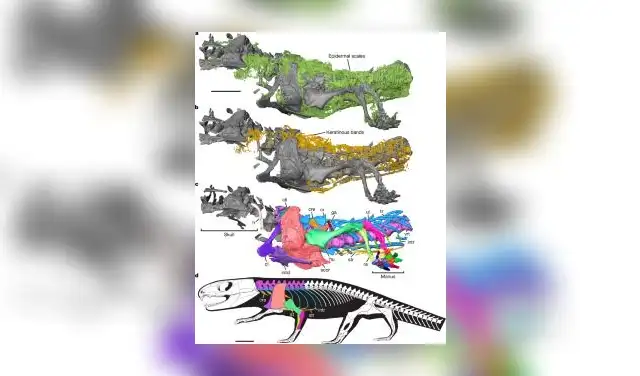
The study revealed the presence of original proteins in the fossil tissues. Photo: Nature
Unlike other ancient remains, this specimen preserves not only bones, but also calcified cartilage and protein remains. Scientists used neutron computed tomography to analyze it without damaging it, revealing fine details of its anatomy. “There was a skin wrap around the torso“said Ethan Mooney when describing the find.
How did the fossil become a key element for respiration?
The analysis made it possible to reconstruct for the first time the complete respiratory system of a primitive amniote. The researchers identified structures such as cartilaginous sternum and specialized ribs, demonstrating the use of the so-called costal breathing: a mechanism in which the intercostal muscles expand and contract the rib cage to ventilate the lungs.
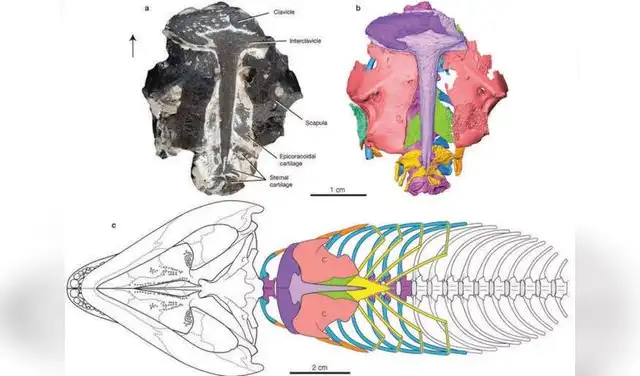
Unlike other ancient fossils, this specimen preserves more than just bones. Photo: Nature
This system represented a decisive evolutionary innovation compared to amphibian inhalation, which depends largely on skin or mouth pumping. Thoracic ventilation allowed for greater efficiency in gas exchange and facilitated a more active lifestyle.
Additionally, the study revealed the presence of original proteins in the tissues, an unprecedented discovery for Paleozoic fossils. The molecules are almost 100 million years older than those previously recorded and expand the known limits of biological conservation.
