
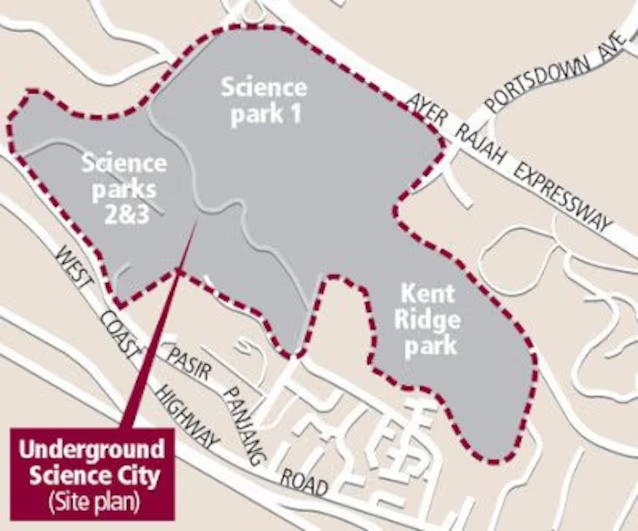
There Singapore Underground Science City (USC) it is one of the most ambitious projects in the country. It is a futuristic underground complex built at 30-80 meters deep, to be built with cutting-edge geotechnical techniques to host laboratories And data centers. Currently, however, it is worth clarifying that this is still a work in the conceptual phase and rather far from actual implementation.
Objectives and characteristics of the project
Located at a depth of approximately 30-80 underground, USC is designed as a high-tech underground complex, within which there will be areas dedicated to biomedical research, data centers and scientific development laboratories. From the point of view of engineering solutions, excavation would require the application of advanced tunneling techniques such as Drill and Blast and the use of mechanical cutters (TBM – Tunnel Boring Machine) with closed shield to manage hydrostatic pressures. The main caverns would feature spans that challenge the limits of rock mechanics and would be equipped with continuous fiber optic structural monitoring systems and supported by pre-stressed cable-stayed bolting and fiber-reinforced shotcrete linings.
The complex ventilation and air conditioning systems are integrated with vertical ventilation shafts in order to manage and guarantee air exchange and fire safety (through the pressurization of escape routes), thermally isolating the underground environments.
The economic impact of USC: increases the level of quality of life
The USC project redefines the concept of resilient urbanization and industrial and urban development. By freeing up precious surface area, the Singapore Government can allocate crucial areas for parks, residential construction and social infrastructure, thus significantly raising the level of quality of life.
From a strictly economic point of view, USC is configured as a hub of attraction for global capital in the Deep Tech and Pharmaceutical sectors. The fact that the project was built underground offers a unique competitive advantage for data centers and precision laboratories: exceptional natural isolation from surface vibrations (caused by traffic and industrial activities) and electromagnetic interference, ensuring the operational continuity of servers and electron microscopes.
The geographical location is also another important advantage. The proximity to pre-existing university and research centers favors a profound logistical and economic interconnection, creating thousands of highly specialized engineering, IT and scientific jobs, and consolidating Singapore’s leadership in these particular sectors.
Energy savings between 20% and 30%: environmental impact
From the point of view of sustainability and environmental impact, USC offers a dual ecological balance but markedly oriented towards long-term efficiency. Although the initial phase, that relating to the construction of the excavations, involves a high initial carbon footprint due to the important and massive use of cement, steel and the management of rock debris, the useful life of the structure will largely offset these emissions.
Thanks to the exploitation of intrinsic thermal stability of the subsoil rock-hosted, USC benefits from a drastic reduction in heat load for cooling compared to surface buildings, which are exposed to direct solar radiation in an equatorial climate; this translates into an estimated energy saving of between 20% and 30% for data center refrigeration systems. The project also involves the creation of waste heat recovery systems for industrial purposes and closed-circuit water networks.
