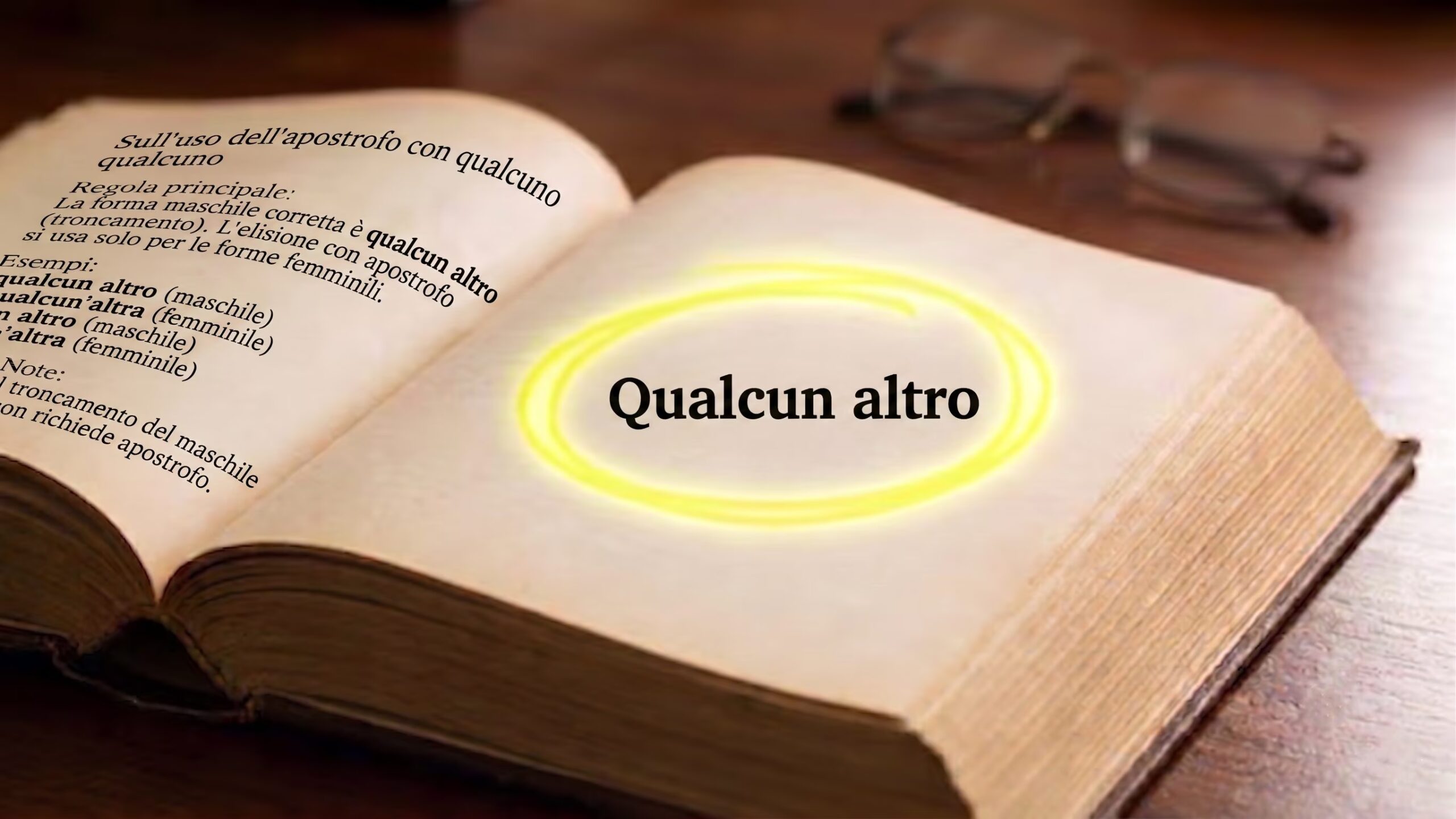
Have you ever stopped halfway through a sentence, undecided whether to write someone else or someone else? Don’t worry: it happens to everyone and making grammatical errors is more common than we think. Someone else, Anyway, it is written without an apostrophe. As always, there is a rule that explains why – it is a truncation like that which the masculine indefinite article “one” undergoes when it becomes “un” – and which, once understood, allows us to remove our doubts and no longer make mistakes. The same reason that will dispel any doubts about how to write another, which is and a little.
The differences between truncation and elision
In the Italian language there are two phenomena that seem like twins, but behave in opposite ways: theelision and the truncation (also called apocope, from the Greek “to cut away”).
The elision it’s what happens when a word loses its final vowel in front of a word that begins with a vowel. It’s one clash between sounds: in order not to make the sentence sound broken, the final vowel of the first word falls and in its place we put the apostrophe, a kind of scar that signals the fall of a letter. “The friend” doesn’t sound right, and in fact we say and write “the friend”. The elision triggers only before a vowel and always leaves its mark, the apostrophe. This is why we also write “un’amica” (from “una amica”) and “un amici” (here there was no fall).
The truncationhowever, is a different phenomenon: the word loses the final vowel or syllable regardless of how the next word begins – it can happen both before a vowel and before a consonant. The fundamental detail to recognize it is that the reduced form has its own autonomy: to exist it does not need the “clash” between two vowels. Think of “lord” which is shortened to “signor”: let’s say Mr. Rossi (in front of a consonant) and Mr. Alessi (in front of a vowel). In neither case is the apostrophe necessary, because the form “mister” is legitimate in itself. The same goes for the masculine article a (which is the truncation of one): we use it both before a consonant (a book) and before a vowel (a friend). Precisely for this reason the truncation does not require the apostrophe: it is not a fall due to the encounter with the following vowel, the word has simply become shorter.
Because “someone else” and “another” don’t want an apostrophe, but “another” and “someone else” do
“Someone else” is written without apostrophe because we are faced with a truncation: the word “someone” loses the final “o” and becomes “someone”, exactly as the article “one” is shortened to “un”. It is no coincidence that “someone” arises from the union of “some” + “one”, and the two follow the same rule.
Treccani observes that one of the most common cases of vowel truncation occurs when the vowel is unstressed (i.e. not stressed), but above all different from “a”and is preceded by l, r, no m. The “o” of someone, unstressed and preceded by the “n”, fits perfectly into the cases. The same goes for “unaltro”: it is masculine, it contains “un” (itself a truncation of “uno”), and the Accademia della Crusca is categorical in recalling that the article “un” is never apostrophized, not even before a vowel. You write a friend, an espresso, a platypus: writing an animal is a mistake.
For women the rules change: “another” and “someone else” are written with the apostrophe. This is because we have the words “some” and “some.” As anticipated, in modern Italian the final “a” is not truncated. So, upon meeting the vowel of the following word (other), the “a” does not disappear silently, but it elidesand elision always leaves a scar of its passage. “Another” becomes “another”; “someone else” becomes “someone else”, and since it is an elision the apostrophe is obligatory.
There is a simple makeup which can save us from doubts: with indefinite articles and their compounds, the apostrophe is placed in front of the vowel only if the following word is feminine.
In short:
- Masculine, no apostrophe: a friend, another, someone else.
- Feminine, obligatory apostrophe: a friend, another, someone else
The other big traps of the apostrophe: “what is,” “a little,” and imperatives
Of course, there are other pitfalls when it comes to apostrophe; the most widespread of all is the spelling of “Which”. Writing it with an apostrophe is considered a serious mistake. The reason is now understandable: Quale undergoes a truncation and becomes Qual, an autonomous form that lives very well on its own (we find it, for example, in the expression “qual good wind”).
Then there is the exception a bit. This is a slight truncation, and in theory the apostrophe should not be needed. But here the history of the language has decided differently, establishing by convention a “courtesy” apostrophe that signals the dropped syllable: po-co becomes po’. Be careful not to replace the apostrophe with the accent: the “pò” form is a very common error.
Finally, some imperatives in the second person singular they are written with an apostrophe, not with an accent. I am Of’ (from you say), ago’ (to do), go (go ahead), is’ (from here) and from’ (come on come on). Here too the apostrophe does its job as a “scar”, warning us that a part of the word has fallen out, and helps us distinguish these forms from insidious homonyms: fa’ (go do it!) is not fa (third person, or the musical note), and da’ (give it to me!) is not da (the preposition).
The apostrophe is more recent than we think
As much as it seems like an immutable piece of writing to us, the apostrophe is a relatively recent invention in the history of Italian. It established itself firmly only starting from the sixteenth century, also thanks to the work of printers, above all the famous Venetian typographer Aldo Manuzio, who were looking for a way to bring order to a still fluctuating written language.
Before then “the friend” could easily appear as “the friend”, all attached. This rule which today still raises some doubts is the result of centuries of attempts to make the language clearer and more “musical”.
