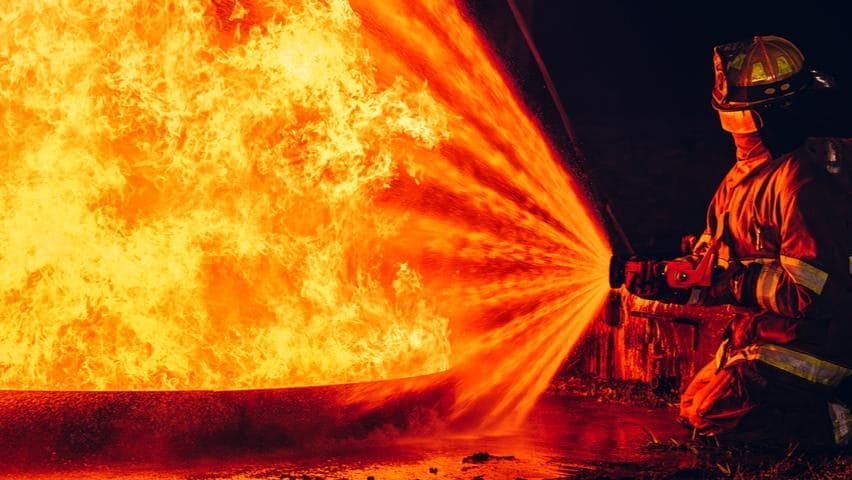
This year, the fire season is proving particularly destructivewith France, Spain and the same Italy who find themselves having to face this type of emergency. And every summer, together with the flames, we talk about again arsonists, fraud and property speculation.
But what do we really know? Let’s start from the beginning: fire is not an object, it is a chemical reaction that needs to exist three precise elements and just subtract one to turn it off.
From here we understand everything else: how a flame becomes a front of kilometers, because a Canadair alone is not enough and, above all, who sets the fire and why. Because behind the malicious act there is often a very concrete interest. According to the ISPRA report, in Italy only the 2% of fires summer has one natural cause: means that the 98% of the fires it is caused by man.
Let us therefore see the trigger mechanisms and what are the reasons why a fire spreads more or less quickly on the plains or between the hills, bringing order between solid data and gray areas and separating what science confirms from what remains uncertain.
What fire really is: the triangle that keeps the flame alive
Fire is one rapid oxidation chemical reaction that releases light and heat. To exist it needs three elementswhat the firefighters call fire triangle: a fuel (in a forest the dry grass, the leaves, the branches, the resin), a oxidizer (the oxygen of the air, about 21%) and a heat trigger which brings the fuel to ignition temperature.
The consequence is all here: if even just one of the three sides is subtracted, combustion stops. It is the principle on which every shutdown technique is based.
Why does a fire run so fast? Wind, slope and “spotting”
To transform a outbreak in a kilometer front they are above all three factors. The wind brings oxygen to the flames and bends them forward, preheating the fuel still intact; it can also trigger it spottingthat is, the projection of burning embers even hundreds of meters away, which generate new outbreaks beyond the front.
There slope accelerates the fire uphillbecause the heat rises by convection and dries out the higher vegetation in advance: this is why we never escape towards the mountains.
Finally, there is the quantity and the dryness of the fuel: an abandoned forest burns much more easily, and the climate crisis, by extending drought and heat, keeps the vegetation flammable for several months of the year.
But how to put out a fire? The teams act on one of the sides of the triangle. With the direct attack you lower the heat or suffocate the flames: the Canadairfor example, releases approx 6,000 liters of water which act mainly by pressure and oxygen subtraction, but it is effective only with low fronts.
With the indirect attack, however, the fuel is removed by opening firebreaks in front of the front, or with the backfirea controlled fire that burns the vegetation in advance.
In Italy the air fleet is coordinated by the COAU and has around 18 Canadairs, plus some helicopters: numbers that make prevention, not shutdown, the real game.
Natural or malicious? One solid fact and one very uncertain
The solid fact is that fire, in Italy, is almost always caused by human activity: in Europe about the 96% of fires have anthropogenic origins and only 4% is natural. In Italy, the natural causes they stop around the 2%as confirmed by the ISPRA report: it means that 98% of fires are caused by man.
Much more uncertain, however, is the boundary between fraud and negligence. According to the historical distribution of the State Forestry Corps, out of the total fires the 58% are maliciousThe 16.9% negligent and around 1-1.5% natural or accidental, but as many as 23.6% remain of dubious, unascertained causes. And in the Fire Brigade statistics the share of unknown origin is even higher.
Not only that: when you try to estimate a cause even for uncertain cases, fires involuntary they might even overcome malicious ones (54% vs. 42%). The honest picture, then, is that the fire is almost always humanbut the division between those who set things maliciously and those who set them negligently must be taken into account prudence.
Who starts the fires and why? From agricultural interests to the myth of speculation
Staying on the malicious part, which is a relevant part but not the entire phenomenon, behind the voluntary fire there is almost always an interest: it is the difference between the arsonistwhich acts for a pathology in a serial manner, e the arsonistwhich acts for a profit. According to the Civil Protection classification the main reason is agricultural-pastoral (renewal of pastures, expansion of crops): in an analysis of arrests for arson beyond 37% were linked to agricultural and pastoral purposeswhile approximately 9% concerned fire extinguishers looking for work (analysis of the period 2000-2010). Revenge, protests and resentment towards restrictions and protected areas follow.
Then there is the most cited and most misunderstood reason: the building speculation. The framework law 353/2000 in fact makes the deal almost impossible: on land affected by fire, the intended use cannot change for at least 15 years and it is forbidden to build for 10, with the obligation to recall the restriction in the sales deeds under penalty of nullity (Law 353/2000, art. 10). The Civil Protection itself defines building speculation as an incorrect prediction of those who set fire. The real engine of arson in Italy remains much more prosaic: grazing, agriculture and local benefits.
