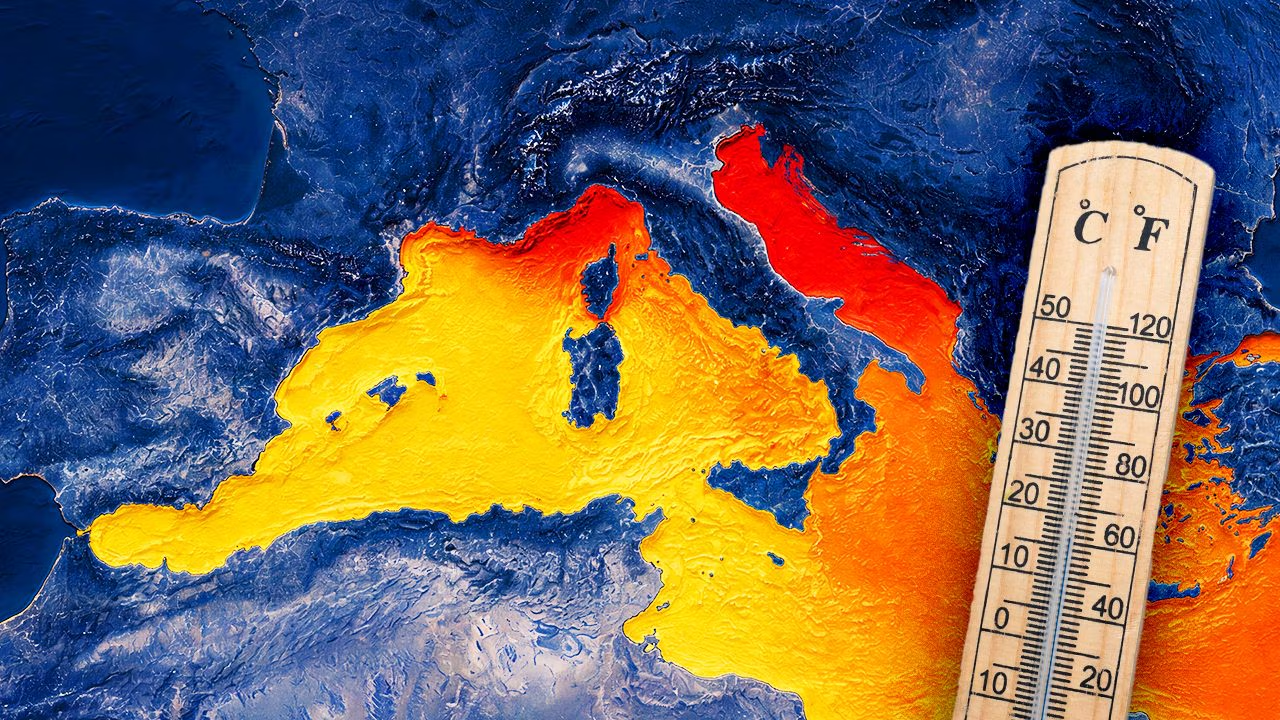
Every summer the same phrase returns to the beach: “The sea is warmer this year, it wasn’t like this once”. It is a widespread perception, but is it also a real fact? The short answer is yes: data from CNR, ENEA, INGV and the European program Copernicus show that the Italian seas, including the Tyrrhenian and Adriatic, have warmed measurably. Before seeing how much, however, it is worth understanding what data we are reasoning on.
What data do we have on sea temperature and how is it measured?
Information on the temperature of our seas comes from three families of complementary data:
- the first is the satellite data from the Copernicus Marine Servicewhich covers the entire Mediterranean every day since 1982: over forty years of homogeneous observations, ideal for long-term trends;
- the second is the direct measurement at sea: on the Tyrrhenian Sea, the MACMAP project of ENEA and INGV has been recording the temperature along the Genoa-Palermo route since 1999, not only on the surface but along the entire water column (ENEA, INGV);
- the third is the network of buoys and coastal monitoringincluding the official ISPRA indicator and the Greenpeace Mare Caldo project in marine protected areas.
It must be said honestly: a direct series of fifty years on the Tyrrhenian Sea alone does not exist, the measurements at sea start from 1999 and the satellite from 1982.
Surface temperature (SST) is measured in three complementary ways. The satellites they read the “skin” of the sea with infrared sensors, at night to avoid reflections from the sun (Copernicus Marine Service). The fixed buoys they measure on site and calibrate the satellites. The disposable XBT probes, launched from scheduled ferries on the Tyrrhenian Sea since 20 September 1999, record the temperature up to hundreds of meters deep: over 3,000 probes in a hundred campaigns, always on the same route (ENEA). It is this continuity that allows us to distinguish a real trend from normal seasonal noise, and to answer the umbrella question with numbers, not by sensation.
How much the Mediterranean, Tyrrhenian and Adriatic have warmed
On the satellite picture, the entire Mediterranean has warmed at the surface of 0.041°C per year between 1982 and 2018 (Pisano et al. 2020, CMEMS data), with a gradient from 0.036°C in the western basin to 0.048°C in the eastern basin. On the Tyrrhenian Sea, direct measurements indicate over 1°C in 25 years (ENEA, INGV), with a jump of over 0.4°C between 2013 and 2016, an almost stationary phase and new growth from 2021 to the maximum in September 2023.
The Mediterranean is a climate hotspot: it is warming about 20% faster than the global average (MedECC) and, in some deep waters, up to ten times faster than the open ocean (ISMAR-CNR). In 2024 the basin reached the highest annual average ever recorded, 21.16°C (CNR-ENEA, Copernicus).
The Tyrrhenian Sea has a recent surface average around 19°C (ISPRA), while the Adriatic, low and semi-closed, goes from a historical summer average of 24-25°C to peaks close to 30°C in the hottest phases, with a trend, as in the Ligurian Sea, above 0.08°C per year (ISPRA).
The sea does not warm in a linear waybut in spurts, with marine heat waves: periods in which the temperature remains well above normal for days or weeks. In the’summer 2025 much of the Mediterranean fell into the “extremely hot” category, with anomalies of +3/+4°C (Copernicus), and in Asinara a peak of +3.5°C was recorded in a wave of 41 days (Greenpeace, Mare Caldo project). 2025 was the fourth consecutive record-breaking year for European seas (ECMWF), and the 2026 has already set the all-time global record for seas and oceans (Copernicus), with anomalies up to around +6°C between southern France and western Italy at the end of June (Greenpeace, Mare Caldo project).
What does warmer sea water mean (without alarmism)
A warmer sea is not a free heated pool. It evaporates moreand for every additional degree the air retains approximately 7% more humidity (Clausus-Clapeyron relationship): more tropical nights and more energy for autumn storms, with potentially more violent rains.
Below the surface, the heat stresses gorgonians and corals and favors the arrival of tropical species (Greenpeace). Without dramatizing: the point is not a single record, but the fact that the sea is losing its ability to return to balancestarting every summer from a warmer base.
