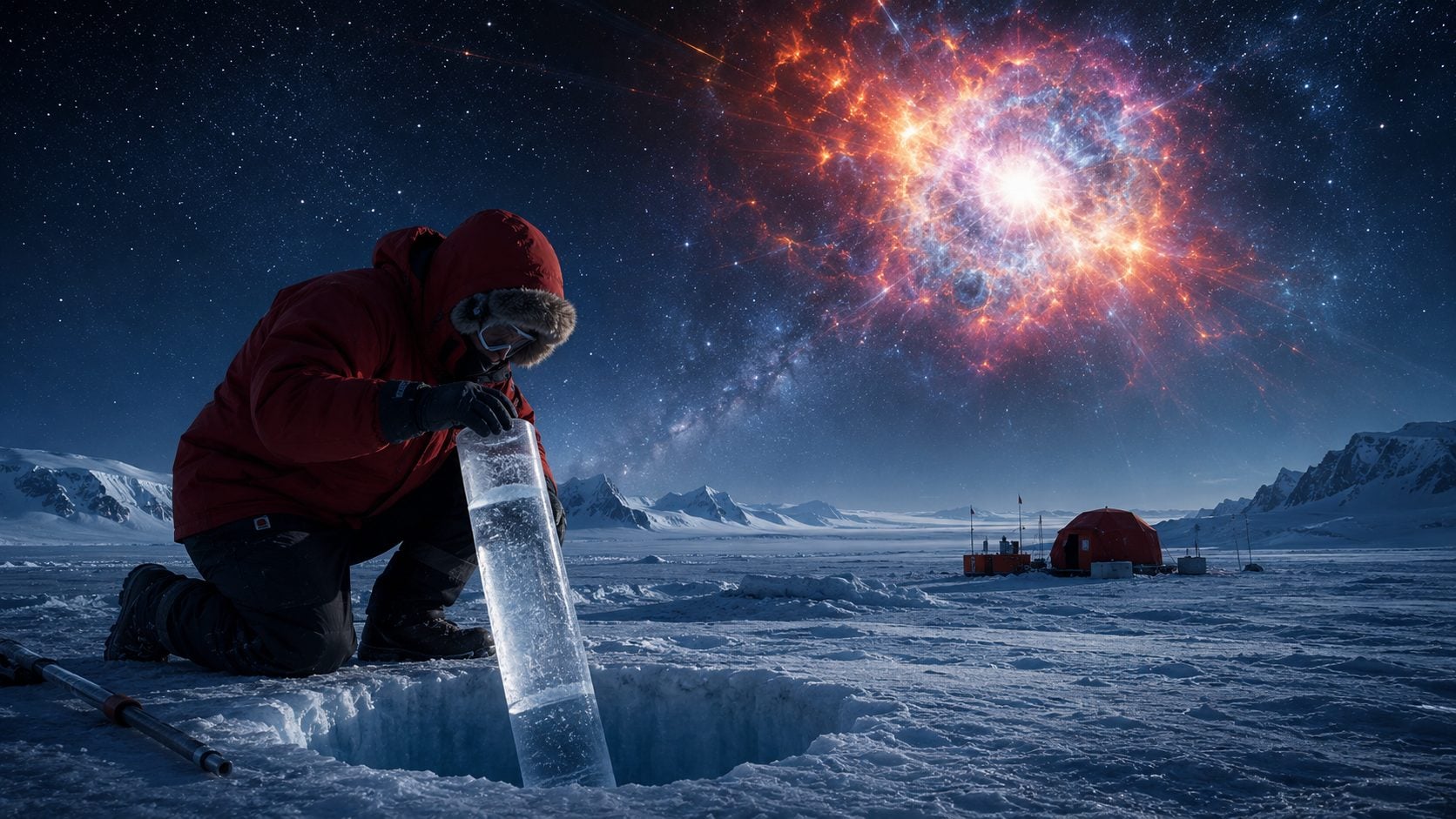
There Local Interstellar Clouda set of gases and dust through which our Solar System moves, appears to have been produced by a single supernova explosion millions of years ago. The result is due to a team of German researchers who collected and analyzed it well 295 kg of Antarctic ice at different depths. The perennial ice of Antarctica constitutes an almost uncontaminated “historical archive”, perfect for reconstructing the composition of the interplanetary dust that precipitates on Earth.
The analysis of the composition of the sample as the depth varied showed the presence of iron-60a radioactive isotope of iron, in quantities that exceed those normally present in the interplanetary dust of our Solar System. The researchers thus concluded that the excess iron-60 could be evidence that the Local Interstellar Cloud is in fact the remnant of a supernovagiven that this radioactive isotope of iron is produced in large quantities in these very violent celestial events.
Details of the study on iron-60 in Antarctica
This discovery was made by a group of German researchers led by Dominik Kollmpart of the European ice core project in Antarctica. The researchers drilled into the frozen surface and collected ice samples at different depths. The samples collected refer in particular to the period included between 40,000 and 80,000 years ago.
The researchers first melted the ice to collect the radioactive particles and then measured the abundance of the various isotopes. The analysis revealed the presence in the collected samples of iron-60 And manganese-53.
Both are produced by the interaction between interplanetary dust and cosmic raysbut in this case the researchers found an amount of iron-60 that was too high to be explained solely by the action of cosmic rays. This means that the excess must have an origin outside the Solar System. Furthermore, by combining data from these samples with that collected from sediments at the bottom of the sea, the researchers were also able to determine how the excess iron-60 has changed over time.
The scenario proposed by the researchers is the following: 80,000 years ago the Solar System has entered a denser region of gas and dust known as the Local Interstellar Cloud. At this point the quantities of iron-60 deposited on the Earth increased until reaching a maximum (when the Solar System was completely immersed in the cloud) and then decreased as the Sun and all the planets headed towards exiting the cloud. Since an additional source of iron-60 are the supernova explosionsthe result of the collapse of very massive stars, the most direct explanation for this measured variation is that the Local Interstellar Cloud is part of a large supernova remnant.
What is the Local Interstellar Cloud
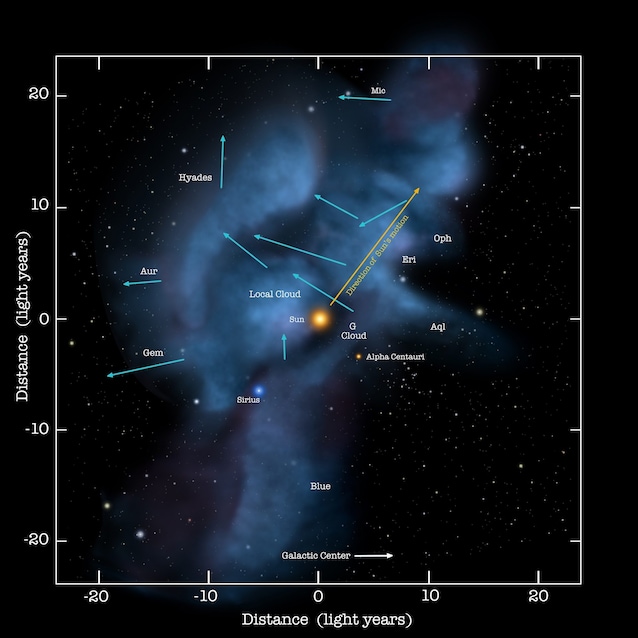
The Local Interstellar Cloud is a collection of gas and dust with a size of approximately 30 light-years through which our Solar System moves. It’s one of 15 clouds of gas and dust that are found in the Sun’s surroundings, many of them remnants of the gases from which new generations of new stars died and then formed.
We are aware of the existence of this cloud and of the fact that we are passing through it thanks to the study of the chemical composition of stars close to the Sun. Their spectrum, in fact, shows the presence of absorption lines indicative of starlight passing through interstellar material. From the analysis of the lines it is also possible to deduce the relative motion with respect to the Sun which is in agreement with models in which the Sun moves through a higher density mediuman interstellar cloud, rather than through a uniform medium.
The Local Interstellar Cloud is part of the interstellar medium closest to the Solar System which begins where the sphere of influence of the Sunthe so-called heliosphere. This interstellar medium, distant more than 20 billion km from Earthwas reached by the Voyager probes in 2012 (Voyager 1) and 2018 (Voyager 2), thus allowing us to directly measure the flow of particles and the magnetic field of this medium that permeates the space between stars.
