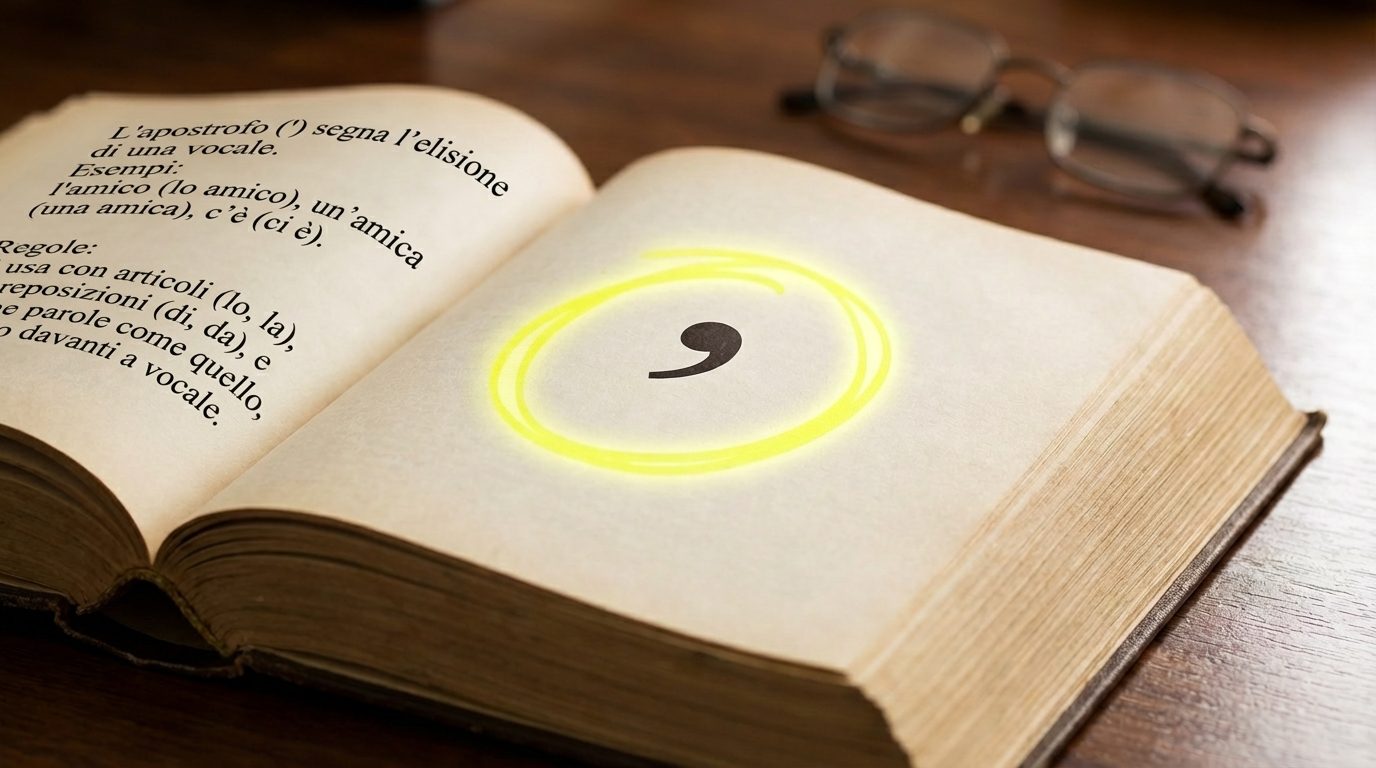
According to a survey conducted by Libreriamo – digital media dedicated to culture – 7 out of 10 Italians (68%) would fail or at least be sent back to a test grammar Italian. Among the grammatical and spelling errors, there is one in particular that shows no signs of dying, the public enemy number one of the boot: theapostrophe.
The investigation, conducted on approx 1600 Italians between 18 and 65 years old, was carried out with the SWOA method (web opinion analysis) through online monitoring on blogs, forums and social media (including YouTube comments), and saw the participation of 20 experts, including sociologists and writers, who, in addition to having observed the grammatical blunders, offered advice on solving this problem.
The 10 most common grammatical errors made by Italians
The list of the 10 most common errors, reported in the Libreriamo survey, ranges from the wrong use of the apostrophe to not knowing when to insert the “euphonic d”:
- The apostrophe (62%) – The apostrophe is our number one enemy. But when does it start? With all feminine words starting with a vowel, then: “a friend” Yes, “a friend” no. The apostrophe is also used when there is a truncation: for example, the apostrophe is necessary in a bit because it is the truncation of the word ‘little’.
- The use of the subjunctive (56%) – The subjunctive is the Achilles’ heel of many Italians. How many times have you heard someone say “If I would have” or “I hope he comes” or “I think he’s fine“, completely forgetting to use the correct verb form? A common phrase, the survey reports, is “The important thing is that you passed the exam”, but since there is “that” this is an incorrect grammatical formula, and would require the use of the subjunctive: “The important thing is that you passed the exam”.
- Pronouns (52%) – The? The? They? Getting pronouns wrong is the order of the day: “The I said she was very beautiful” is a very common case: “gli” is wrong, because we are talking about a female person, so we must use the pronoun “le”: “The I said it was very beautiful.”
- The correct declension of verbs (50%) – A very common error, both in speech and in writing, concerns the declension of verbs, especially regarding the use of verb tenses and the choice of the auxiliary. Confusing the use of the auxiliary be with having (for example, saying “I went” instead of “I went”) is a common mistake, as is the declension of irregular verbs.
- The use of C or Q (48%) in front of the letter U – According to Italian grammar, “QU” is used when there is an after the u vocal (a, e, i, o, u), “CU” is used when there is a after the u consonant. But there are some exceptions which make this error one of the most popular, such as adjectives ending in “cuo” or “cue” (conspicuous, profitable, promiscuous, harmless) and verbs (evacuate, shake, strike, collect, flay, sharpen).
- Neither or nor? (44%) – The accent on “nor” is used when this is intended to be used as a negation “I don’t want to nor This nor that”. If there is no negation, it should be used without an accent (e.g. “no I just want to talk to you” or “about this no we’ll discuss later”).
- Punctuation (39%) – Commas, semicolons, colons… should not be used haphazardly: each punctuation mark follows precise rules. For example: the comma gives a precise cadence to long and complex sentences; colons are used, for example, to introduce direct speech or to present an explanation or list. And the infamous semicolon? It is used to separate two sentences that are conceptually related, but formally distinct, thus indicating an intermediate pause between the comma and the period.
- A little, a little or a little? (37%) – How many times have you read a bit written with the accent, i.e. “a little”? The wrong version seems to be more and more widespread, but it must be remembered that the apostrophe must be used, since it is the result of a truncation.
- And or and? To or to? (35%) – This is a common mistake even for the best of us. The addition of the euphonic ‘d’ must be done when the following word begins with the same vowel with which the previous word ends. So: “I’m going to Hamburg“; “He was happy and enthusiastic“.
- But there are also more original errors, which take tenth place: “own” instead of “own”, “sorry” instead of “unfortunately”, or “sausage” instead of “sausage”, “knife” instead of “knife” or the terrible “wrapped” instead of “sometimes”. Last but not least, a great classic: “there is neither” and “there is neither” instead of the only correct form “there is”.
These errors are not simply grammatical distractions: they often indicate one loss of command of the languagea sign of a superficial and neglected language, and if in speech they are not very noticeable, in writing it is quite the opposite.
Why all these mistakes are made and how to make fewer mistakes
The reasons why we make all these mistakes are different.
First of all, i local dialects spoken in many regions often influence the grammar and pronunciation of the language, with incorrect verb constructions and conjugations for Italian grammar and syntax. Furthermore, there is a notable difference between schools and regions regarding level of grammatical education: Not everyone learns grammatical rules with the same depth, and this can lead to confusion or unawareness regarding the correct rules to apply. Then there is a point to be made in our “favor”: some grammatical and spelling rules require different ones exceptionsmaking our language not always intuitive.
To address this problem and write (and speak) in the most correct way possible, experts suggest:
- read regularly: a habit that has been lost over time, but which is good to carry on from an early age
- write by hand to regain familiarity and strengthen mastery of the rules
- avoid the too frequent use of artificial intelligence chatbots that write for us and wean us from writing
- train your mind by “playing” with your knowledge of the Italian language, through books and games that allow you to review the rules of our language in a simple and fun way
