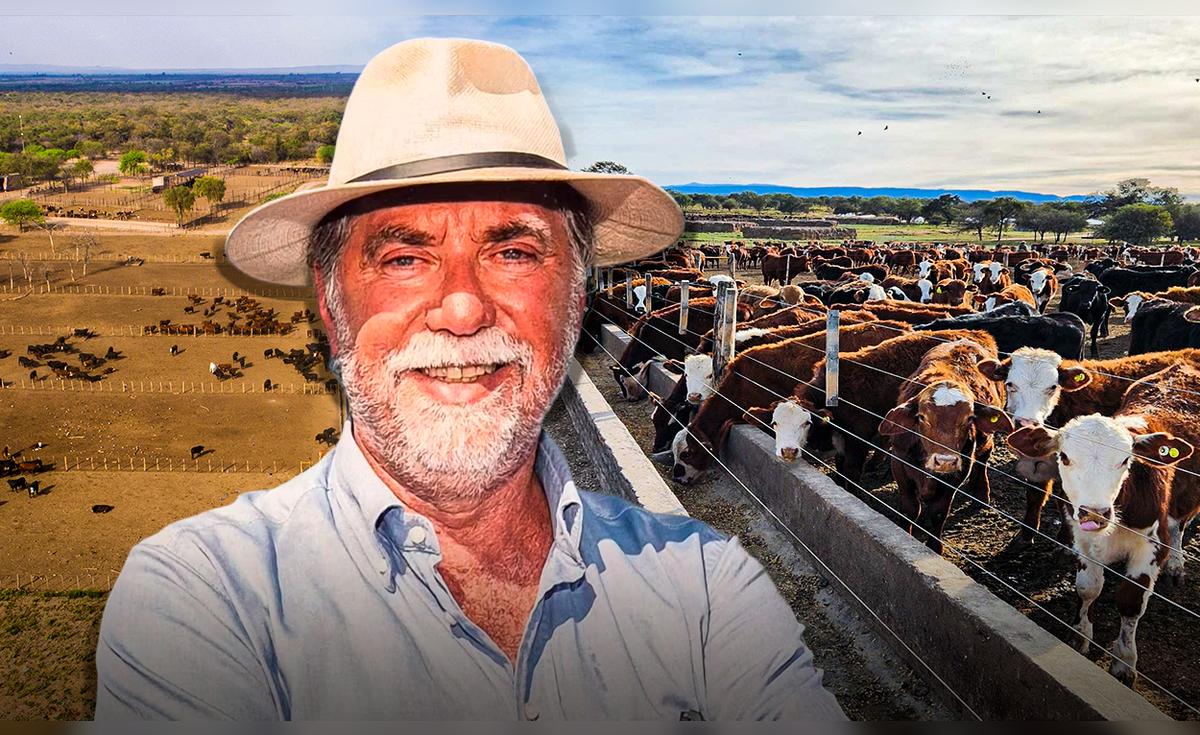
At 72 years old, Daniel Bartolucci consolidated a benchmark productive ecosystem in northern Argentina through the integration of agriculture, livestock and technological advances. This structure currently covers 30,000 hectares distributed strategically between Catamarca, Santiago del Estero and Tucumán. The businessman’s management stands out for his specialization in seed production, efficient irrigation systems and a solid projection towards international markets. Its track record demonstrates that operational diversification is key to achieving competitive scale in challenging climates.
The newspaper La Nación highlighted this growth as a testimony of perseverance and business vision in the face of a lack of initial capital. According to the media, the protagonist “started without great financial resources (…) and today directs an agricultural-livestock empire“based on sustainability. This institutional evolution positions its firms under constant modernization standards, which guarantees a positive impact on the regional economy. The press emphasizes that the success of the project lies in the fusion of technical pillars with a rigorous environmental commitment.
WE RECOMMEND YOU
HEALING THE FEMALE LINEAGE: THE WOUNDS WE INHERIT WITHOUT REALIZING IT | ASTROMOOD WITH JHAN SANDOVAL
From engineering in Argentina to pig success in Canada
Bartolucci consolidated his technical base as an engineer at the National University of Tucumán, which was essential to understand the industrial processes that marked his later career. After obtaining his professional degree, the young man from Tucuman chose to emigrate with the aim of finding cutting-edge productive ecosystems and new job prospects outside national limits.
The journey in Canada began from the most basic levels, as a laborer on a large-scale pig farm. That initial physical effort gave way to a notable hierarchical evolution within the agricultural establishment, in which the specialist assumed management roles. Eventually, he reached partner and marketing director positionfunctions that facilitated the trade of animal genetics to Argentine territory and strengthened its executive profile abroad.
This international residency gave him the financial support and commercial expertise necessary for his definitive return. Dominance of the Latin American market allowed the businessman to found his own projects with the assets collected in North America. His learning abroad was key to his return to the country, as he transformed his vision into an independent and solid business model.
Bartolucci’s productive model: expansion and legacy in the Norte Grande
After his return to Argentina, the businessman invested his savings in the acquisition of land in Salta and Santiago del Estero. This strategic move laid the foundations for its incursion into the national agricultural sector. In 1989, the establishment purchase Mistol Ancho in Catamarca consolidated the operational center of its current activities, the starting point for a regional scale structure.
The firm today manages a total of 30,000 hectares, distributed between planting and livestock production. The scheme allocates 20,000 hectares to soybean, corn and wheat crops, while the remaining 10,000 support an intensive fattening system. Regarding livestock, the Argentine explained to La Nación that “breeding occupies little surface area (…) the main axis is the feedlot,” and prioritizes efficiency in land use.
The success of the organization lies in shared management with its direct heirs. Married and with three descendants, the protagonist delegated key responsibilities to guarantee the validity of the agroindustrial project. Regarding this family commitment, the group leader assured: “My three children are in the company doing a spectacular job.”
Regional expansion and added value: the engine of agricultural success
The company consolidates its international presence by sending seeds to Bolivia and Uruguaydestinations that complement its strong dominance in the Argentine market. During the 2025 cycle, the firm reached a sales volume of 380,000 bags of soybeans, corn and wheat, a figure that supports its competitiveness under rigorous quality protocols.
The current business scheme stands out for sustained growth that integrates innovation and sustainability in each production stage. After receiving the award for best extensive agriculture, the organization reaffirms a vision focused on profitability through the transformation of raw materials.
